Osei Eric, Oppong Samuel, Adanfo Daniel, Doepe Bless Ativor, Owusu Andrews, Kupour Augustine Goma, Der Joyce
1Department of Population and Behavioural Sciences, School of Public Health, University of Health and Allied Sciences, Ho, Ghana.
2Department of Epidemiology, School of Public Health, University of Health and Allied Sciences, Ho, Ghana.
Glob Health Res Policy. 2019 Dec 17;4:37. doi: 10.1186/s41256-019-0128-9. eCollection 2019.
Tuberculosis (TB) remains a petrified condition with a huge economic and health impact on families and health systems in Ghana. Monitoring of TB programme performance indicators can provide reliable data for direct measurement of TB incidence and mortality. This study reflects on the trends of TB case notification and treatment outcomes and makes comparison among 10 districts of the Volta region of Ghana.
This was a retrospective analysis of surveillance data of a cohort of TB cases from 2013 to 2017. Trends of case notification and treatment outcomes were examined and compared. Logistic regression was used to determine the independent relationship between patients and disease characteristics and unsuccessful treatment outcomes. Odds ratios, 95% confidence intervals and -values were estimated.
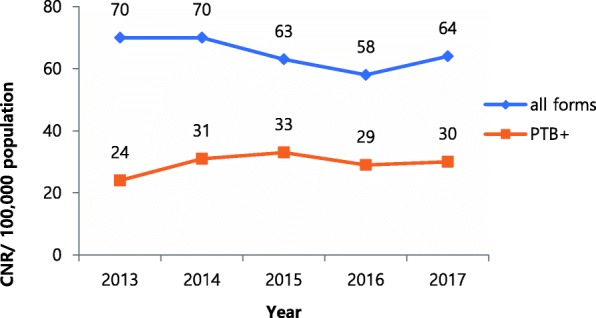
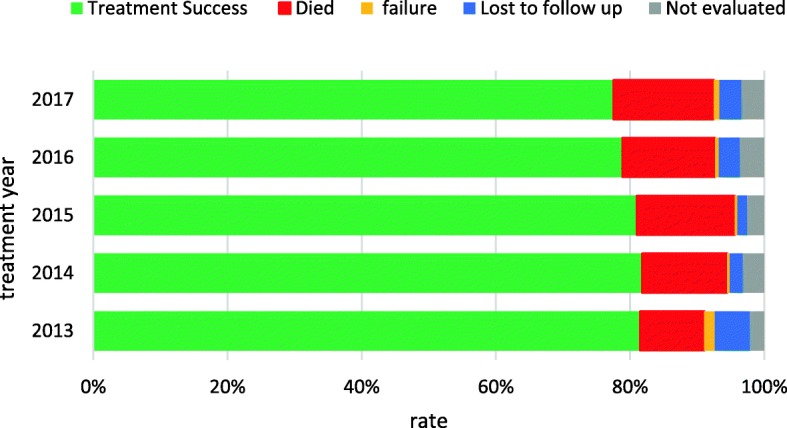
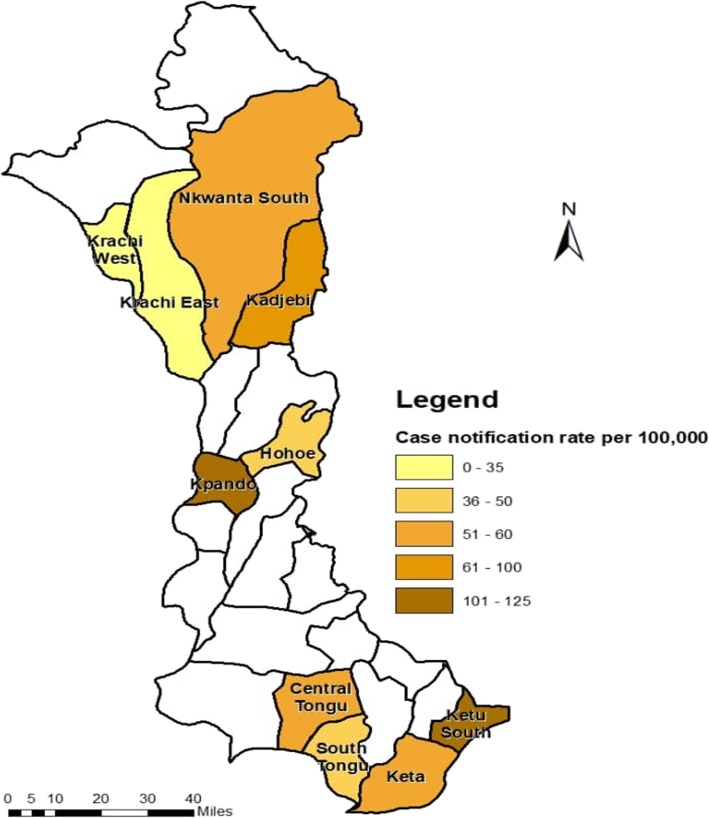
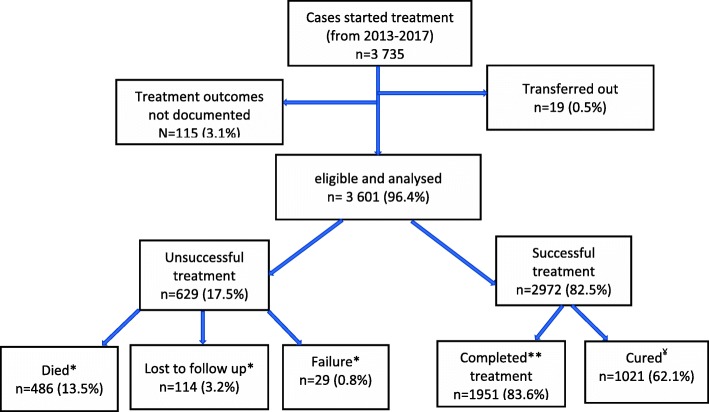
A gradual declining trend of case notification of all forms of TB was noticed, with an overall case notification rate (CNR) of 65 cases per 100,000 population during the period. A wide variation of case notification of TB was observed among the districts, ranging from 32 to 124 cases per 100,000 population. Similarly, treatment success rate decreased slightly from 83.1% during the first year to 80.2% in 2017, with an overall treatment success rate of 82.5% (95% CI: 81.3-83.8%). Treatment failure, death, and lost to follow up rates were 0.8% (range 0.5-1.2%), 13.5% (range 12.4-14.7%), and 3.1% (range 2.6-3.8%) respectively. The treatment success rate among districts ranged from 70.5% in South Tongu to 90.8% in Krachi West district. Returned after treatment interruption (Adjusted odds ratio [AOR]: 3.62; 95% CI: 1.66-7.91; < 0.001) and TB/HIV co-infection (AOR: 1.94; 95% CI: 1.57-2.40; < 0.001) predicts poor treatment outcomes.
Over the past five years, TB case notification and successful treatment outcomes did not significantly improve. Wide district variations in CNR was observed. The overall treatment success rate observed in this study is below the target of > 90% set by the World Health Organization's (WHO) end TB strategy. Additionally, patients who returned to continue treatment after interruption and those who were co-infected with HIV strongly predict unsuccessful treatment outcomes. Sustained interventions to prevent treatment interruptions and improved management of co-morbidities can enhance treatment outcomes, as required to achieve the elimination goal.
结核病仍然是一种顽固的疾病,对加纳的家庭和卫生系统造成了巨大的经济和健康影响。监测结核病规划绩效指标可为直接测量结核病发病率和死亡率提供可靠数据。本研究分析了结核病病例通报和治疗结果的趋势,并对加纳沃尔特地区的10个区进行了比较。
这是一项对2013年至2017年一组结核病病例监测数据的回顾性分析。检查并比较了病例通报和治疗结果的趋势。采用逻辑回归确定患者和疾病特征与治疗结果不佳之间的独立关系。估计了比值比、95%置信区间和P值。
注意到所有形式结核病的病例通报呈逐渐下降趋势,在此期间总体病例通报率(CNR)为每10万人口65例。各地区结核病病例通报差异很大,每10万人口从32例到124例不等。同样,治疗成功率从第一年的83.1%略有下降至2017年的80.2%,总体治疗成功率为82.5%(95%CI:81.3-83.8%)。治疗失败、死亡和失访率分别为0.8%(范围0.5-1.2%)、13.5%(范围12.4-14.7%)和3.1%(范围2.6-3.8%)。各地区的治疗成功率从南通古的70.5%到克拉奇西区的90.8%不等。治疗中断后返回(调整比值比[AOR]:3.62;95%CI:1.66-7.91;P<0.001)和结核病/艾滋病病毒合并感染(AOR:1.94;95%CI:1.57-2.40;P<0.001)预示治疗结果不佳。
在过去五年中,结核病病例通报和成功治疗结果没有显著改善。观察到各地区CNR存在很大差异。本研究中观察到的总体治疗成功率低于世界卫生组织(WHO)终止结核病战略设定的>90%的目标。此外,中断治疗后返回继续治疗的患者以及合并感染艾滋病毒的患者强烈预示治疗结果不佳。按照实现消除目标的要求,持续采取干预措施以防止治疗中断并改善合并症管理可提高治疗结果。