Department of Obstetrics and Gynecology, University of Helsinki and Welfare District of Päijät-Häme, Keskussairaalankatu 7, 15850, Lahti, Finland.
Obstetrics and Gynecology, University of Helsinki and Helsinki University Hospital, Haartmaninkatu 2, PL 140, 00029 HUS, Helsinki, Finland.
BMC Pregnancy Childbirth. 2019 Dec 31;20(1):2. doi: 10.1186/s12884-019-2670-3.
To establish the changes in perinatal morbidity and mortality in twin pregnancies in Finland, a retrospective register research was conducted. Our extensive data from a 28-year study period provide important information on the outcome of twin pregnancies in Finland that has previously not been reported to this extent.
All 23,498 twin pregnancies with 46,996 children born in Finland during 1987-2014 were included in the study. Data were gathered from the Medical Birth Register and the Hospital Discharge Register (Finnish Institute for Health and Welfare, Finland) regarding perinatal mortality (PNM) and morbidity. For statistical analysis, binomial regression analysis and crosstabs were performed. The results are expressed in means, percentages and ranges with comparison to singletons when appropriate. Odds ratios from binomial regression analysis are reported. A p-value <0.05 was considered statistically significant.
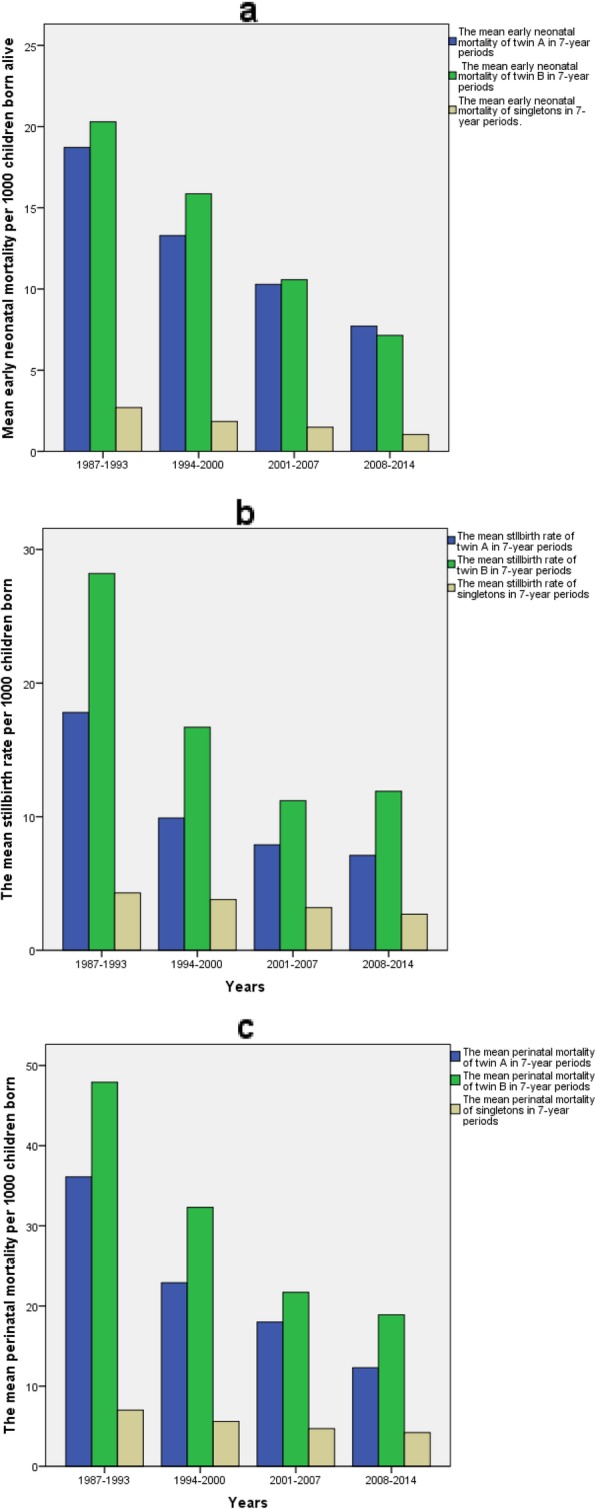
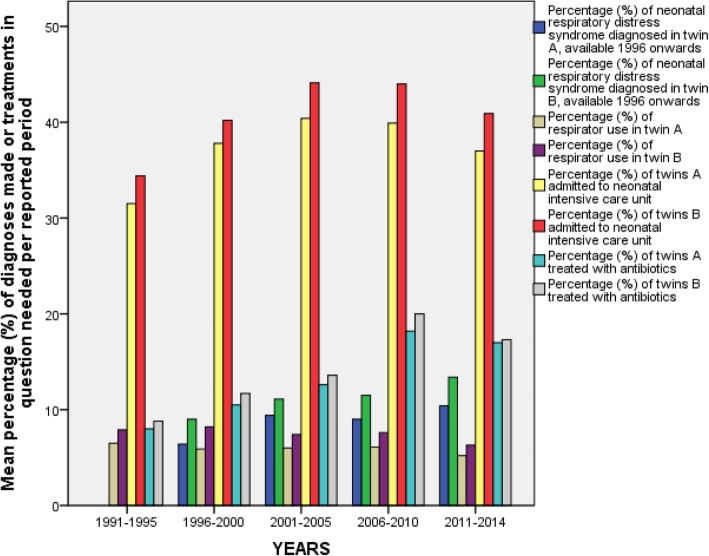
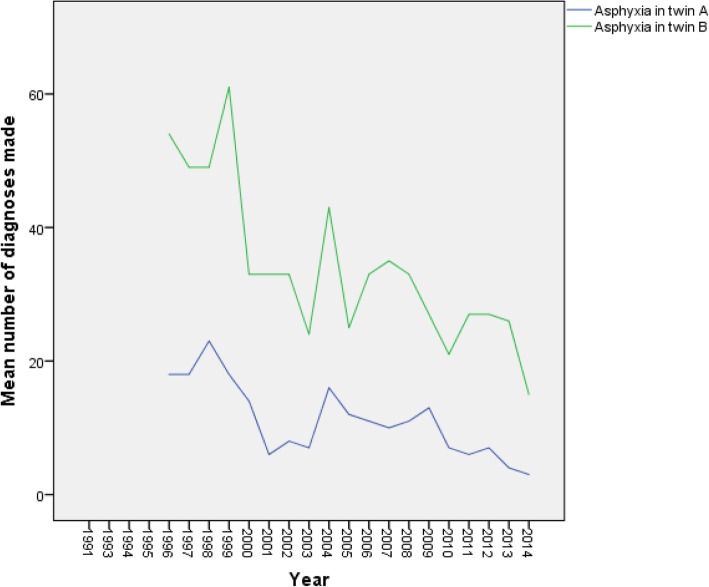
There were 46,363 liveborn and 633 stillborn twins in Finland during 1987-2014. Perinatal mortality decreased markedly, from 45.1 to 6.5 per 1000 for twin A and from 54.1 to 11.9 per 1000 for twin B during the study period. Yet, the PNM difference between twin A and B remained. Early neonatal mortality did not differ between twins, but has decreased in both. Asphyxia, respiratory distress syndrome, need for antibiotics and Neonatal Intensive Care Unit (NICU) stay were markedly more common in twin B.
In Finland, PNM and early neonatal mortality in twins decreased significantly during 1987-2014 and are nowadays very low. However, twin B still faces more complications. The outline provided may be used to further improve the monitoring and thus perinatal outcome of twins, especially twin B.
为了确定芬兰双胎妊娠围产发病率和围产死亡率的变化,我们进行了一项回顾性登记研究。我们在 28 年的研究期间积累了广泛的数据,这些数据为芬兰双胎妊娠的结局提供了重要信息,这在以前没有被如此广泛地报道过。
本研究纳入了 1987 年至 2014 年期间在芬兰出生的 23498 例双胎妊娠及其 46996 例活产儿。围产儿死亡率(perinatal mortality,PNM)和发病率的数据来自于医疗出生登记(Medical Birth Register)和医院出院登记(Hospital Discharge Register)(芬兰卫生与福利研究所,芬兰)。采用二项式回归分析和交叉表进行统计学分析。结果以均值、百分比和范围表示,与单胎妊娠进行比较。二项式回归分析的比值比(odds ratio)也一并报告。p 值<0.05 被认为具有统计学意义。
1987 年至 2014 年期间,芬兰有 46363 例活产双胎和 633 例死产双胎。围产儿死亡率显著下降,从研究期间的每 1000 例活产儿 45.1 例降至 6.5 例(A 胎),从每 1000 例活产儿 54.1 例降至 11.9 例(B 胎)。然而,A 胎和 B 胎之间的 PNM 差异仍然存在。双胎的早期新生儿死亡率没有差异,但都有所下降。窒息、呼吸窘迫综合征、需要使用抗生素和新生儿重症监护病房(Neonatal Intensive Care Unit,NICU)入住的情况在 B 胎中更为常见。
在芬兰,1987 年至 2014 年间,双胎妊娠的围产儿死亡率和早期新生儿死亡率显著下降,目前已非常低。然而,B 胎仍然面临更多的并发症。本研究提供的概况可用于进一步改善双胎妊娠,尤其是 B 胎的围产儿结局的监测。