Department of Physical Biochemistry, Max Planck Institute for Biophysical Chemistry, 37077 Göttingen, Germany.
Department of Theoretical and Computational Biophysics, Max Planck Institute for Biophysical Chemistry, 37077 Göttingen, Germany.
Sci Adv. 2019 Dec 20;5(12):eaax8030. doi: 10.1126/sciadv.aax8030. eCollection 2019 Dec.
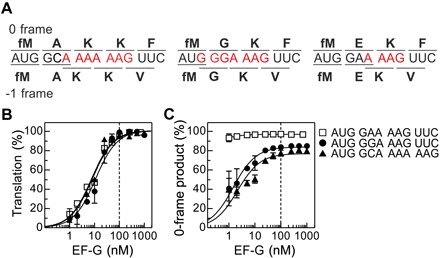
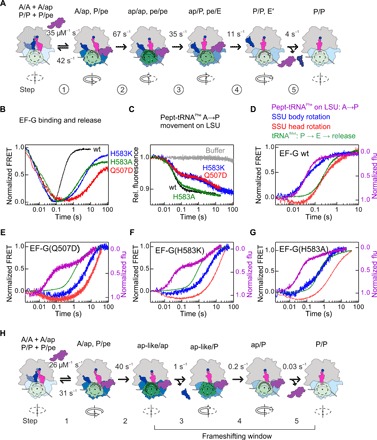
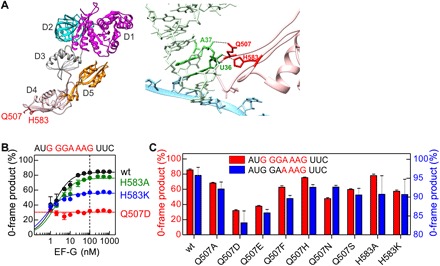
During translation, the ribosome moves along the mRNA one codon at a time with the help of elongation factor G (EF-G). Spontaneous changes in the translational reading frame are extremely rare, yet how the precise triplet-wise step is maintained is not clear. Here, we show that the ribosome is prone to spontaneous frameshifting on mRNA slippery sequences, whereas EF-G restricts frameshifting. EF-G helps to maintain the mRNA reading frame by guiding the A-site transfer RNA during translocation due to specific interactions with the tip of EF-G domain 4. Furthermore, EF-G accelerates ribosome rearrangements that restore the ribosome's control over the codon-anticodon interaction at the end of the movement. Our data explain how the mRNA reading frame is maintained during translation.
在翻译过程中,核糖体在延伸因子 G(EF-G)的帮助下一次移动一个密码子沿着 mRNA。翻译阅读框的自发变化极其罕见,但如何精确地维持三联体步骤尚不清楚。在这里,我们表明核糖体在 mRNA 滑动序列上容易自发移码,而 EF-G 限制移码。EF-G 通过与 EF-G 结构域 4 的尖端的特定相互作用,在易位过程中引导 A 位转移 RNA,从而有助于维持 mRNA 的阅读框。此外,EF-G 加速核糖体重排,从而在移动结束时恢复核糖体对密码子-反密码子相互作用的控制。我们的数据解释了在翻译过程中如何维持 mRNA 的阅读框。