Department of Neurology, Global Brain Health Institute, Memory and Aging Center, University of California, San Francisco, CA.
Department of Neurology, Movement Disorders Unit, Tel Aviv Sourazky Medical Center, Affiliated to the Sackler Faculty of Medicine, Tel-Aviv University, Israel.
Sleep. 2020 May 12;43(5). doi: 10.1093/sleep/zsz290.
To examine the association between sleep duration trajectories over 28 years and measures of cognition, gray matter volume, and white matter microstructure. We hypothesize that consistently meeting sleep guidelines that recommend at least 7 hours of sleep per night will be associated with better cognition, greater gray matter volumes, higher fractional anisotropy, and lower radial diffusivity values.
We studied 613 participants (age 42.3 ± 5.03 years at baseline) who self-reported sleep duration at five time points between 1985 and 2013, and who had cognitive testing and magnetic resonance imaging administered at a single timepoint between 2012 and 2016. We applied latent class growth analysis to estimate membership into trajectory groups based on self-reported sleep duration over time. Analysis of gray matter volumes was carried out using FSL Voxel-Based-Morphometry and white matter microstructure using Tract Based Spatial Statistics. We assessed group differences in cognitive and MRI outcomes using nonparametric permutation testing.
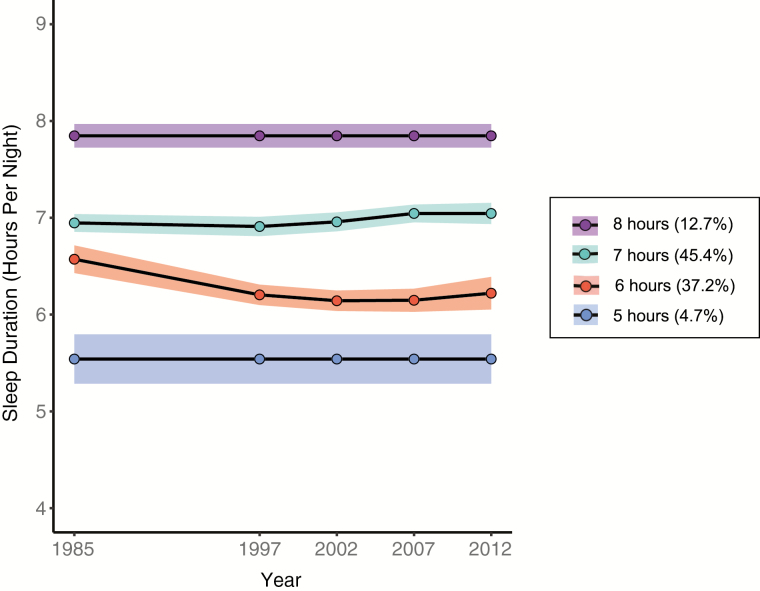
Latent class growth analysis identified four trajectory groups, with an average sleep duration of 5.4 ± 0.2 hours (5%, N = 29), 6.2 ± 0.3 hours (37%, N = 228), 7.0 ± 0.2 hours (45%, N = 278), and 7.9 ± 0.3 hours (13%, N = 78). No differences in cognition, gray matter, and white matter measures were detected between groups.
Our null findings suggest that current sleep guidelines that recommend at least 7 hours of sleep per night may not be supported in relation to an association between sleep patterns and cognitive function or brain structure.
研究 28 年期间的睡眠时间轨迹与认知、灰质体积和白质微观结构测量值之间的关系。我们假设,始终遵循建议每晚至少睡 7 小时的睡眠指南,与更好的认知、更大的灰质体积、更高的各向异性分数和更低的径向扩散率值相关。
我们研究了 613 名参与者(基线时年龄为 42.3±5.03 岁),他们在 1985 年至 2013 年期间的五个时间点报告了睡眠时间,并且在 2012 年至 2016 年期间的单个时间点进行了认知测试和磁共振成像。我们应用潜在类别增长分析根据随时间报告的睡眠时间来估计轨迹组的成员身份。使用 FSL Voxel-Based-Morphometry 分析灰质体积,使用基于束的空间统计学分析白质微观结构。我们使用非参数置换检验评估认知和 MRI 结果的组间差异。
潜在类别增长分析确定了四个轨迹组,平均睡眠时间为 5.4±0.2 小时(5%,N=29)、6.2±0.3 小时(37%,N=228)、7.0±0.2 小时(45%,N=278)和 7.9±0.3 小时(13%,N=78)。各组之间的认知、灰质和白质测量值没有差异。
我们的阴性结果表明,目前建议每晚至少睡 7 小时的睡眠指南可能与睡眠模式和认知功能或大脑结构之间的关联不相关。