FMRIB Centre, Nuffield Department of Clinical Neurosciences, University of Oxford, Oxford, United Kingdom.
Department of Psychiatry, University of Oxford, Oxford, United Kingdom.
Hum Brain Mapp. 2017 Nov;38(11):5465-5473. doi: 10.1002/hbm.23739. Epub 2017 Jul 26.
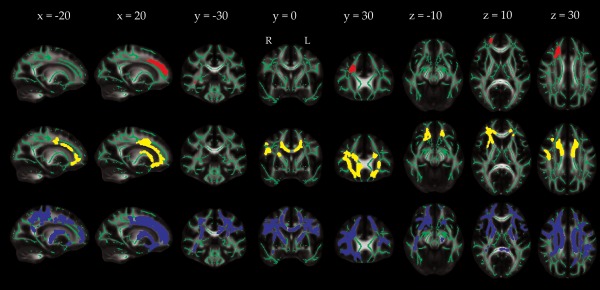
Both sleep disturbances and decline in white matter microstructure are commonly observed in ageing populations, as well as in age-related psychiatric and neurological illnesses. A relationship between sleep and white matter microstructure may underlie such relationships, but few imaging studies have directly examined this hypothesis. In a study of 448 community-dwelling members of the Whitehall II Imaging Sub-Study aged between 60 and 82 years (90 female, mean age 69.2 ± 5.1 years), we used the magnetic resonance imaging technique diffusion tensor imaging to examine the relationship between self-reported sleep quality and white matter microstructure. Poor sleep quality at the time of the diffusion tensor imaging scan was associated with reduced global fractional anisotropy and increased global axial diffusivity and radial diffusivity values, with small effect sizes. Voxel-wise analysis showed that widespread frontal-subcortical tracts, encompassing regions previously reported as altered in insomnia, were affected. Radial diffusivity findings remained significant after additional correction for demographics, general cognition, health, and lifestyle measures. No significant differences in general cognitive function, executive function, memory, or processing speed were detected between good and poor sleep quality groups. The number of times participants reported poor sleep quality over five time-points spanning a 16-year period was not associated with white matter measures. In conclusion, these data demonstrate that current sleep quality is linked to white matter microstructure. Small effect sizes may limit the extent to which poor sleep is a promising modifiable factor that may maintain, or even improve, white matter microstructure in ageing. Hum Brain Mapp 38:5465-5473, 2017. © 2017 Wiley Periodicals, Inc.
睡眠障碍和白质微观结构的衰退在老年人群中以及与年龄相关的精神和神经疾病中都很常见。睡眠与白质微观结构之间的关系可能是这些关系的基础,但很少有影像学研究直接检验这一假设。在一项对年龄在 60 至 82 岁之间的 448 名居住在社区的 Whitehall II 成像子研究参与者(90 名女性,平均年龄 69.2±5.1 岁)的研究中,我们使用磁共振成像技术扩散张量成像来检查自我报告的睡眠质量与白质微观结构之间的关系。在进行扩散张量成像扫描时,睡眠质量差与全脑分数各向异性降低以及全脑轴向弥散率和径向弥散率增加有关,其效应大小较小。体素分析显示,广泛的额皮质下束受到影响,这些区域以前被报道在失眠中发生改变。在对人口统计学、一般认知、健康和生活方式因素进行额外校正后,径向弥散率的发现仍然具有统计学意义。在良好和不良睡眠质量组之间,未发现一般认知功能、执行功能、记忆或处理速度有显著差异。在跨越 16 年的 5 个时间点上,参与者报告睡眠质量差的次数与白质测量值无关。总之,这些数据表明,当前的睡眠质量与白质微观结构有关。较小的效应大小可能限制了睡眠质量作为一种有前途的可改变因素的程度,这种因素可能保持甚至改善衰老过程中的白质微观结构。人类大脑映射 38:5465-5473,2017。© 2017 威利父子公司