Department of Medical Parasitology and Mycology, School of Public Health, Tehran University of Medical Sciences, Tehran, Iran.
Health Affairs, Jiroft University of Medical Sciences, Jiroft, Iran.
BMC Infect Dis. 2020 Jan 6;20(1):12. doi: 10.1186/s12879-019-4730-8.
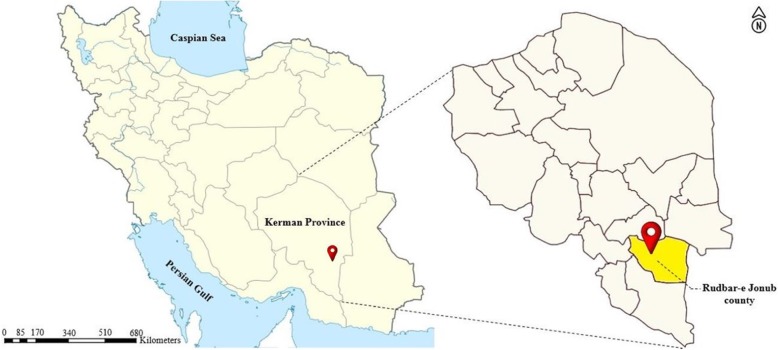
Determination of the prevalence and distribution pattern of intestinal parasites is a fundamental step to set up an effective control program to improve the health status. This study aimed to determine the prevalence of intestinal parasitic infections and associated risk factors among inhabitants of Rudbar-e Jonub county, southeast of Kerman province, southeastern Iran.
In this cross-sectional study, 861 stool specimens were collected from inhabitants of Rudbar-e Jonub county through a multistage cluster sampling method in 2018. The collected specimens were examined by parasitological methods including, direct wet-mounting (for the fresh specimens with a watery consistency), formalin-ethyl acetate sedimentation and agar plate culture.
The prevalence of intestinal parasites was 34.2% (95% CI 30.1 to 38.2). The prevalence of protozoan parasites 32.3% (95% CI 28.4 to 36.5) was significantly higher than helminthic parasites 3.2% (95% CI 2.1 to 4.7). Blastocystis sp. (13.3%), Entamoeba coli (11.4%) and Giardia lamblia (10.6%) as protozoan parasite and Hymenolepis nana (2.4%) as helminthic parasite were the most common detected intestinal parasites in the study. Entamoeba histolytica/dispar (1.5%), Iodamoeba bütschlii (1.0%), Chilomastix mesnili (0.5%), Entamoeba hartmanni (0.4%), Enterobius vermicularis (0.3%) and Ascaris lambercoides (0.3%) were other detected parasites. Multiple logistic regression revealed a significant association of intestinal parasitic infections with source of drinking water and residency status (rural/urban). Multiple infections with 2 or 3 parasitic agents constituted 22.7% of 295 infected cases.
This study revealed a high prevalence of intestinal protozoan infections among inhabitants of Rudbar-e Jonub county. Intestinal parasites especially protozoans remain a challenging public health problem wherever sanitation and health measures are limited in Iran.
确定肠道寄生虫的流行率和分布模式是制定有效控制计划以改善健康状况的基本步骤。本研究旨在确定伊朗东南部克尔曼省东南部鲁德巴尔-乔努布县居民的肠道寄生虫感染流行率及其相关危险因素。
在这项横断面研究中,2018 年采用多阶段聚类抽样方法从鲁德巴尔-乔努布县居民中采集了 861 份粪便标本。采集的标本通过寄生虫学方法进行检查,包括直接湿载片(用于具有水样稠度的新鲜标本)、福尔马林-乙酸乙酯沉淀和琼脂平板培养。
肠道寄生虫的流行率为 34.2%(95%CI 30.1 至 38.2)。原生动物寄生虫的流行率为 32.3%(95%CI 28.4 至 36.5),明显高于蠕虫寄生虫的 3.2%(95%CI 2.1 至 4.7)。在本研究中,最常见的肠道寄生虫是蓝氏贾第鞭毛虫(13.3%)、结肠内阿米巴(11.4%)和肠梨形鞭毛虫(10.6%)作为原生动物寄生虫和微小膜壳绦虫(2.4%)作为蠕虫寄生虫。溶组织内阿米巴/迪斯帕(1.5%)、碘内阿米巴(1.0%)、齿状鞭毛虫(0.5%)、哈氏内阿米巴(0.4%)、蠕形住肠线虫(0.3%)和犬弓首线虫(0.3%)是其他检测到的寄生虫。多变量逻辑回归显示,肠道寄生虫感染与饮用水来源和居住状态(农村/城市)显著相关。295 例感染病例中,有 2 或 3 种寄生虫混合感染的比例为 22.7%。
本研究显示,鲁德巴尔-乔努布县居民中肠道原生动物感染率较高。在伊朗,无论卫生和健康措施如何有限,肠道寄生虫特别是原生动物仍然是一个具有挑战性的公共卫生问题。