MTA-ELTE "Lendület" Evolutionary Genomics Research Group, H-1117 Budapest, Hungary.
Department of Biological Physics, Eötvös Loránd University, H-1117 Budapest, Hungary.
Proc Natl Acad Sci U S A. 2020 Jan 21;117(3):1606-1611. doi: 10.1073/pnas.1913104117. Epub 2020 Jan 6.
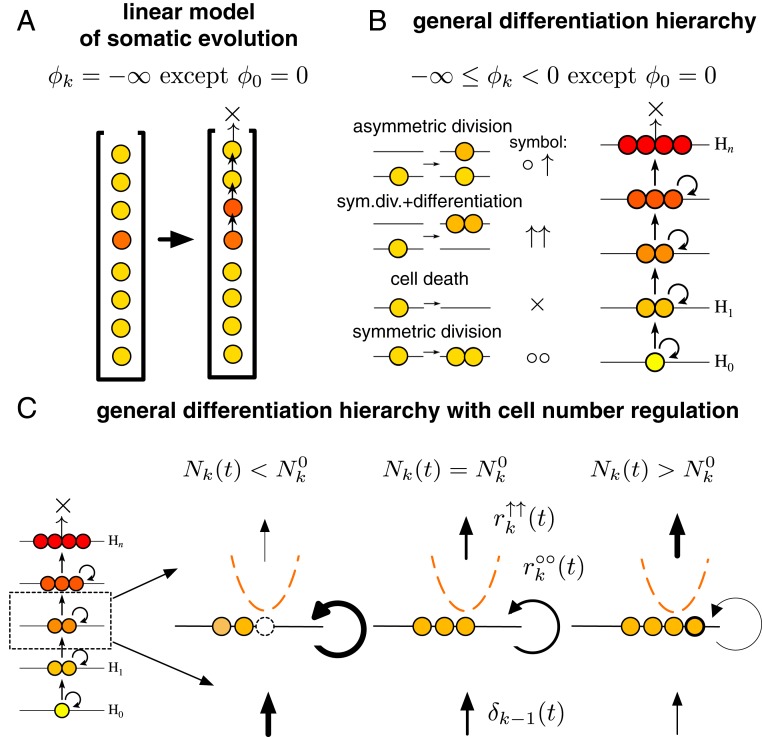
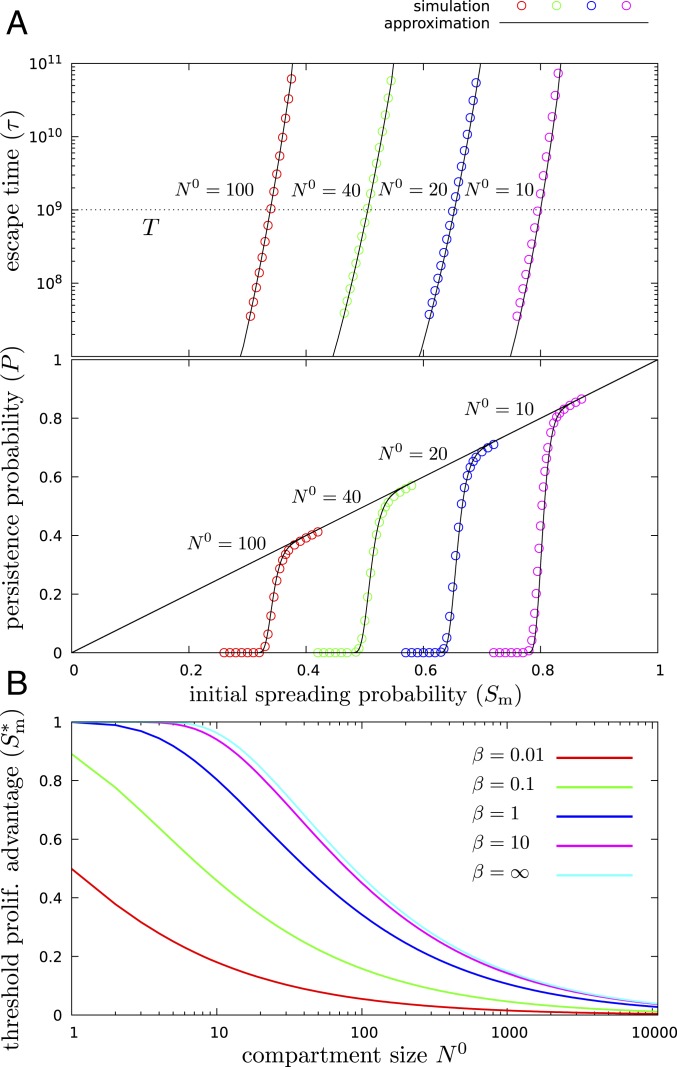
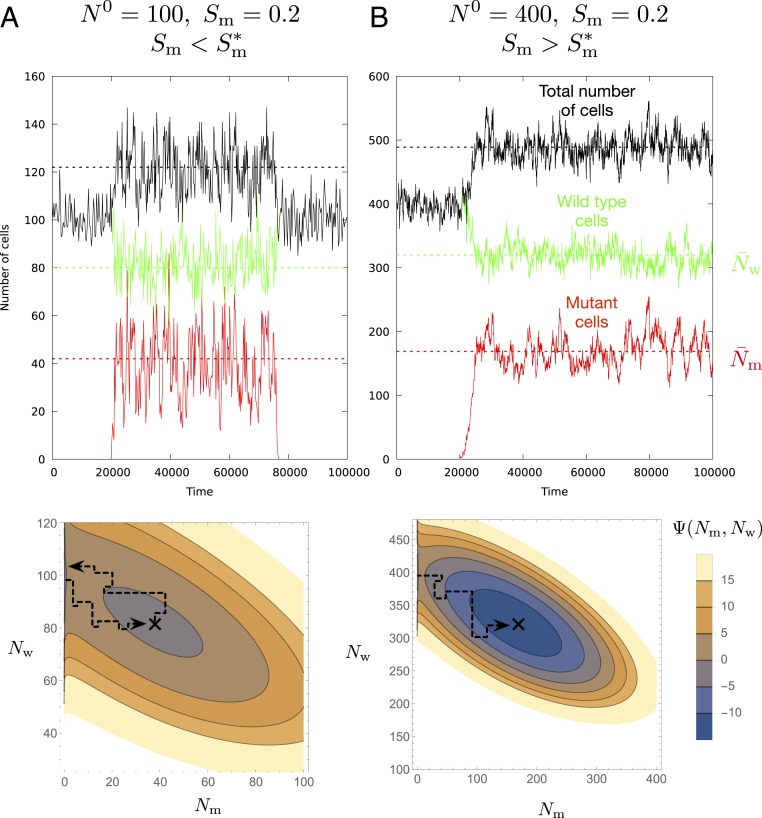
Cancer is a genetic disease fueled by somatic evolution. Hierarchical tissue organization can slow somatic evolution by two qualitatively different mechanisms: by cell differentiation along the hierarchy "washing out" harmful mutations and by limiting the number of cell divisions required to maintain a tissue. Here we explore the effects of compartment size on somatic evolution in hierarchical tissues by considering cell number regulation that acts on cell division rates such that the number of cells in the tissue has the tendency to return to its desired homeostatic value. Introducing mutants with a proliferative advantage, we demonstrate the existence of a third fundamental mechanism by which hierarchically organized tissues are able to slow down somatic evolution. We show that tissue size regulation leads to the emergence of a threshold proliferative advantage, below which mutants cannot persist. We find that the most significant determinant of the threshold selective advantage is compartment size, with the threshold being higher the smaller the compartment. Our results demonstrate that, in sufficiently small compartments, even mutations that confer substantial proliferative advantage cannot persist, but are expelled from the tissue by differentiation along the hierarchy. The resulting selective barrier can significantly slow down somatic evolution and reduce the risk of cancer by limiting the accumulation of mutations that increase the proliferation of cells.
癌症是一种由体细胞进化驱动的遗传疾病。分层组织的结构可以通过两种不同的机制来减缓体细胞进化:沿着层次结构进行细胞分化,“冲刷”有害突变,以及限制维持组织所需的细胞分裂次数。在这里,我们通过考虑对细胞分裂率起作用的细胞数量调节,来探索在分层组织中腔室大小对体细胞进化的影响,使得组织中的细胞数量有回归到其期望的稳态值的趋势。通过引入具有增殖优势的突变体,我们证明了分层组织能够减缓体细胞进化的第三种基本机制的存在。我们表明,组织大小调节导致出现一个增殖优势的阈值,低于该阈值,突变体就无法存活。我们发现,选择优势的阈值的最显著决定因素是腔室大小,腔室越小,阈值越高。我们的研究结果表明,在足够小的腔室中,即使是赋予显著增殖优势的突变也无法存活,而是会通过沿着层次结构进行分化而从组织中被驱逐。由此产生的选择障碍可以显著减缓体细胞进化,并通过限制增加细胞增殖的突变积累来降低癌症风险。