AP-HP, Groupe hospitalier Hôtel-Dieu, URC Economie de la Santé Ile de France, Paris, France.
Inserm, ECEVE UMR-S 1123, Paris, France.
Trials. 2020 Jan 7;21(1):36. doi: 10.1186/s13063-019-3997-9.
Non-medical data, such as the amount of time that patients and caregivers spend managing their condition, may be relevant when assessing therapeutic strategies. For chronic pediatric conditions, the time that patients and caregivers spend in seeking and providing care (which are the indirect costs in an economic evaluation) can be significantly different depending on the treatment arm. To explore methods for collecting information on the care burden for caregivers and patients, we investigated whether a patient diary provided additional information compared to retrospective investigator-led interviews and whether a diary that was completed intermittently produced more or less information than a diary completed continually. The main objective of this study was to identify which type of data collection was most effective for measuring the time spent by caregivers and for estimating indirect treatment costs over 9 months.
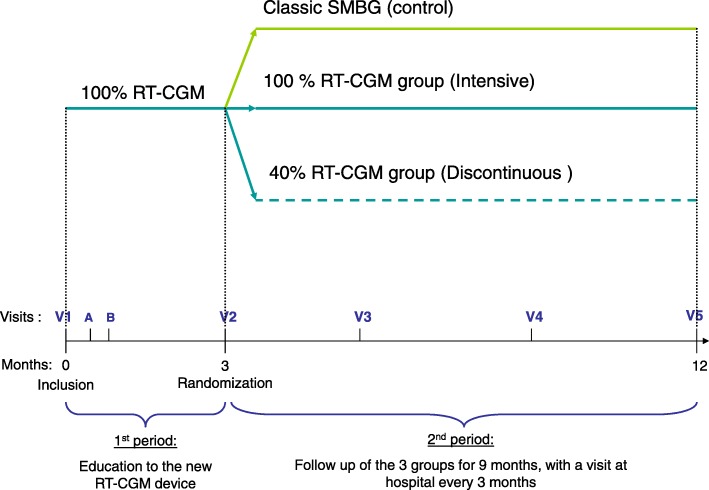
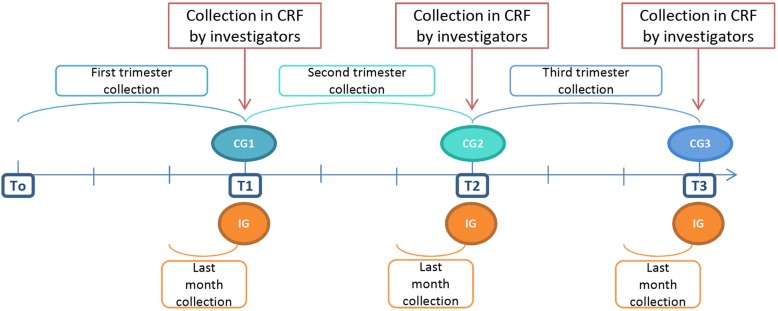
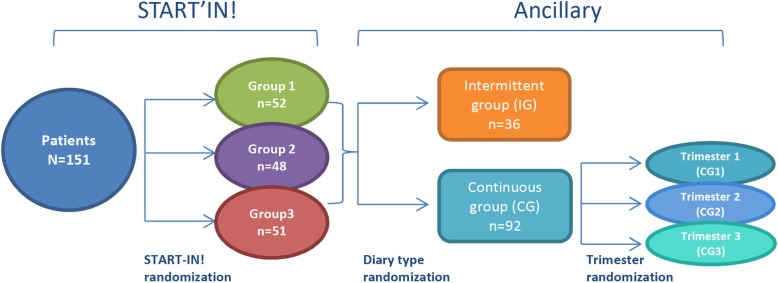
Start-In! is a randomized controlled trial comparing the efficacy of three strategies of real-time continuous glucose monitoring for 12 months in children and adolescents with type 1 diabetes. We designed an ancillary study to assess methods of collecting information on the time spent by patients and caregivers in managing their condition (indirect costs). Data were entered retrospectively in case report forms (CRFs) by investigators during quarterly follow-up visits, which were supplemented with diaries completed prospectively by children or caregivers either continuously or intermittently. Data about absences from school and work as well as the time that caregivers spent on diabetes care were collected and the three collection methods were compared.
At the end of the 9-month study, 42% of the study participants failed to return their diary. For the diaries that were received, less than 10% of expected data were collected versus 82% during investigators'interviews. Based on all the information collected, we calculated that over 9 months, caregivers lost on average 3.9 days of working time (€786) and 4 days of personal time, i.e. the equivalent of €526, and spent around 15 min of time on care per day, i.e. the equivalent of €1700.
The CRFs completed by investigators during quarterly visits cannot be replaced by a diary. Completing the diaries appeared to represent an important additional burden to children and their caregivers, and the diaries provided little additional information compared to investigators' entries in the CRF.
ClinicalTrials.gov, NCT00949221. Registered on 30 July 2009. Registry name: Study of Insulin Therapy Augmented by Real Time Sensor in Type 1 Children and Adolescents (START-IN!).
在评估治疗策略时,非医学数据(例如患者和照护者管理病情所花费的时间)可能具有相关性。对于慢性儿科疾病,患者和照护者在寻求和提供护理方面所花费的时间(这是经济评估中的间接成本)可能因治疗手臂的不同而有显著差异。为了探索收集照护者和患者护理负担信息的方法,我们研究了患者日记是否比回顾性研究者主导的访谈提供了更多信息,以及间断填写的日记是否比连续填写的日记提供了更多或更少的信息。本研究的主要目的是确定哪种类型的数据收集最有效,可用于测量照护者花费的时间,并估计 9 个月的间接治疗成本。
Start-In! 是一项比较实时连续血糖监测在 12 个月内对 1 型糖尿病儿童和青少年疗效的随机对照试验。我们设计了一项辅助研究来评估收集患者和照护者管理病情时间信息(间接成本)的方法。数据由研究者在季度随访期间通过病例报告表(CRF)回顾性输入,通过儿童或照护者前瞻性填写的日记进行补充,要么连续填写,要么间断填写。收集有关缺课和旷工以及照护者花在糖尿病护理上的时间的数据,并比较了三种收集方法。
在 9 个月的研究结束时,42%的研究参与者未能归还他们的日记。对于收到的日记,只有不到 10%的预期数据被收集,而在研究者访谈中收集了 82%的数据。根据收集到的所有信息,我们计算出在 9 个月内,照护者平均损失 3.9 天的工作时间(786 欧元)和 4 天的个人时间,即 526 欧元,每天花费大约 15 分钟的时间进行护理,即 1700 欧元。
研究者在季度随访期间填写的 CRF 不能被日记替代。填写日记似乎给儿童及其照护者带来了重要的额外负担,与 CRF 中研究者的记录相比,日记提供的额外信息很少。
ClinicalTrials.gov,NCT00949221。于 2009 年 7 月 30 日注册。注册名称:1 型儿童和青少年实时传感器强化胰岛素治疗研究(START-IN!)。