Nieves-Cordones Manuel, García-Sánchez Francisco, Pérez-Pérez Juan G, Colmenero-Flores Jose M, Rubio Francisco, Rosales Miguel A
Departamento de Nutrición Vegetal, Centro de Edafología y Biología Aplicada del Segura-CSIC, Murcia, Spain.
Centro para el Desarrollo de la Agricultura Sostenible (CDAS), Instituto Valenciano de Investigaciones Agrarias (IVIA), Valencia, Spain.
Front Plant Sci. 2019 Dec 20;10:1619. doi: 10.3389/fpls.2019.01619. eCollection 2019.
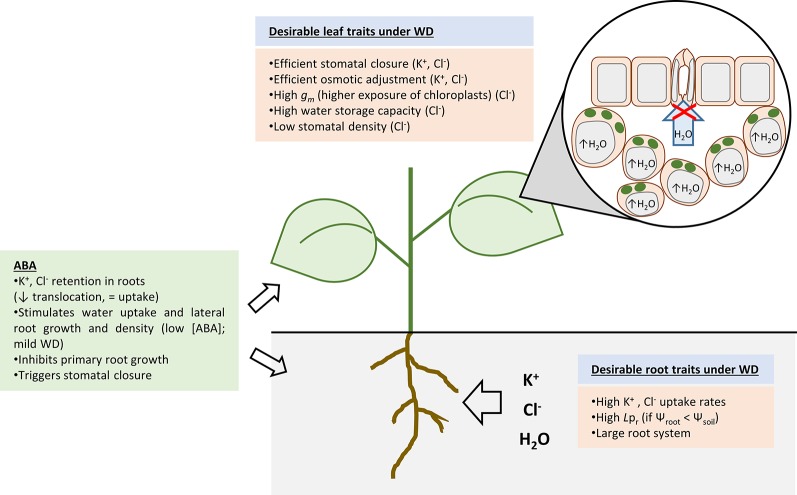
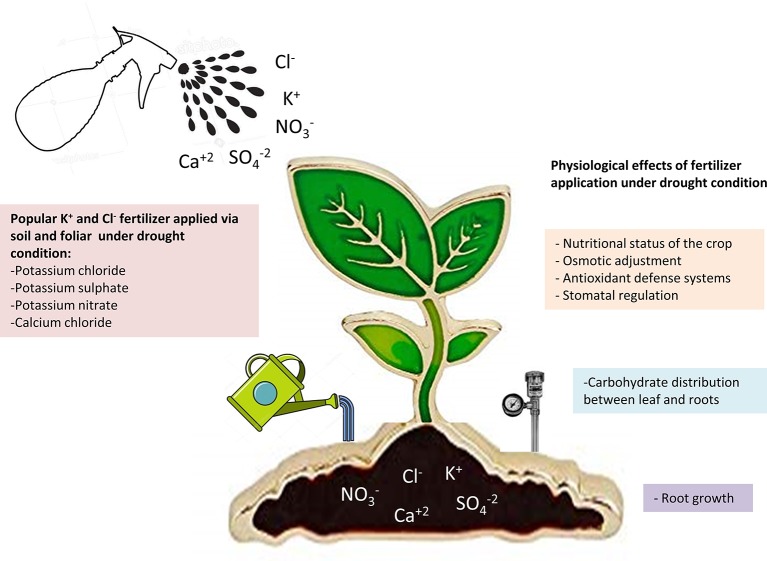
Drought is now recognized as the abiotic stress that causes most problems in agriculture, mainly due to the strong water demand from intensive culture and the effects of climate change, especially in arid/semi-arid areas. When plants suffer from water deficit (WD), a plethora of negative physiological alterations such as cell turgor loss, reduction of CO net assimilation rate, oxidative stress damage, and nutritional imbalances, among others, can lead to a decrease in the yield production and loss of commercial quality. Nutritional imbalances in plants grown under drought stress occur by decreasing water uptake and leaf transpiration, combined by alteration of nutrient uptake and long-distance transport processes. Plants try to counteract these effects by activating drought resistance mechanisms. Correct accumulation of salts and water constitutes an important portion of these mechanisms, in particular of those related to the cell osmotic adjustment and function of stomata. In recent years, molecular insights into the regulation of K, Cl, and water transport under drought have been gained. Therefore, this article brings an update on this topic. Moreover, agronomical practices that ameliorate drought symptoms of crops by improving nutrient homeostasis will also be presented.
干旱现已被公认为是给农业带来最多问题的非生物胁迫,这主要归因于集约化种植对水分的强烈需求以及气候变化的影响,特别是在干旱/半干旱地区。当植物遭受水分亏缺(WD)时,大量负面的生理变化,如细胞膨压丧失、净二氧化碳同化率降低、氧化应激损伤和营养失衡等,都可能导致产量下降和商业品质损失。干旱胁迫下生长的植物会因水分吸收和叶片蒸腾作用降低,以及养分吸收和长距离运输过程的改变而出现营养失衡。植物试图通过激活抗旱机制来对抗这些影响。盐分和水分的正确积累是这些机制的重要组成部分,特别是那些与细胞渗透调节和气孔功能相关的机制。近年来,人们在干旱条件下对钾、氯和水分运输调控的分子层面有了深入了解。因此,本文将对这一主题进行更新。此外,还将介绍通过改善养分稳态来减轻作物干旱症状的农艺措施。