Sigit Fathimah S, Tahapary Dicky L, Trompet Stella, Sartono Erliyani, Willems van Dijk Ko, Rosendaal Frits R, de Mutsert Renée
1Department of Clinical Epidemiology, Leiden University Medical Center, Albinusdreef 2, 2333 ZA Leiden, The Netherlands.
2Metabolic, Cardiovascular, and Aging Cluster, The Indonesian Medical Education and Research Institute, Faculty of Medicine-Universitas Indonesia, Jalan Salemba Raya No 6, Jakarta, 10430 Indonesia.
Diabetol Metab Syndr. 2020 Jan 7;12:2. doi: 10.1186/s13098-019-0503-1. eCollection 2020.
The prevalence of metabolic syndrome varies among populations with different ethnicities. Asian populations develop metabolic complications at lower amounts of adiposity than western populations. The role of abdominal obesity in the metabolic differences between the two populations is poorly understood.
Our objectives were to estimate the prevalence of metabolic syndrome and the relative contribution of its components in the Indonesian and the Dutch population, as well as to examine the associations of overall and abdominal obesity with metabolic syndrome.
In this cross-sectional study of middle-aged adults in the Netherlands Epidemiology of Obesity Study (n = 6602) and the Indonesian National Health Surveillance (n = 10,575), metabolic syndrome was defined by the unified IDF and AHA/NHLBI criteria. We performed logistic and linear regressions to examine associations of BMI and waist circumference with the metabolic syndrome, mutually adjusted for waist circumference and BMI.
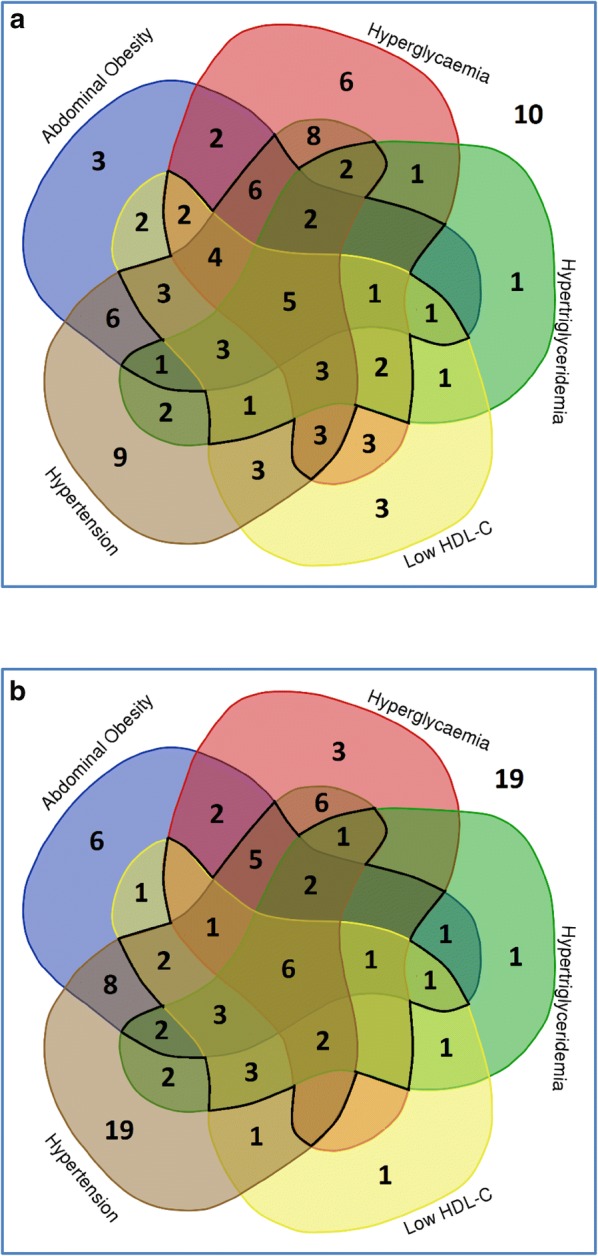
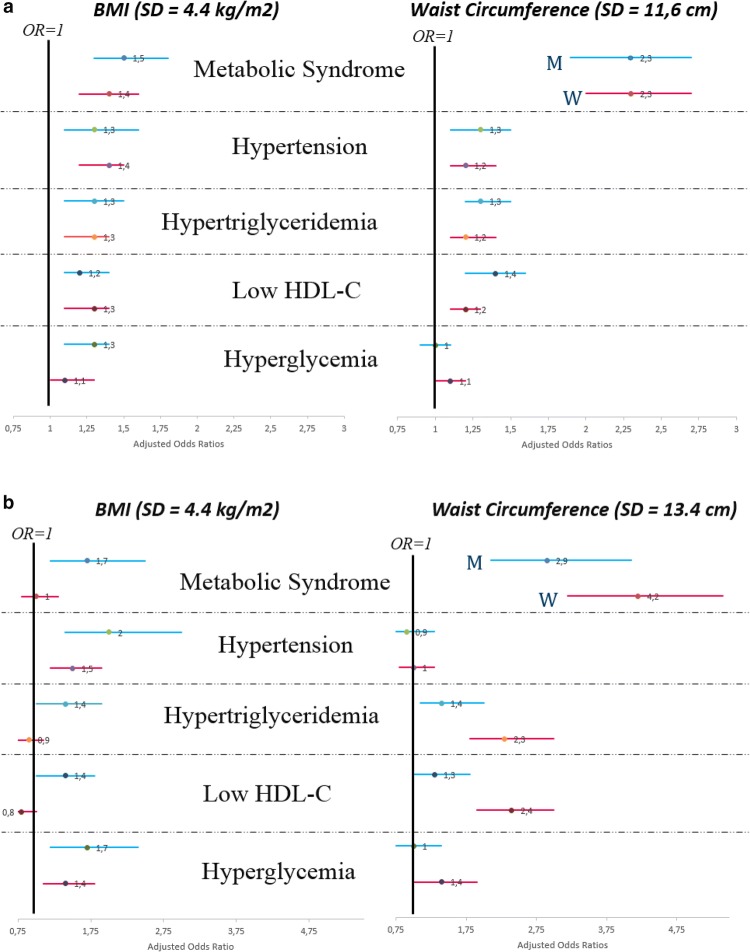
The prevalence of metabolic syndrome was 28% and 46% in Indonesian men and women, and 36% and 24% in Dutch men and women. The most prominent components were hypertension (61%) and hyperglycemia (51%) in the Indonesian, and hypertension (62%) and abdominal obesity (40%) in the Dutch population. Per SD in BMI and waist circumference, odds ratios (ORs, 95% CI) of metabolic syndrome were 1.5 (1.3-1.8) and 2.3 (1.9-2.7) in Indonesian men and 1.7 (1.2-2.5) and 2.9 (2.1-4.1) in Dutch men. The ORs of metabolic syndrome were 1.4 (1.2-1.6) and 2.3 (2.0-2.7) in Indonesian women and 1.0 (0.8-1.3) and 4.2 (3.2-5.4) in Dutch women.
More Indonesian women than men have metabolic syndrome, whereas the opposite is true for the Dutch population. In both the Indonesian and the Dutch populations, hypertension is the primary contributor to the prevalence of metabolic syndrome. In both populations, abdominal adiposity was more strongly associated with metabolic syndrome than overall adiposity.
代谢综合征的患病率在不同种族人群中有所不同。亚洲人群在脂肪堆积量低于西方人群时就会出现代谢并发症。腹部肥胖在这两个人群代谢差异中的作用尚不清楚。
我们的目的是估计印度尼西亚和荷兰人群中代谢综合征的患病率及其各组分的相对贡献,并研究总体肥胖和腹部肥胖与代谢综合征的关联。
在荷兰肥胖流行病学研究(n = 6602)和印度尼西亚国家健康监测(n = 10575)中对中年成年人进行的这项横断面研究中,代谢综合征采用统一的国际糖尿病联盟(IDF)和美国心脏协会/美国国立卫生研究院心肺血液研究所(AHA/NHLBI)标准进行定义。我们进行了逻辑回归和线性回归,以研究体重指数(BMI)和腰围与代谢综合征的关联,并对腰围和BMI进行相互校正。
印度尼西亚男性和女性代谢综合征的患病率分别为28%和46%,荷兰男性和女性分别为36%和24%。印度尼西亚人群中最突出的组分是高血压(61%)和高血糖(51%),荷兰人群中是高血压(62%)和腹部肥胖(40%)。在印度尼西亚男性中,BMI和腰围每增加一个标准差,代谢综合征的比值比(OR,95%可信区间)分别为1.5(1.3 - 1.8)和2.3(1.9 - 2.7);在荷兰男性中分别为1.7(1.