Sun Hainan, Jiang Cuijuan, Wu Ling, Bai Xue, Zhai Shumei
Key Laboratory of Colloid and Interface Chemistry of the Ministry of Education, School of Chemistry and Chemical Engineering, Shandong University, Jinan, China.
Shandong Vocational College of Light Industry, Zibo, China.
Front Bioeng Biotechnol. 2019 Dec 12;7:414. doi: 10.3389/fbioe.2019.00414. eCollection 2019.
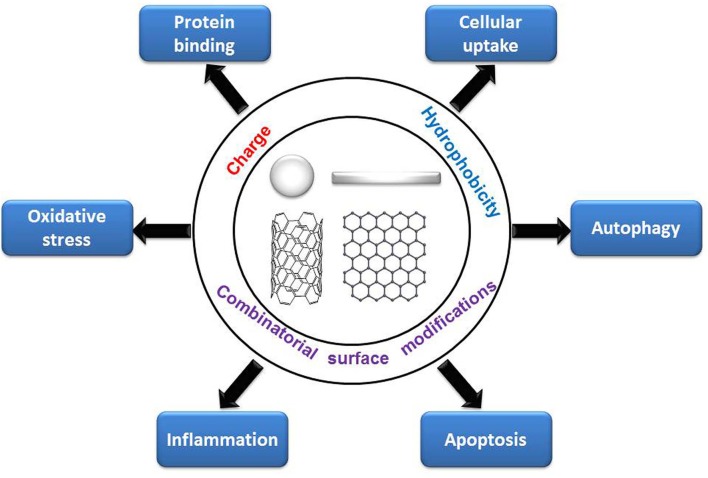
Nanoparticles (NPs) are widely used in a variety of fields, including those related to consumer products, architecture, energy, and biomedicine. Once they enter the human body, NPs contact proteins in the blood and interact with cells in organs, which may induce cytotoxicity. Among the various factors of NP surface chemistry, surface charges, hydrophobicity levels and combinatorial decorations are found to play key roles inregulating typical cytotoxicity-related bioeffects, including protein binding, cellular uptake, oxidative stress, autophagy, inflammation, and apoptosis. In this review, we summarize the recent progress made in directing the levels and molecular pathways of these cytotoxicity-related effects by the purposeful design of NP surface charge, hydrophobicity, and combinatorial decorations.
纳米颗粒(NPs)广泛应用于各种领域,包括与消费品、建筑、能源和生物医学相关的领域。一旦它们进入人体,纳米颗粒会与血液中的蛋白质接触并与器官中的细胞相互作用,这可能会诱导细胞毒性。在纳米颗粒表面化学的各种因素中,表面电荷、疏水性水平和组合修饰被发现在调节典型的细胞毒性相关生物效应中起关键作用,这些效应包括蛋白质结合、细胞摄取、氧化应激、自噬、炎症和凋亡。在这篇综述中,我们总结了通过有目的地设计纳米颗粒的表面电荷、疏水性和组合修饰来指导这些细胞毒性相关效应的水平和分子途径方面取得的最新进展。