Department of Pharmacy, The Fifth Affiliated Hospital of Guangzhou Medical University, Guangzhou, Guangdong 510700, P.R. China.
Guangdong Province Key Laboratory of Pharmacodynamic Constituents of TCM and New Drugs Research, College of Pharmacy, Jinan University, Guangzhou, Guangdong 510632, P.R. China.
Mol Med Rep. 2020 Mar;21(3):1043-1050. doi: 10.3892/mmr.2020.10920. Epub 2020 Jan 9.
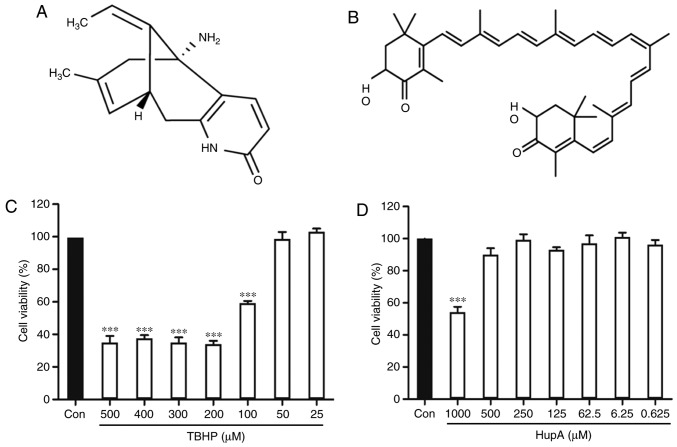
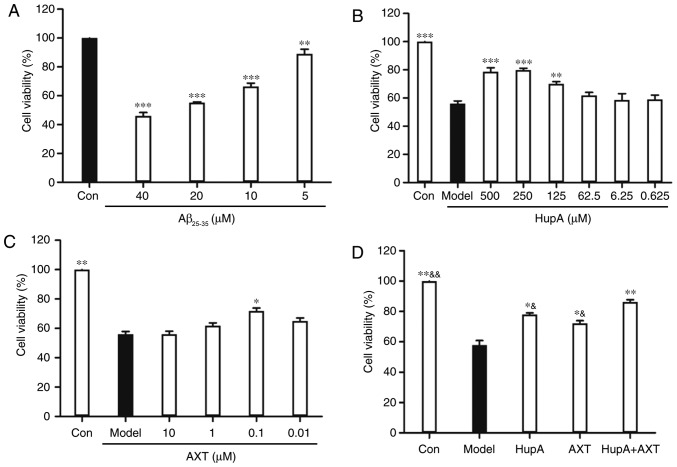
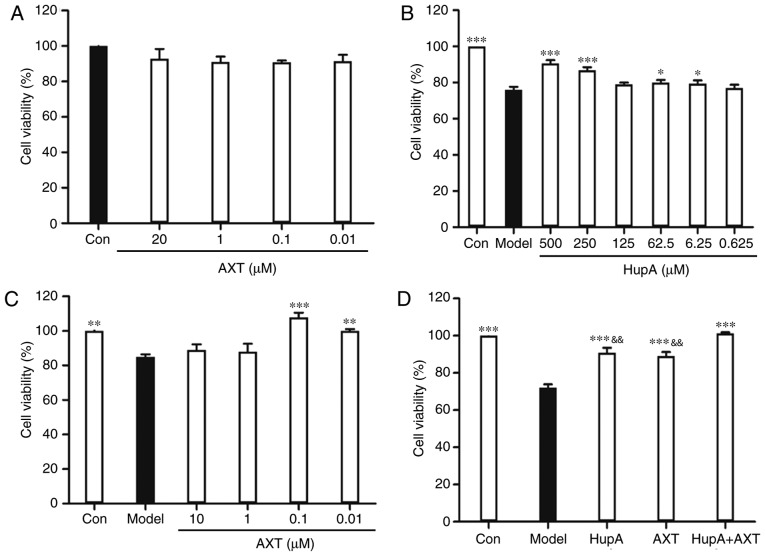
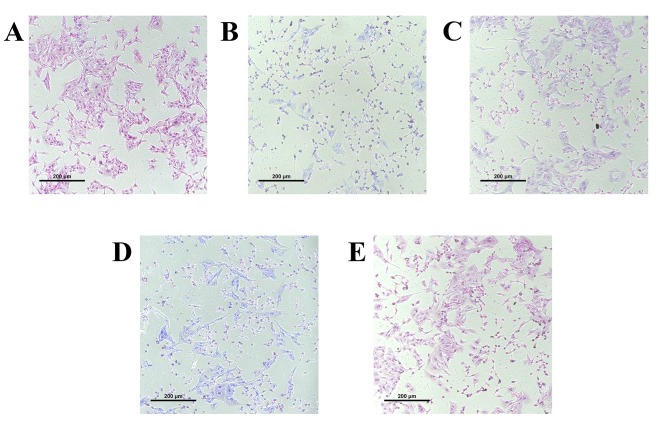
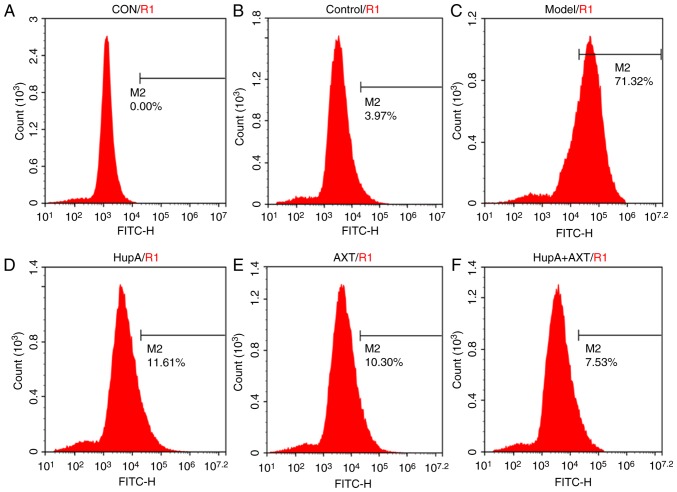
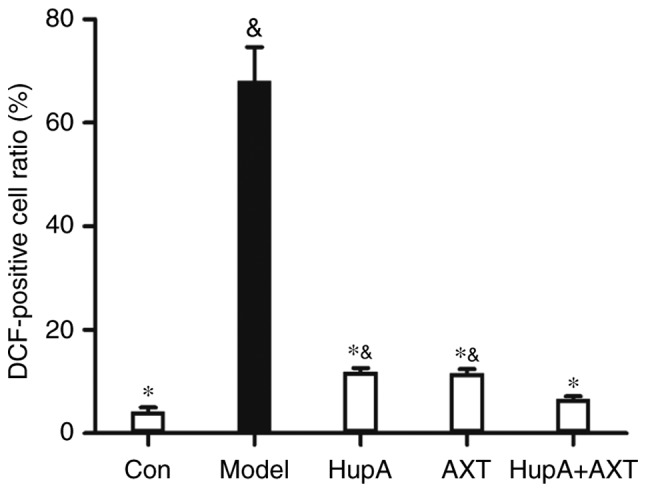
Oxidative stress is a pathophysiological condition resulting in neurotoxicity, which is possibly associated with neurodegenerative disorders. In this study, the antioxidative effects of the antioxidant astaxanthin (AXT) in combination with huperzine A (HupA), which is used as a cholinesterase inhibitor for the treatment of Alzheimer's disease, were investigated. PC12 cells were treated with either tert‑butyl hydroperoxide (TBHP), or with the toxic version of β‑amyloid, Aβ25‑35, to induce oxidative stress and neurotoxicity. Cell viability, morphology, lactate dehydrogenase (LDH) release, intracellular accumulation of reactive oxygen species (ROS), superoxide dismutase (SOD) activity and malondialdehyde (MDA) content were determined, while neuroprotection was also monitored using an MTT assay. It was found that combining AXT with HupA significantly increased the viability of PC12 cells, prevented membrane damage (as measured by LDH release), attenuated intracellular ROS formation, increased SOD activity and decreased the level of MDA after TBHP exposure when compared to these drugs administered alone. Pretreatment with HupA and AXT decreased toxic damage produced by Aβ25‑35. These data indicated that combining an antioxidant with a cholinesterase inhibitor increases the degree of neuroprotection; with future investigation this could be a potential therapy used to decrease neurotoxicity in the brain.
氧化应激是一种导致神经毒性的病理生理状态,可能与神经退行性疾病有关。在这项研究中,研究了抗氧化剂虾青素 (AXT) 与石杉碱甲 (HupA) 联合使用的抗氧化作用,HupA 被用作治疗阿尔茨海默病的胆碱酯酶抑制剂。用叔丁基过氧化物 (TBHP) 或毒性版本的 β-淀粉样蛋白 Aβ25-35 处理 PC12 细胞,以诱导氧化应激和神经毒性。测定细胞活力、形态、乳酸脱氢酶 (LDH) 释放、细胞内活性氧 (ROS) 积累、超氧化物歧化酶 (SOD) 活性和丙二醛 (MDA) 含量,同时通过 MTT 测定法监测神经保护作用。结果发现,与单独使用这些药物相比,AXT 与 HupA 联合使用可显著提高 PC12 细胞的活力,防止膜损伤(通过 LDH 释放测量),减弱细胞内 ROS 的形成,增加 SOD 活性并降低 TBHP 暴露后的 MDA 水平。HupA 和 AXT 的预处理可减少 Aβ25-35 产生的毒性损伤。这些数据表明,将抗氧化剂与胆碱酯酶抑制剂联合使用可提高神经保护程度;未来的研究可能是一种潜在的治疗方法,用于减少大脑中的神经毒性。