Bowerman Kate L, Varelias Antiopi, Lachner Nancy, Kuns Rachel D, Hill Geoffrey R, Hugenholtz Philip
Australian Centre for Ecogenomics, School of Chemistry and Molecular Biosciences, The University of Queensland , St Lucia, Australia.
QIMR Berghofer Medical Research Institute , Brisbane, Australia.
Gut Microbes. 2020 Jul 3;11(4):754-770. doi: 10.1080/19490976.2019.1705729. Epub 2020 Jan 13.
The gut microbiome plays a key role in the development of acute graft-versus-host disease (GVHD) following allogeneic hematopoietic stem cell transplantation. Here we investigate the individual contribution of the pre- and post-transplant gut microbiome to acute GVHD using a well-studied mouse model.
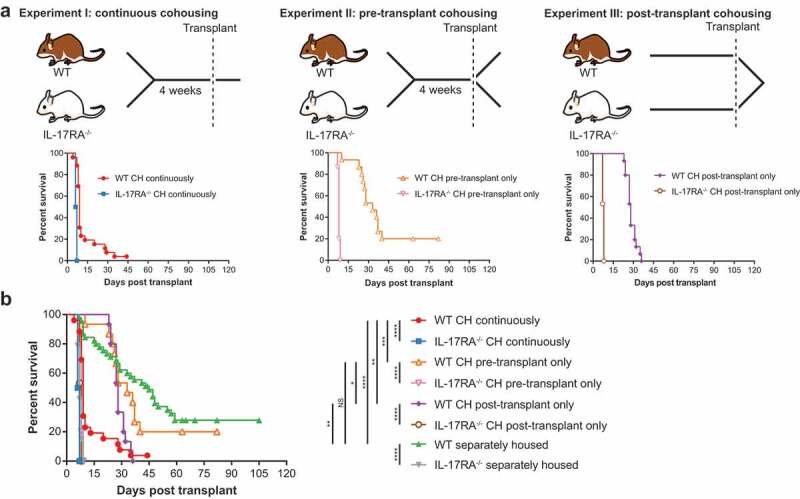
Wild-type mice were cohoused with IL-17RA mice, susceptible to hyperacute GVHD, either pre- or post-transplant alone or continuously (i.e., pre- and post-transplant). Fecal samples were collected from both WT and IL-17RA mice pre- and post-cohousing and post-transplant and the microbiome analyzed using metagenomic sequencing.
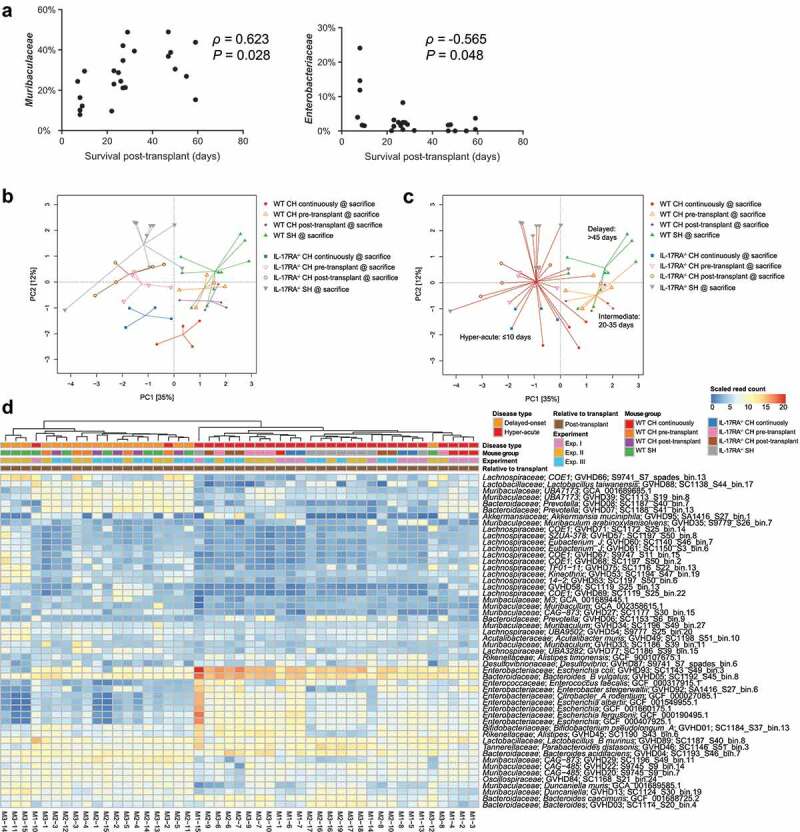
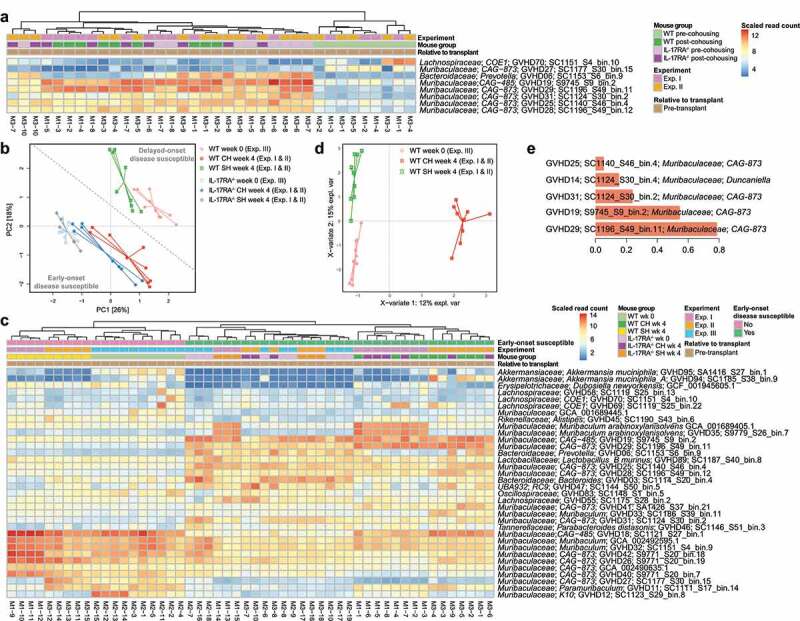
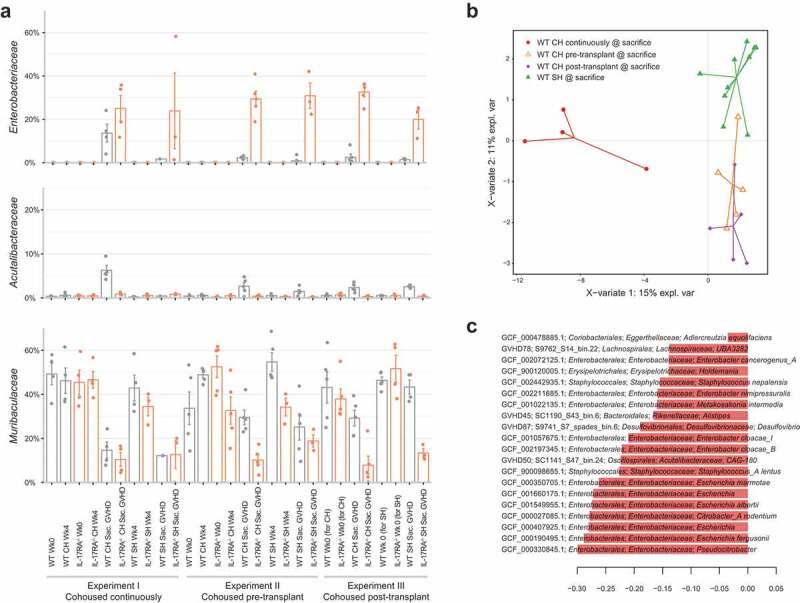
Priming wild-type mice via cohousing pre-transplant only is insufficient to accelerate GVHD, however, accelerated disease is observed in WT mice cohoused post-transplant only. When mice are cohoused continuously, the effect of priming and exacerbation is additive, resulting in a greater acceleration of disease in WT mice beyond that seen with cohousing post-transplant only. Metagenomic analysis of the microbiome revealed pre-transplant cohousing is associated with the transfer of specific species within two as-yet-uncultured genera of the bacterial family and . Post-transplant, we observed GVHD-associated blooms of members and subsp. , and hyperacute GVHD gut microbiome distinct from that associated with delayed-onset disease (>10 days post-transplant).
These results clarify the importance of the peri-transplant microbiome in the susceptibility to acute GVHD post-transplant and demonstrate the species-specific nature of this association.
肠道微生物群在异基因造血干细胞移植后的急性移植物抗宿主病(GVHD)发展中起关键作用。在此,我们使用一个经过充分研究的小鼠模型,研究移植前和移植后肠道微生物群对急性GVHD的个体贡献。
将野生型小鼠与易患超急性GVHD的IL - 17RA小鼠在移植前单独同笼饲养、移植后单独同笼饲养或持续(即移植前和移植后)同笼饲养。在同笼饲养前和后以及移植后,从野生型和IL - 17RA小鼠收集粪便样本,并使用宏基因组测序分析微生物群。
仅在移植前通过同笼饲养启动野生型小鼠不足以加速GVHD,然而,仅在移植后同笼饲养的野生型小鼠中观察到疾病加速。当小鼠持续同笼饲养时,启动和加重的效果是相加的,导致野生型小鼠的疾病加速程度比仅在移植后同笼饲养时更大。微生物群的宏基因组分析显示,移植前同笼饲养与细菌家族两个尚未培养的属内特定物种的转移有关。移植后,我们观察到与GVHD相关的成员和亚种的大量繁殖,以及超急性GVHD肠道微生物群与延迟发病疾病(移植后>10天)相关的微生物群不同。
这些结果阐明了移植周围微生物群在移植后对急性GVHD易感性中的重要性,并证明了这种关联的物种特异性性质。