Institut de Biotecnologia i Biomedicina and Departament de Bioquímica i Biologia Molecular, Universitat Autònoma de Barcelona, 08193 Barcelona, Spain.
Galicia Supercomputing Center (CESGA), 15705 Santiago de Compostela, A Coruña, Spain.
Cells. 2020 Jan 8;9(1):145. doi: 10.3390/cells9010145.
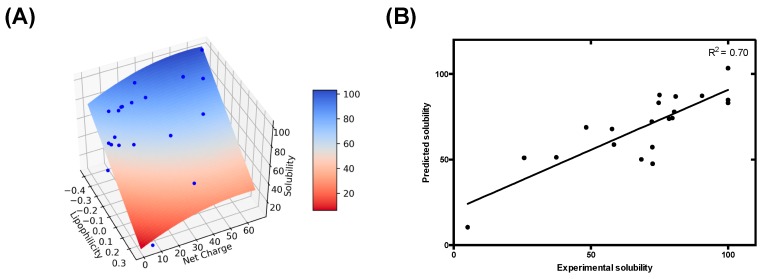
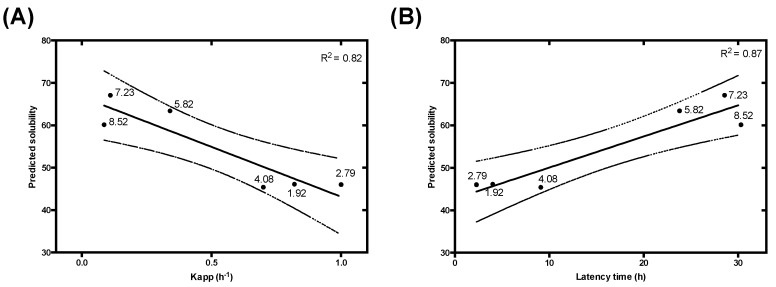
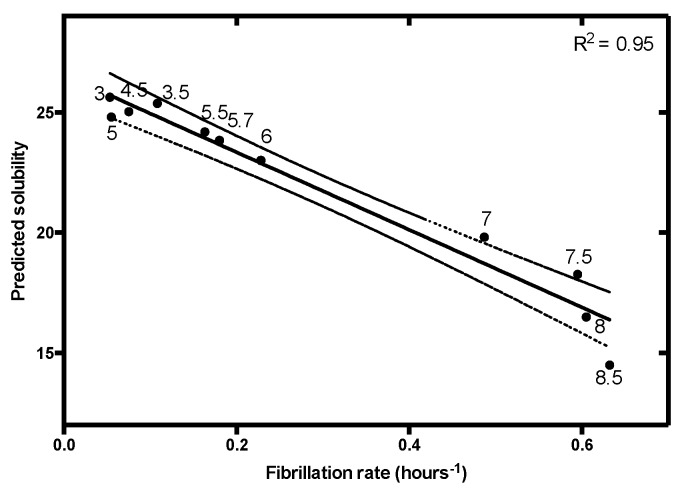
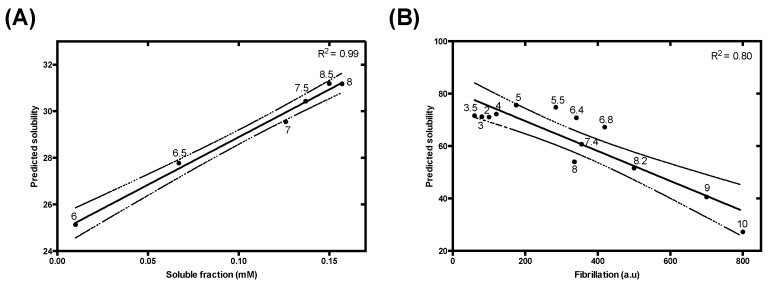
Protein aggregation is associated with an increasing number of human disorders and premature aging. Moreover, it is a central concern in the manufacturing of recombinant proteins for biotechnological and therapeutic applications. Nevertheless, the unique architecture of protein aggregates is also exploited by nature for functional purposes, from bacteria to humans. The relevance of this process in health and disease has boosted the interest in understanding and controlling aggregation, with the concomitant development of a myriad of algorithms aimed to predict aggregation propensities. However, most of these programs are blind to the protein environment and, in particular, to the influence of the pH. Here, we developed an empirical equation to model the pH-dependent aggregation of intrinsically disordered proteins (IDPs) based on the assumption that both the global protein charge and lipophilicity depend on the solution pH. Upon its parametrization with a model IDP, this simple phenomenological approach showed unprecedented accuracy in predicting the dependence of the aggregation of both pathogenic and functional amyloidogenic IDPs on the pH. The algorithm might be useful for diverse applications, from large-scale analysis of IDPs aggregation properties to the design of novel reversible nanofibrillar materials.
蛋白质聚集与越来越多的人类疾病和早衰有关。此外,它也是生物技术和治疗应用中重组蛋白制造的核心关注点。然而,从细菌到人,蛋白质聚集的独特结构也被自然界用于功能目的。由于这一过程与健康和疾病的相关性,人们对理解和控制聚集的兴趣大增,同时也开发了大量旨在预测聚集倾向的算法。然而,这些程序大多忽略了蛋白质环境,特别是 pH 的影响。在这里,我们开发了一个经验公式来模拟基于假设的固有无序蛋白质(IDP)的 pH 依赖性聚集,即全局蛋白质电荷和疏水性都取决于溶液 pH。用模型 IDP 对其进行参数化后,这种简单的唯象方法在预测致病性和功能性淀粉样 IDP 聚集对 pH 的依赖性方面表现出了前所未有的准确性。该算法可能对各种应用有用,从 IDP 聚集特性的大规模分析到新型可逆纳米纤维材料的设计。