Department of Orthopaedic Surgery, Experimental Orthopaedics, Centre for Medical Biotechnology (ZMB/Biopark 1), University of Regensburg, 93053 Regensburg, Germany.
Institute of Pathology, University of Regensburg, 93053 Regensburg, Germany.
Int J Mol Sci. 2020 Jan 8;21(2):405. doi: 10.3390/ijms21020405.
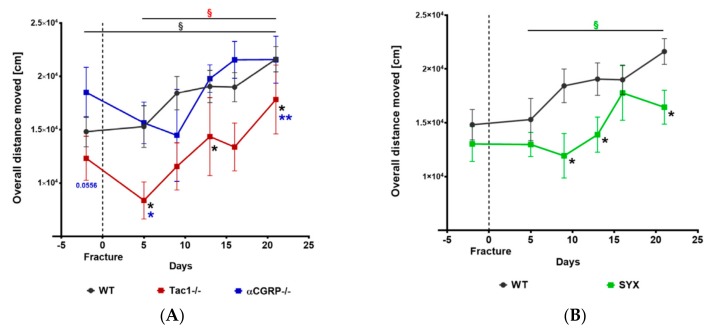
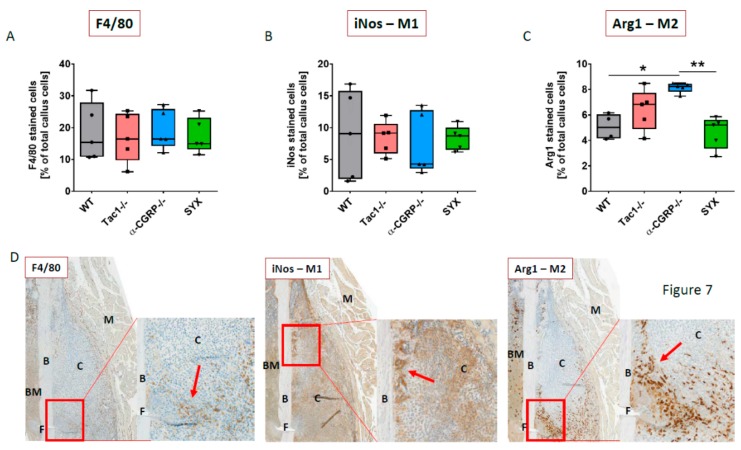
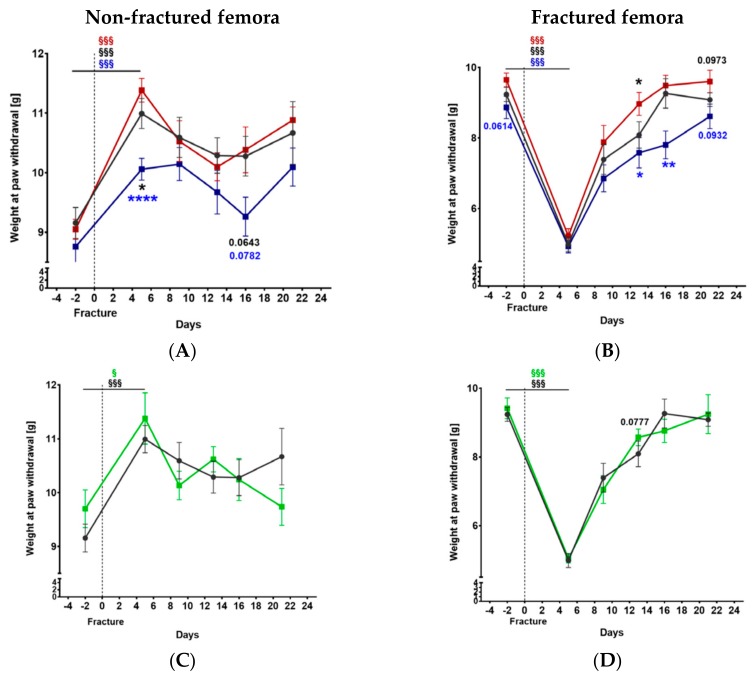
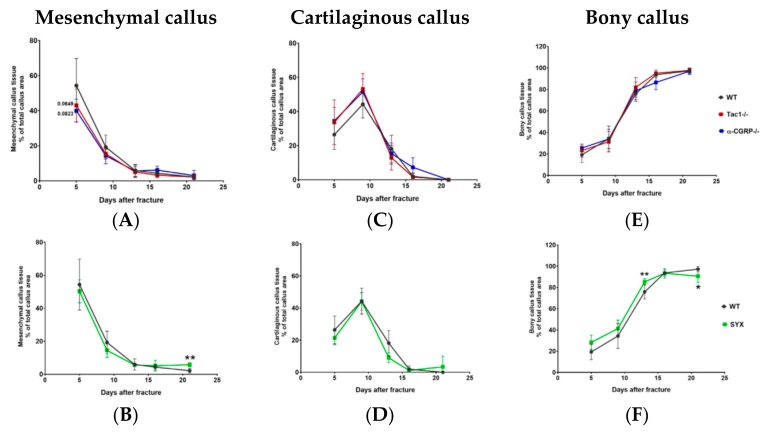
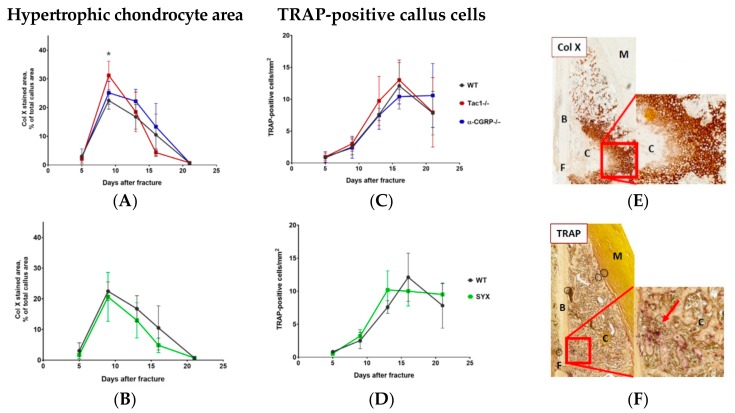
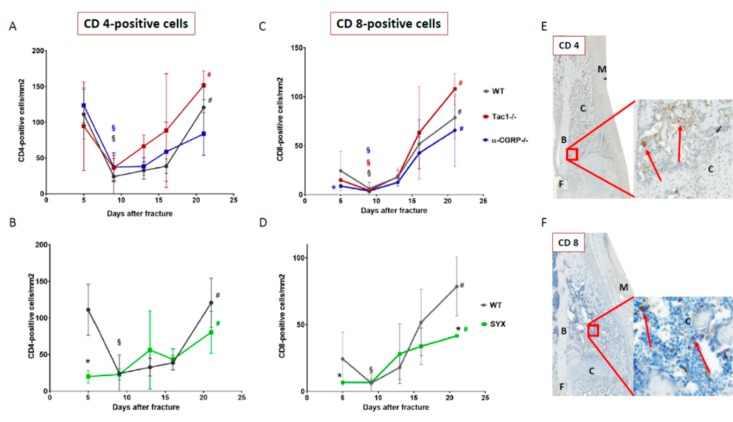
The peripheral nervous system modulates bone repair under physiological and pathophysiological conditions. Previously, we reported an essential role for sensory neuropeptide substance P (SP) and sympathetic nerve fibers (SNF) for proper fracture healing and bone structure in a murine tibial fracture model. A similar distortion of bone microarchitecture has been described for mice lacking the sensory neuropeptide α-calcitonin gene-related peptide (α-CGRP). Here, we hypothesize that loss of SP, α-CGRP, and SNF modulates inflammatory and pain-related processes and also affects bone regeneration during fracture healing under postmenopausal conditions. Intramedullary fixed femoral fractures were set to 28 days after bilateral ovariectomy (OVX) in female wild type (WT), SP-, α-CGRP-deficient, and sympathectomized (SYX) mice. Locomotion, paw withdrawal threshold, fracture callus maturation and numbers of TRAP-, CD4-, CD8-, F4/80-, iNos-, and Arg1-positive cells within the callus were analyzed. Nightly locomotion was reduced in unfractured SP-deficient and SYX mice after fracture. Resistance to pressure was increased for the fractured leg in SP-deficient mice during the later stages of fracture healing, but was decreased in α-CGRP-deficient mice. Hypertrophic cartilage area was increased nine days after fracture in SP-deficient mice. Bony callus maturation was delayed in SYX mice during the later healing stages. In addition, the number of CD 4-positive cells was reduced after five days and the number of CD 8-positive cells was additionally reduced after 21 days in SYX mice. The number of Arg1-positive M2 macrophages was higher in α-CGRP-deficient mice five days after fracture. The alkaline phosphatase level was increased in SYX mice 16 days after fracture. Absence of α-CGRP appears to promote M2 macrophage polarization and reduces the pain threshold, but has no effect on callus tissue maturation. Absence of SP reduces locomotion, increases the pain-threshold, and accelerates hypertrophic callus tissue remodeling. Destruction of SNF reduces locomotion after fracture and influences bony callus tissue remodeling during the later stages of fracture repair, whereas pain-related processes are not affected.
外周神经系统在生理和病理生理条件下调节骨修复。此前,我们报道了感觉神经肽 P 物质 (SP) 和交感神经纤维 (SNF) 对小鼠胫骨骨折模型中骨折愈合和骨结构的正常修复具有重要作用。在缺乏感觉神经肽 α-降钙素基因相关肽 (α-CGRP) 的小鼠中,也描述了类似的骨微结构扭曲。在这里,我们假设 SP、α-CGRP 和 SNF 的缺失会调节炎症和疼痛相关过程,并影响绝经后骨折愈合过程中的骨再生。在双侧卵巢切除 (OVX) 后 28 天,在雌性野生型 (WT)、SP 缺陷型、α-CGRP 缺陷型和交感神经切断型 (SYX) 小鼠的髓内固定股骨骨折。分析了骨折后未骨折的 SP 缺陷型和 SYX 小鼠的夜间活动、爪退缩阈值、骨折痂成熟度以及骨痂内的 TRAP-、CD4-、CD8-、F4/80-、iNos- 和 Arg1-阳性细胞的数量。骨折后,未骨折的 SP 缺陷型和 SYX 小鼠的夜间活动减少。SP 缺陷型小鼠在骨折愈合的后期阶段,对骨折腿的抗压力增加,但在 α-CGRP 缺陷型小鼠中,抗压力减少。骨折后 9 天,SP 缺陷型小鼠的肥大软骨区增加。SYX 小鼠在后期愈合阶段,骨痂成熟延迟。此外,SYX 小鼠在 5 天后 CD4 阳性细胞数量减少,21 天后 CD8 阳性细胞数量进一步减少。骨折后 5 天,α-CGRP 缺陷型小鼠中 Arg1 阳性 M2 巨噬细胞的数量增加。SYX 小鼠在骨折后 16 天碱性磷酸酶水平升高。缺乏 α-CGRP 似乎促进了 M2 巨噬细胞极化,降低了痛阈,但对痂组织成熟没有影响。缺乏 SP 可减少运动,增加痛阈,并加速肥大性痂组织重塑。SNF 的破坏会减少骨折后的运动,并影响骨折修复后期的骨痂组织重塑,而不会影响疼痛相关过程。