Lee Joo Hyung, Park Sang Ho, Kim Seong Hun
Department of Organic and Nano Engineering, College of Engineering, Hanyang University, Seoul 04763, Korea.
LG Hausys R&D Center, Seoul 07796, Korea.
Polymers (Basel). 2020 Jan 9;12(1):178. doi: 10.3390/polym12010178.
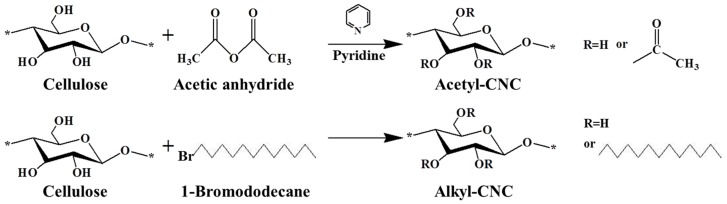
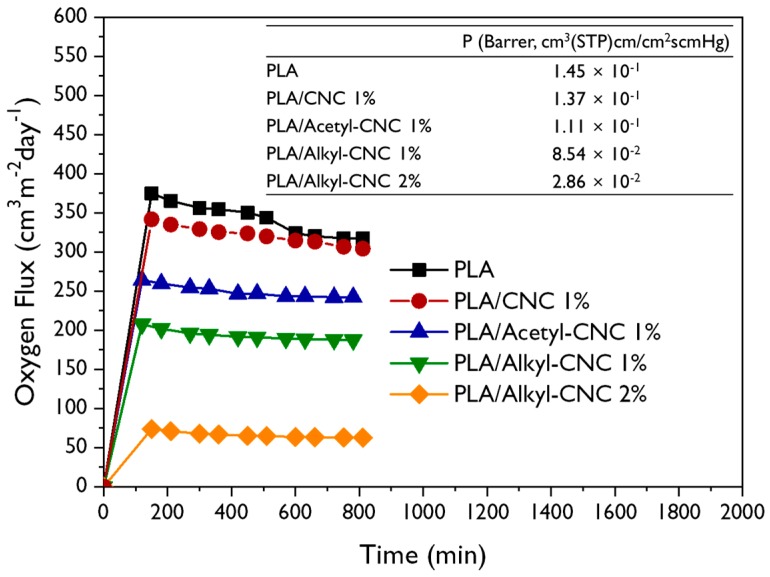
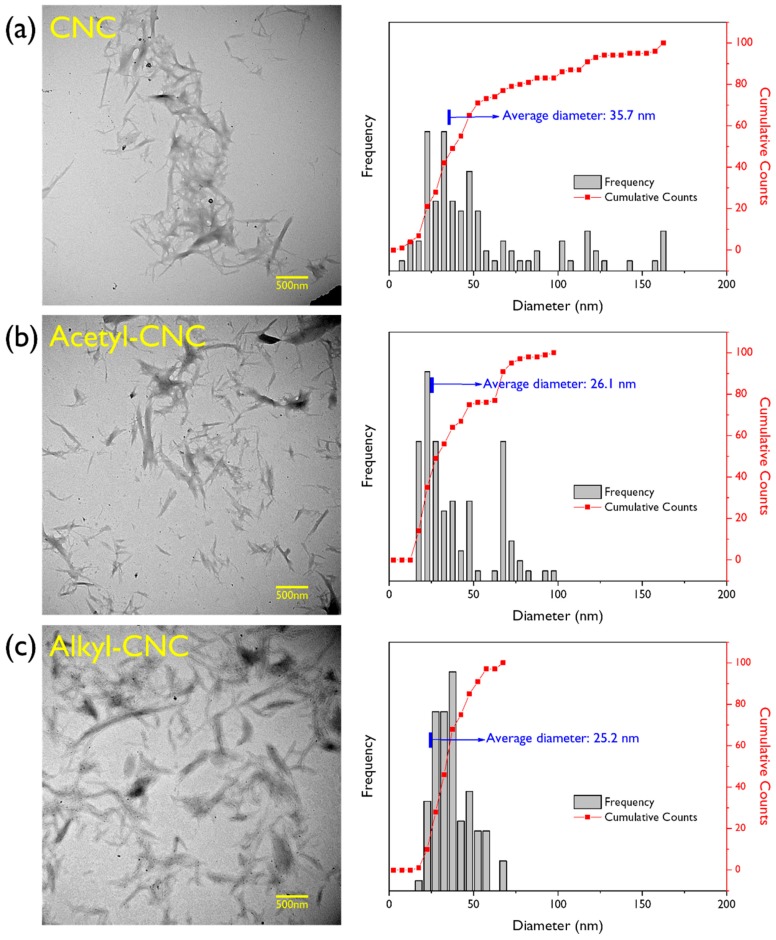
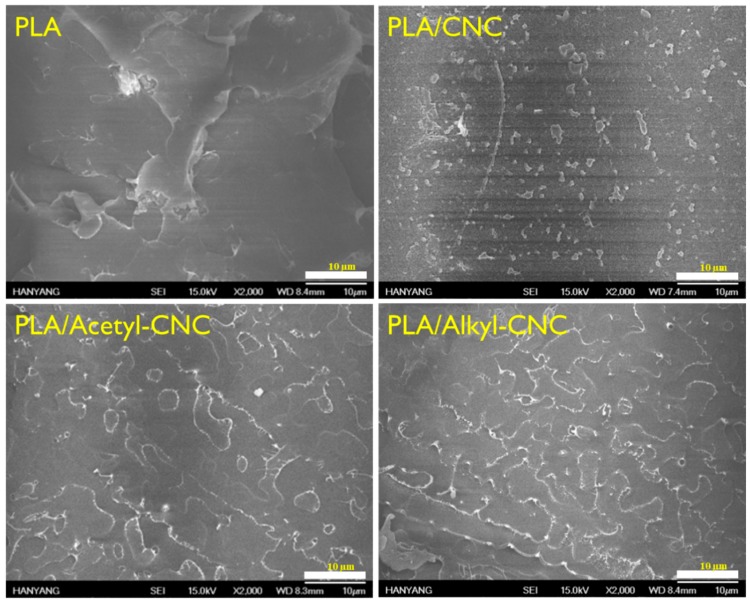
Effective surface alkylation of cellulose nanocrystals (CNCs) was developed using a nucleophilic substitution reaction with an alkyl bromide to convert hydrophilic groups on the CNCs into alkyl groups and the degree of substitution was quantitatively determined. The resultant alkylated CNCs exhibited improved dispersion in a nonpolar environment and increased hydrophobicity, compared with unmodified and acetylated CNCs. Polylactide (PLA) nanocomposites reinforced with unmodified and modified CNCs were prepared by a solution casting method and the effects of reinforcement on the thermal stability, mechanical properties, morphology, and barrier properties were investigated. In addition, modeling of the mechanical properties was evaluated to simulate the modulus of the PLA nanocomposites and results were compared with the experimental values. PLA nanocomposites reinforced with alkylated CNCs exhibited superior properties in terms of thermal stability, tensile strength, Young's modulus, and barrier properties because of the uniform dispersion and strong interfacial adhesion between filler and matrix. This high performance and fully return-to-nature nanocomposite is expected to expand the utilization of CNCs from sustainable bioresources and the practical application of biodegradable plastics.
通过与烷基溴的亲核取代反应,实现了纤维素纳米晶体(CNCs)的有效表面烷基化,将CNCs上的亲水基团转化为烷基,并对取代度进行了定量测定。与未改性和乙酰化的CNCs相比,所得烷基化CNCs在非极性环境中的分散性得到改善,疏水性增强。采用溶液浇铸法制备了未改性和改性CNCs增强的聚乳酸(PLA)纳米复合材料,并研究了增强对热稳定性、力学性能、形态和阻隔性能的影响。此外,对力学性能进行建模以模拟PLA纳米复合材料的模量,并将结果与实验值进行比较。由于填料与基体之间的均匀分散和强界面粘附性,烷基化CNCs增强的PLA纳米复合材料在热稳定性、拉伸强度、杨氏模量和阻隔性能方面表现出优异的性能。这种高性能且完全回归天然的纳米复合材料有望扩大CNCs在可持续生物资源中的利用以及可生物降解塑料的实际应用。