Cui Luqing, Wang Xiangru, Huang Deyu, Zhao Yue, Feng Jiawei, Lu Qirong, Pu Qinqin, Wang Yulian, Cheng Guyue, Wu Min, Dai Menghong
The Cooperative Innovation Center for Sustainable Pig Production, Huazhong Agricultural University, Wuhan 430070, China.
Department of Biomedical Sciences, University of North Dakota School of Medicine and Health Sciences, Grand Forks, ND 58203, USA.
Pathogens. 2020 Jan 10;9(1):53. doi: 10.3390/pathogens9010053.
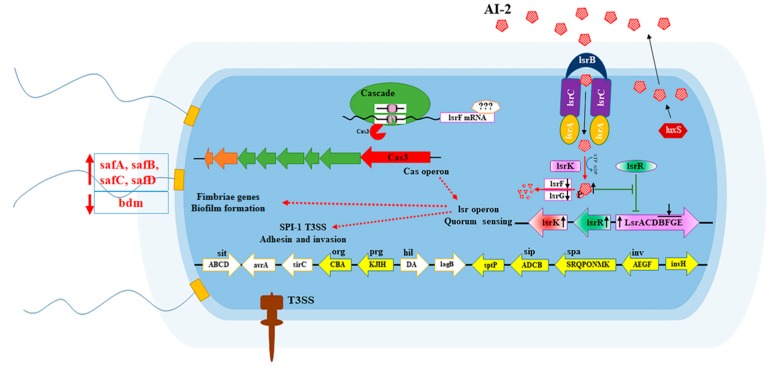
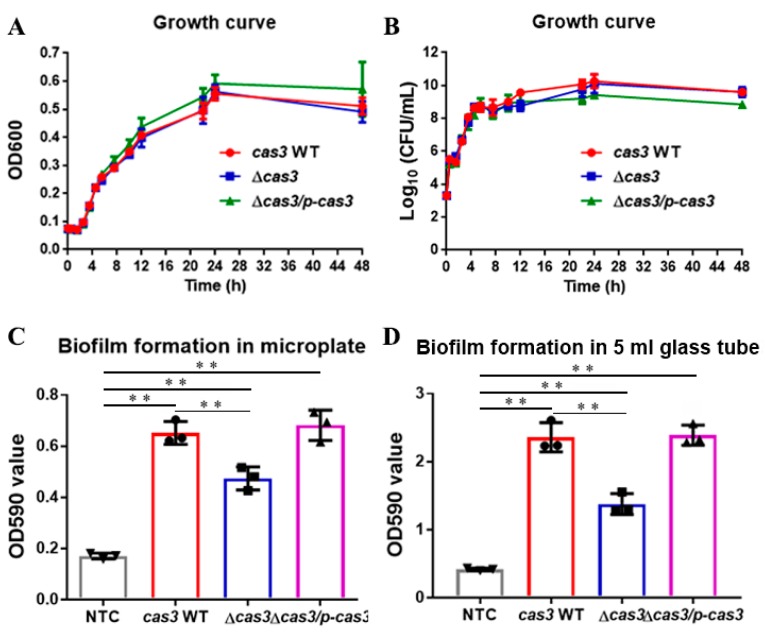
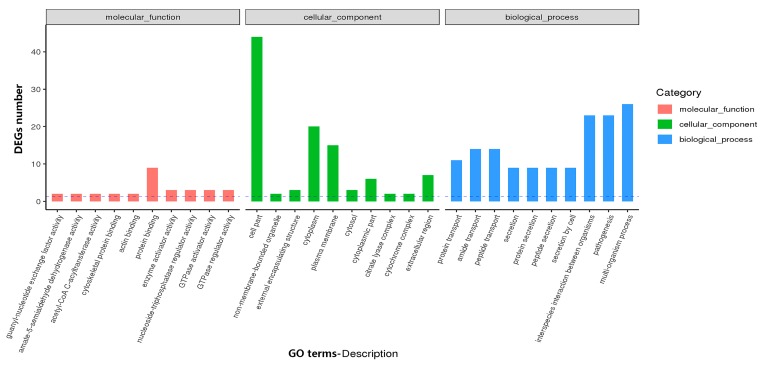
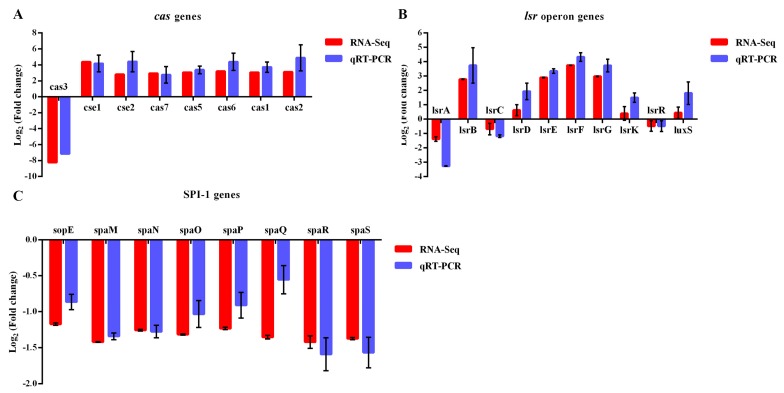
is recognized as one of the most common microbial pathogens worldwide. The bacterium contains the clustered regularly interspaced short palindromic repeats (CRISPR)-CRISPR-associated (Cas) systems, providing adaptive immunity against invading foreign nucleic acids. Previous studies suggested that certain bacteria employ the Cas proteins of CRISPR-Cas systems to target their own genes, which also alters the virulence during invasion of mammals. However, whether CRISPR-Cas systems in have similar functions during bacterial invasion of host cells remains unknown. Here, we systematically analyzed the genes that are regulated by Cas3 in a type I-E CRISPR-Cas system and the virulence changes due to the deletion of in serovar Enteritidis. Compared to the gene wild-type ( WT) strain, deletion upregulated the genes in () operon related to quorum sensing (QS) and downregulated biofilm-forming-related genes and pathogenicity island 1 (SPI-1) genes related to the type three secretion system (T3SS). Consistently, the biofilm formation ability was downregulated in the deletion mutant (Δ). The bacterial invasive and intracellular capacity of Δ to host cells was also reduced, thereby increasing the survival of infected host cells and live chickens. By the transcriptome-wide screen (RNA-Seq), we found that the gene impacts a series of genes related to QS, the flagellum, and SPI-1-T3SS system, thereby altering the virulence phenotypes. As QS SPI-1-T3SS and CRISPR-Cas systems are widely distributed in the bacteria kingdom, our findings extend our understanding of virulence regulation and pathogenicity in mammalian hosts for and potentially other bacteria.
被认为是全球最常见的微生物病原体之一。该细菌含有成簇规律间隔短回文重复序列(CRISPR)-CRISPR相关(Cas)系统,可提供针对入侵外来核酸的适应性免疫。先前的研究表明,某些细菌利用CRISPR-Cas系统的Cas蛋白靶向自身基因,这在入侵哺乳动物期间也会改变毒力。然而,在宿主细胞细菌入侵过程中,[具体细菌名称未提及]中的CRISPR-Cas系统是否具有类似功能仍不清楚。在这里,我们系统地分析了I-E型CRISPR-Cas系统中由Cas3调控的基因,以及肠炎血清型[具体细菌名称未提及]中因[具体基因未提及]缺失导致的毒力变化。与[具体基因未提及]基因野生型(WT)[具体细菌名称未提及]菌株相比,[具体基因未提及]缺失上调了与群体感应(QS)相关的[具体操纵子未提及]操纵子中的[具体基因未提及]基因,并下调了生物膜形成相关基因以及与三型分泌系统(T3SS)相关的致病岛1(SPI-1)基因。一致地,[具体基因未提及]缺失突变体(Δ)中的生物膜形成能力下调。Δ对宿主细胞的细菌侵袭和细胞内能力也降低,从而提高了受感染宿主细胞和活鸡的存活率。通过全转录组筛选(RNA测序),我们发现[具体基因未提及]基因影响一系列与QS、鞭毛和SPI-1-T3SS系统相关的基因,从而改变毒力表型。由于QS、SPI-1-T3SS和CRISPR-Cas系统广泛分布于细菌界,我们的发现扩展了我们对[具体细菌名称未提及]以及潜在其他细菌在哺乳动物宿主中毒力调控和致病性的理解。