Department of Epidemiology, Biostatistics and Occupational Health, McGill University, Montreal, Canada.
McGill International TB Centre, McGill University, Montreal, Canada.
Sci Rep. 2020 Jan 14;10(1):210. doi: 10.1038/s41598-019-56589-3.
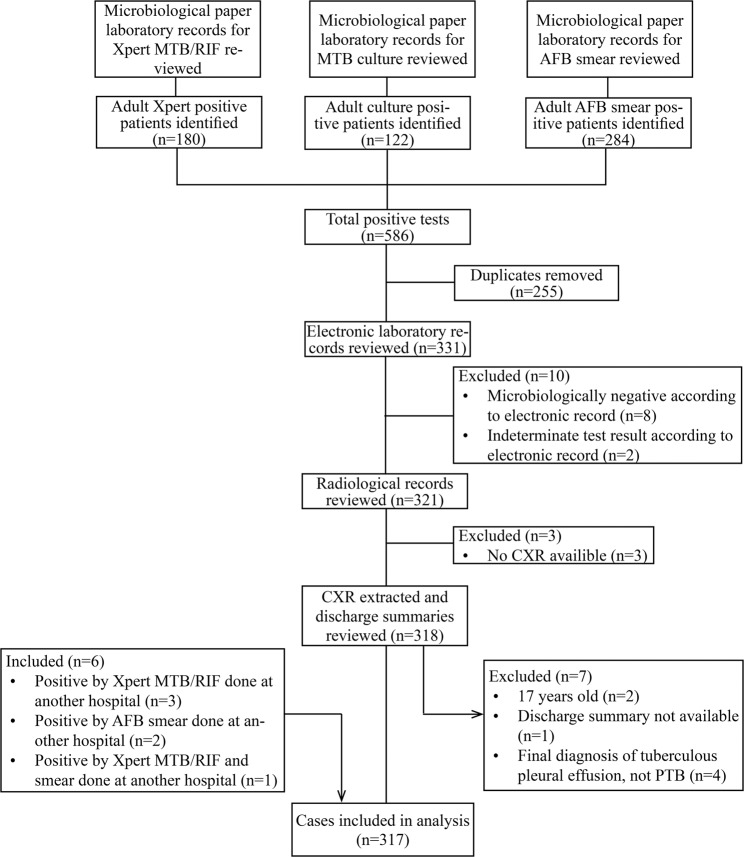
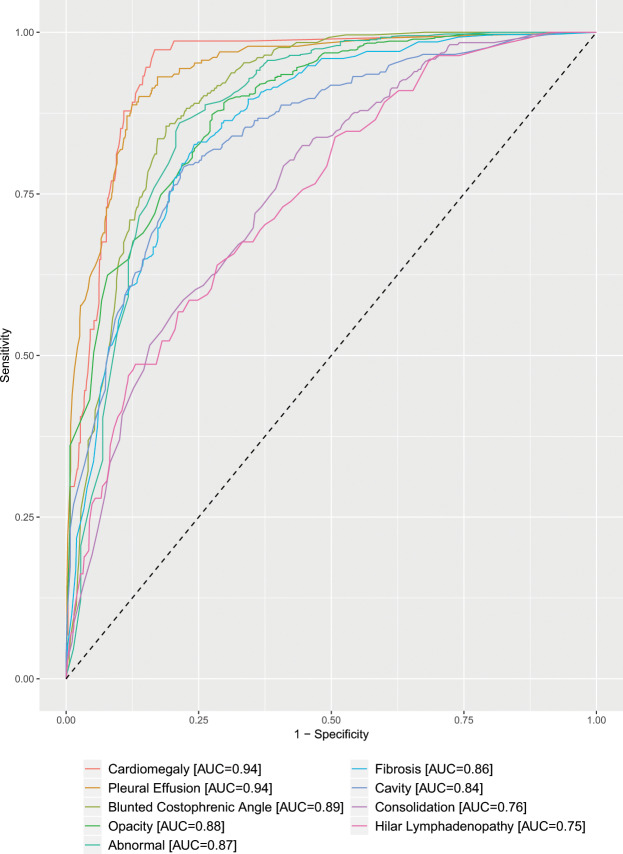
In general, chest radiographs (CXR) have high sensitivity and moderate specificity for active pulmonary tuberculosis (PTB) screening when interpreted by human readers. However, they are challenging to scale due to hardware costs and the dearth of professionals available to interpret CXR in low-resource, high PTB burden settings. Recently, several computer-aided detection (CAD) programs have been developed to facilitate automated CXR interpretation. We conducted a retrospective case-control study to assess the diagnostic accuracy of a CAD software (qXR, Qure.ai, Mumbai, India) using microbiologically-confirmed PTB as the reference standard. To assess overall accuracy of qXR, receiver operating characteristic (ROC) analysis was used to determine the area under the curve (AUC), along with 95% confidence intervals (CI). Kappa coefficients, and associated 95% CI, were used to investigate inter-rater reliability of the radiologists for detection of specific chest abnormalities. In total, 317 cases and 612 controls were included in the analysis. The AUC for qXR for the detection of microbiologically-confirmed PTB was 0.81 (95% CI: 0.78, 0.84). Using the threshold that maximized sensitivity and specificity of qXR simultaneously, the software achieved a sensitivity and specificity of 71% (95% CI: 66%, 76%) and 80% (95% CI: 77%, 83%), respectively. The sensitivity and specificity of radiologists for the detection of microbiologically-confirmed PTB was 56% (95% CI: 50%, 62%) and 80% (95% CI: 77%, 83%), respectively. For detection of key PTB-related abnormalities 'pleural effusion' and 'cavity', qXR achieved an AUC of 0.94 (95% CI: 0.92, 0.96) and 0.84 (95% CI: 0.82, 0.87), respectively. For the other abnormalities, the AUC ranged from 0.75 (95% CI: 0.70, 0.80) to 0.94 (95% CI: 0.91, 0.96). The controls had a high prevalence of other lung diseases which can cause radiological manifestations similar to PTB (e.g., 26% had pneumonia, 15% had lung malignancy, etc.). In a tertiary hospital in India, qXR demonstrated moderate sensitivity and specificity for the detection of PTB. There is likely a larger role for CAD software as a triage test for PTB at the primary care level in settings where access to radiologists in limited. Larger prospective studies that can better assess heterogeneity in important subgroups are needed.
一般来说,胸部 X 光片(CXR)在由人类读者解读时对活动性肺结核(PTB)筛查具有较高的敏感性和中等特异性。然而,由于硬件成本和在资源匮乏、PTB 负担高的环境中解释 CXR 的专业人员短缺,因此难以扩展。最近,已经开发了几种计算机辅助检测(CAD)程序来促进自动 CXR 解释。我们进行了一项回顾性病例对照研究,以评估一种 CAD 软件(qXR,Qure.ai,印度孟买)的诊断准确性,以微生物学证实的 PTB 作为参考标准。为了评估 qXR 的总体准确性,使用接收者操作特征(ROC)分析来确定曲线下面积(AUC),以及 95%置信区间(CI)。kappa 系数及其相关的 95%CI 用于研究放射科医生检测特定胸部异常的一致性。共有 317 例病例和 612 例对照纳入分析。qXR 检测微生物学证实的 PTB 的 AUC 为 0.81(95%CI:0.78,0.84)。使用同时最大化 qXR 敏感性和特异性的阈值,该软件实现了 71%(95%CI:66%,76%)和 80%(95%CI:77%,83%)的敏感性和特异性。放射科医生检测微生物学证实的 PTB 的敏感性和特异性分别为 56%(95%CI:50%,62%)和 80%(95%CI:77%,83%)。对于检测关键的与结核病相关的异常“胸腔积液”和“空洞”,qXR 的 AUC 分别为 0.94(95%CI:0.92,0.96)和 0.84(95%CI:0.82,0.87)。对于其他异常,AUC 范围为 0.75(95%CI:0.70,0.80)至 0.94(95%CI:0.91,0.96)。对照组患有其他肺部疾病的患病率较高,这些疾病可能导致与结核病相似的放射学表现(例如,26%患有肺炎,15%患有肺部恶性肿瘤等)。在印度的一家三级医院,qXR 对结核病的检测具有中等的敏感性和特异性。在放射科医生有限的情况下,CAD 软件作为结核病初级保健水平的分诊试验可能具有更大的作用。需要更大的前瞻性研究来更好地评估重要亚组的异质性。