Environmental Health and Ecological Sciences Department, Ifakara Health Institute, P. O. Box 53, Ifakara, Tanzania.
School of Life Science and Bioengineering, The Nelson Mandela African Institution of Science and Technology, P. O. Box 447, Arusha, Tanzania.
Malar J. 2020 Jan 15;19(1):22. doi: 10.1186/s12936-020-3108-0.
Malaria control in Africa relies extensively on indoor residual spraying (IRS) and insecticide-treated nets (ITNs). IRS typically targets mosquitoes resting on walls, and in few cases, roofs and ceilings, using contact insecticides. Unfortunately, little attention is paid to where malaria vectors actually rest indoors, and how such knowledge could be used to improve IRS. This study investigated preferred resting surfaces of two major malaria vectors, Anopheles funestus and Anopheles arabiensis, inside four common house types in rural south-eastern Tanzania.
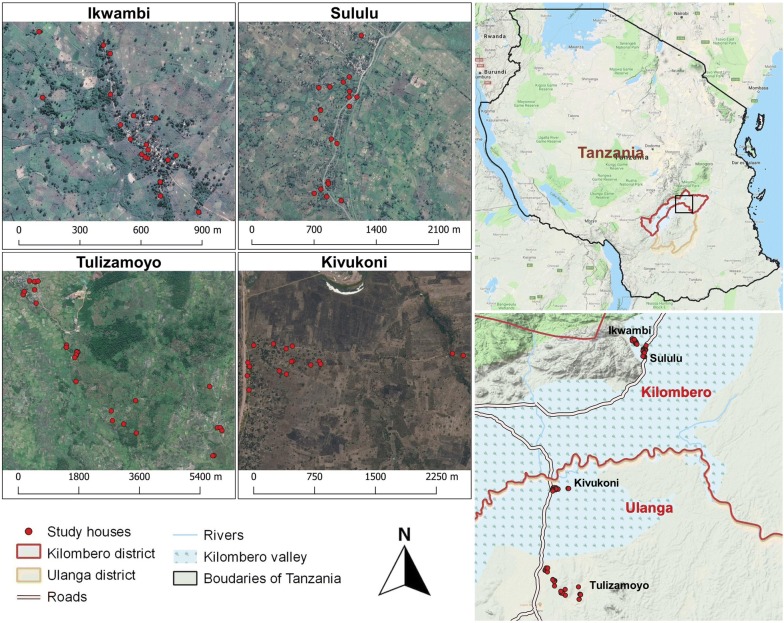
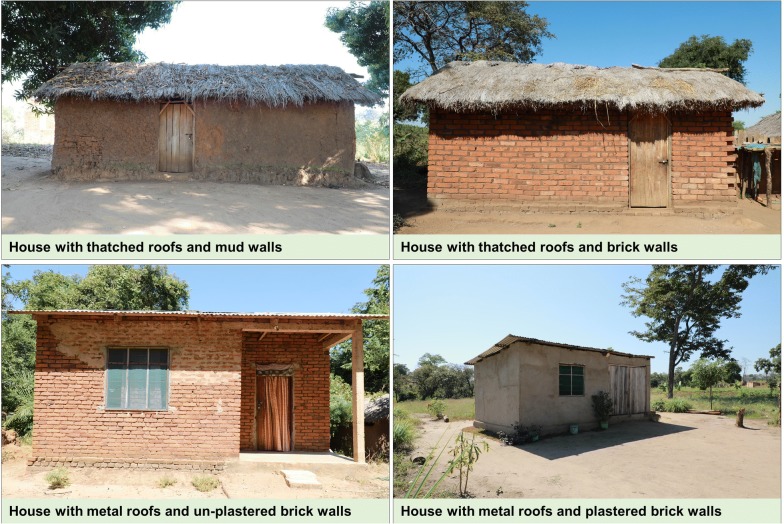
The assessment was done inside 80 houses including: 20 with thatched roofs and mud walls, 20 with thatched roofs and un-plastered brick walls, 20 with metal roofs and un-plastered brick walls, and 20 with metal roofs and plastered brick walls, across four villages. In each house, resting mosquitoes were sampled in mornings (6 a.m.-8 a.m.), evenings (6 p.m.-8 p.m.) and at night (11 p.m.-12.00 a.m.) using Prokopack aspirators from multiple surfaces (walls, undersides of roofs, floors, furniture, utensils, clothing, curtains and bed nets).
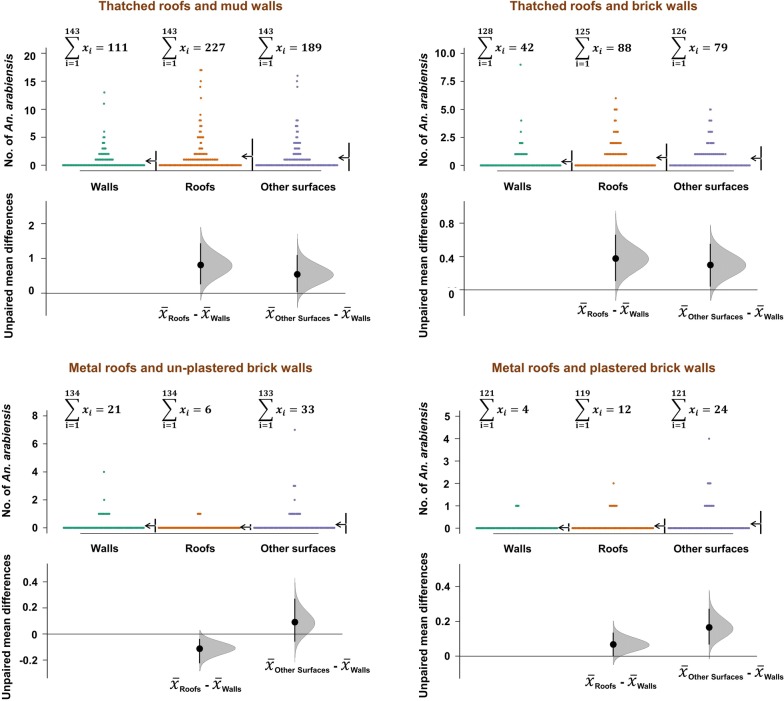
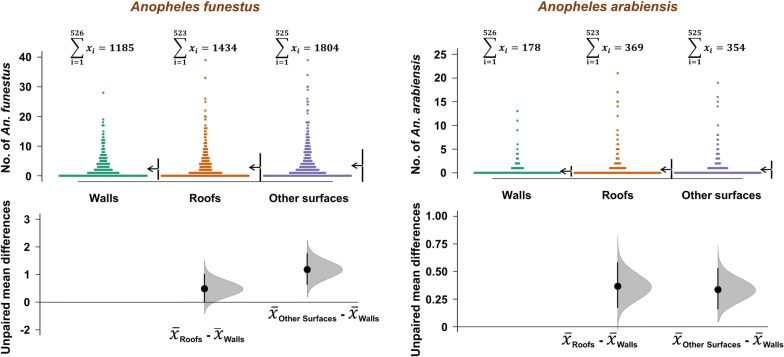
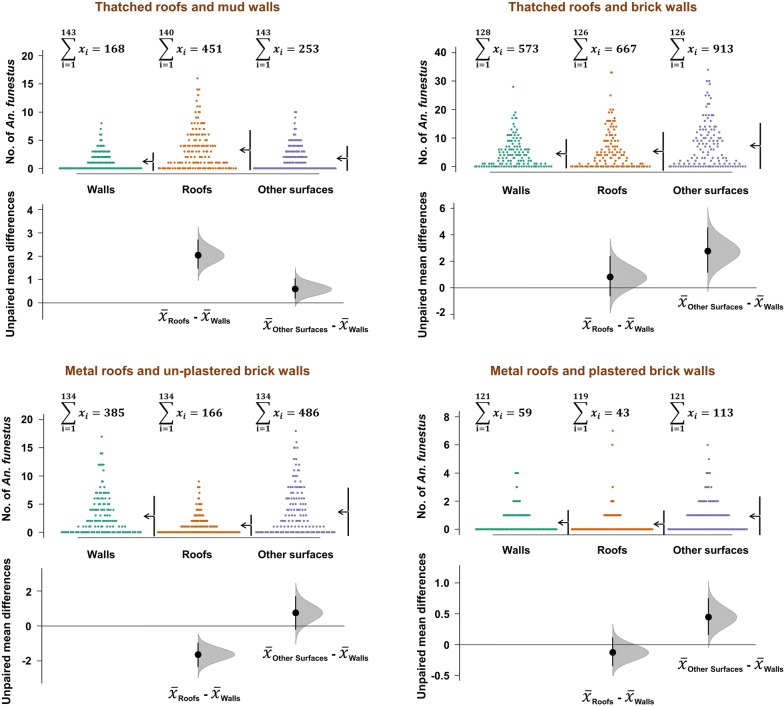
Overall, only 26% of An. funestus and 18% of An. arabiensis were found on walls. In grass-thatched houses, 33-55% of An. funestus and 43-50% of An. arabiensis rested under roofs, while in metal-roofed houses, only 16-20% of An. funestus and 8-30% of An. arabiensis rested under roofs. Considering all data together, approximately 40% of mosquitoes rested on surfaces not typically targeted by IRS, i.e. floors, furniture, utensils, clothing and bed nets. These proportions were particularly high in metal-roofed houses (47-53% of An. funestus; 60-66% of An. arabiensis).
While IRS typically uses contact insecticides to target adult mosquitoes on walls, and occasionally roofs and ceilings, significant proportions of vectors rest on surfaces not usually sprayed. This gap exceeds one-third of malaria mosquitoes in grass-thatched houses, and can reach two-thirds in metal-roofed houses. Where field operations exclude roofs during IRS, the gaps can be much greater. In conclusion, there is need for locally-obtained data on mosquito resting behaviours and how these influence the overall impact and costs of IRS. This study also emphasizes the need for alternative approaches, e.g. house screening, which broadly tackle mosquitoes beyond areas reachable by IRS and ITNs.
非洲的疟疾控制主要依赖室内滞留喷洒(IRS)和经杀虫剂处理的蚊帐(ITN)。IRS 通常针对的是栖息在墙壁上的蚊子,在极少数情况下,也会针对屋顶和天花板上的蚊子进行处理,使用接触杀虫剂。不幸的是,人们很少关注疟疾传播媒介实际上在室内何处栖息,以及如何利用这些知识来改进 IRS。本研究调查了坦桑尼亚东南部四个农村常见房屋类型内两种主要疟疾传播媒介(冈比亚按蚊和阿拉伯按蚊)的首选栖息表面。
在 80 所房屋内进行评估,包括:20 所茅草屋顶和泥墙房屋、20 所茅草屋顶和未抹灰砖墙房屋、20 所金属屋顶和未抹灰砖墙房屋以及 20 所金属屋顶和抹灰砖墙房屋,分布在四个村庄。在每个房屋内,清晨(6 点至 8 点)、傍晚(6 点至 8 点)和夜间(11 点至 12 点)使用 Prokopack 吸气器从多个表面(墙壁、屋顶下方、地板、家具、器皿、衣物、窗帘和蚊帐)采集栖息的蚊子。
总体而言,仅在墙壁上发现了 26%的冈比亚按蚊和 18%的阿拉伯按蚊。在茅草屋顶房屋中,33-55%的冈比亚按蚊和 43-50%的阿拉伯按蚊栖息在屋顶下,而在金属屋顶房屋中,仅 16-20%的冈比亚按蚊和 8-30%的阿拉伯按蚊栖息在屋顶下。综合所有数据,大约有 40%的蚊子栖息在 IRS 通常不针对的表面上,即地板、家具、器皿、衣物和蚊帐。在金属屋顶房屋中,这些比例特别高(冈比亚按蚊 47-53%;阿拉伯按蚊 60-66%)。
尽管 IRS 通常使用接触杀虫剂来针对墙壁上的成年蚊子进行处理,偶尔也会针对屋顶和天花板进行处理,但大量的蚊子栖息在通常不喷洒杀虫剂的表面上。这个差距在茅草屋顶房屋中超过了三分之一的疟疾蚊子,在金属屋顶房屋中可以达到三分之二。在 IRS 期间,如果田间作业排除了屋顶,那么差距可能会更大。总之,需要获得有关蚊子栖息行为的本地数据,以及这些行为如何影响 IRS 的整体影响和成本。本研究还强调需要采取替代方法,例如房屋筛选,广泛应对 IRS 和 ITN 无法触及的区域的蚊子。