Department of Veterinary Integrative Biosciences, College of Veterinary Medicine and Biomedical Sciences, Texas A&M University, College Station, TX, United States of America.
Microscopy and Imaging Center, Texas A&M University, College Station, TX, United States of America.
PLoS One. 2020 Jan 21;15(1):e0228072. doi: 10.1371/journal.pone.0228072. eCollection 2020.
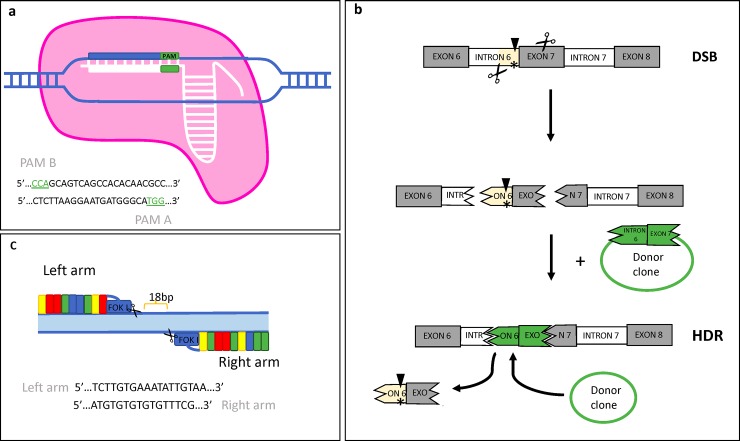
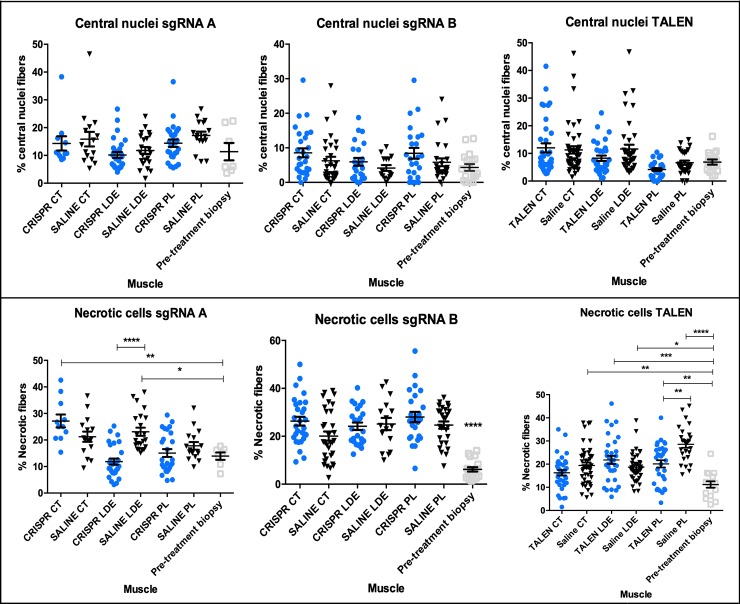
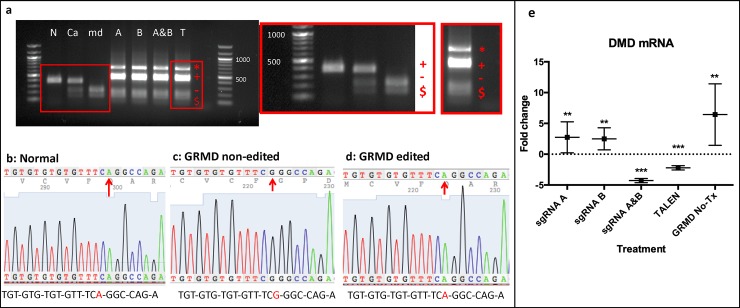
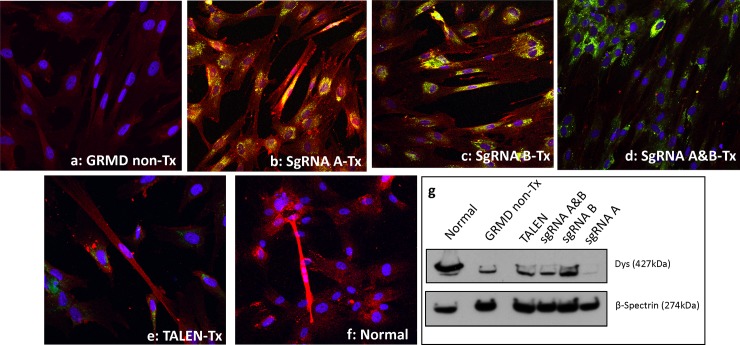
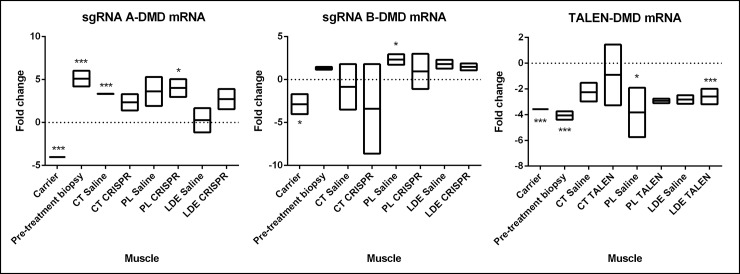
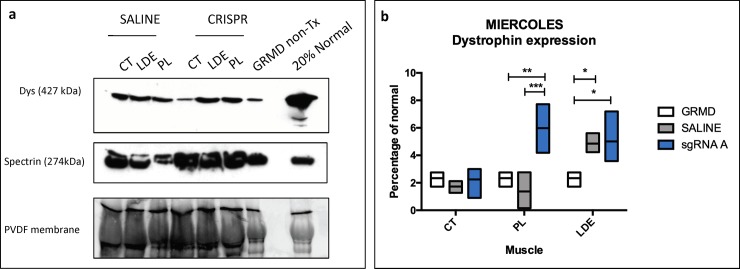
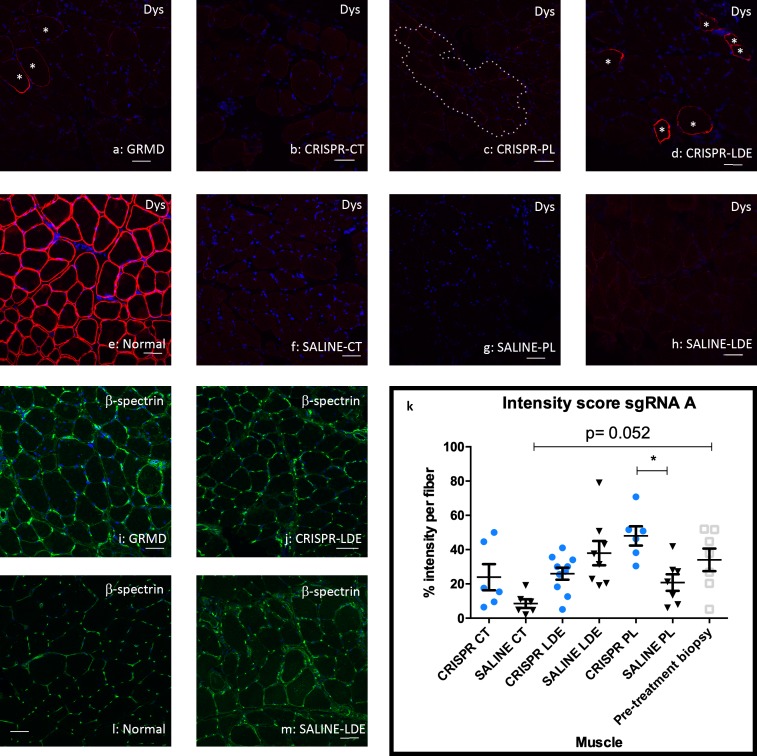
Duchenne muscular dystrophy (DMD) is caused by mutations in the DMD gene that abolish the expression of dystrophin protein. Dogs with the genetic homologue, golden retriever muscular dystrophy dog (GRMD), have a splice site mutation that leads to skipping of exon 7 and a stop codon in the DMD transcript. Gene editing via homology-directed repair (HDR) has been used in the mdx mouse model of DMD but not in GRMD. In this study, we used clustered regularly interspaced short palindromic repeats (CRISPR) and transcription activator-like effector nucleases (TALEN) to restore dystrophin expression via HDR in myoblasts/myotubes and later via intramuscular injection of GRMD dogs. In vitro, DNA and RNA were successfully corrected but dystrophin protein was not translated. With intramuscular injection of two different guide arms, sgRNA A and B, there was mRNA expression and Sanger sequencing confirmed inclusion of exon 7 for all treatments. On Western blot analysis, protein expression of up to 6% of normal levels was seen in two dogs injected with sgRNA B and up to 16% of normal in one dog treated with sgRNA A. TALEN did not restore any dystrophin expression. While there were no adverse effects, clear benefits were not seen on histopathologic analysis, immunofluorescence microscopy, and force measurements. Based on these results, methods must be modified to increase the efficiency of HDR-mediated gene repair and protein expression.
杜氏肌营养不良症(DMD)是由 DMD 基因突变引起的,该突变导致抗肌萎缩蛋白的表达缺失。具有遗传同源物的狗,即金毛猎犬肌营养不良症狗(GRMD),具有一个剪接位点突变,导致 DMD 转录本中第 7 外显子跳跃和终止密码子。通过同源定向修复(HDR)的基因编辑已用于 DMD 的 mdx 小鼠模型中,但未用于 GRMD。在这项研究中,我们使用了成簇的规律间隔的短回文重复序列(CRISPR)和转录激活因子样效应物核酸酶(TALEN),通过 HDR 在肌母细胞/肌管中恢复抗肌萎缩蛋白的表达,然后通过肌内注射 GRMD 狗。在体外,成功纠正了 DNA 和 RNA,但未翻译抗肌萎缩蛋白。通过肌内注射两种不同的向导臂,sgRNA A 和 B,所有治疗均显示出 mRNA 表达,并且 Sanger 测序证实了第 7 外显子的包含。在 Western blot 分析中,在注射 sgRNA B 的两只狗中,观察到高达正常水平 6%的蛋白质表达,在一只用 sgRNA A 治疗的狗中,高达正常水平的 16%的蛋白质表达。TALEN 未恢复任何抗肌萎缩蛋白的表达。尽管没有不良反应,但在组织病理学分析、免疫荧光显微镜和力测量中未看到明显的益处。基于这些结果,必须修改方法以提高 HDR 介导的基因修复和蛋白质表达的效率。