Department of Psychology and Princeton Neuroscience Institute, Princeton University, Princeton, NJ, USA.
Department of Psychology and Princeton Neuroscience Institute, Princeton University, Princeton, NJ, USA.
Cortex. 2020 Apr;125:44-59. doi: 10.1016/j.cortex.2019.12.012. Epub 2020 Jan 3.
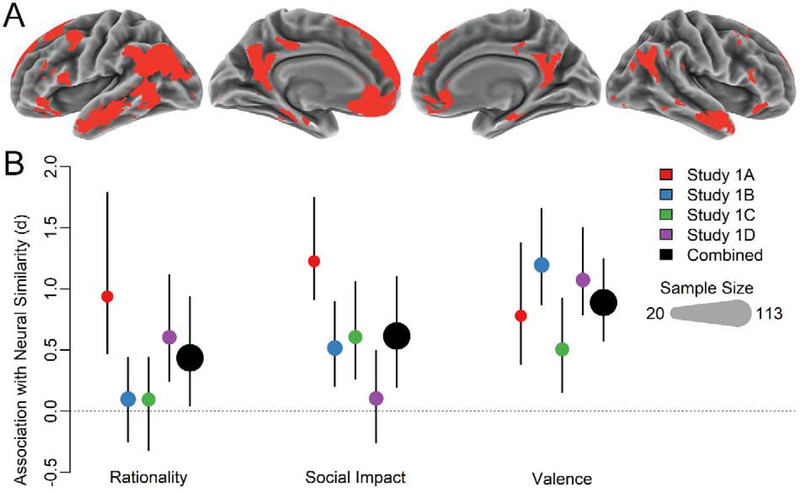
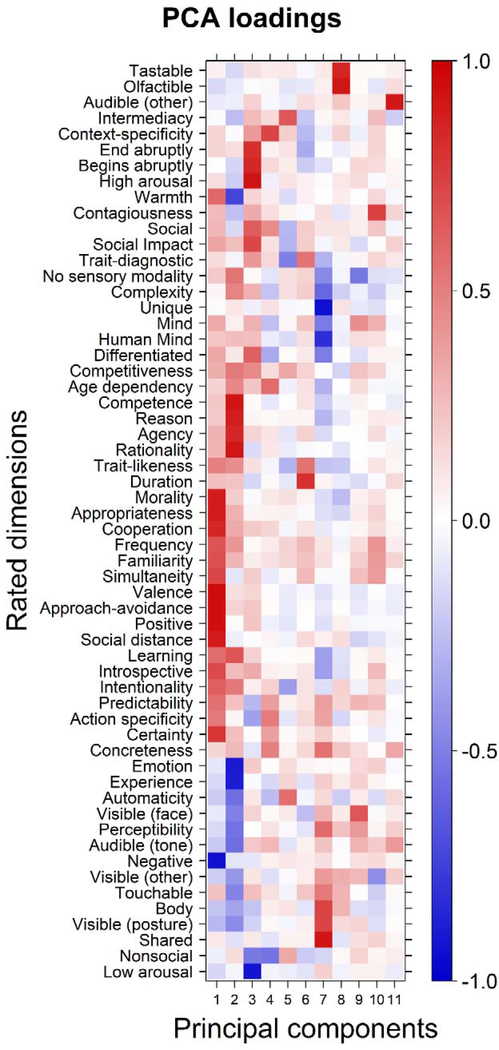
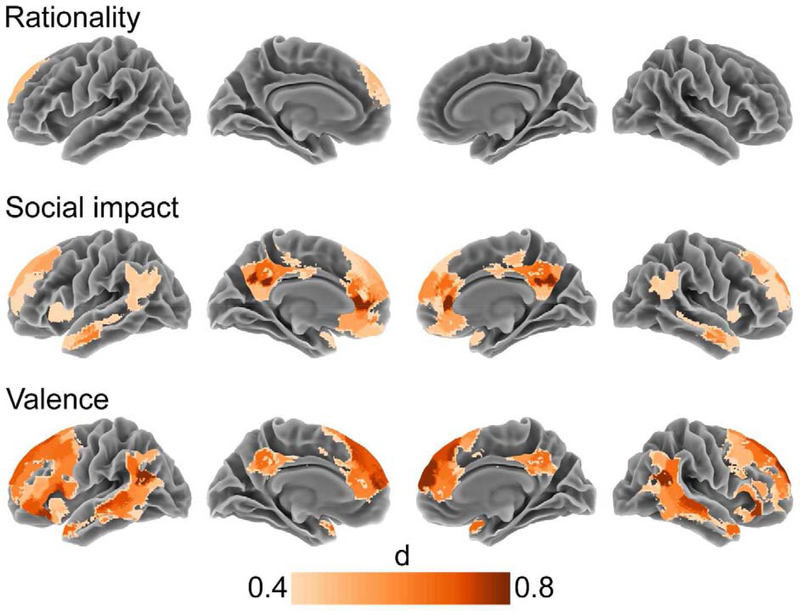
Humans can experience a wide variety of different thoughts and feelings in the course of everyday life. To successfully navigate the social world, people need to perceive, understand, and predict others' mental states. Previous research suggests that people use three dimensions to represent mental states: rationality, social impact, and valence. This 3d Mind Model allows people to efficiently "see" the state of another person's mind by considering whether that state is rational or emotional, more or less socially impactful, and positive or negative. In the current investigation, we validate this model using neural, behavioral, and linguistic evidence. First, we examine the robustness of the 3d Mind Model by conducting a mega-analysis of four fMRI studies in which participants considered others' mental states. We find evidence that rationality, social impact, and valence each contribute to explaining the neural representation of mental states. Second, we test whether the 3d Mind Model offers the optimal combination of dimensions for describing neural representations of mental state. Results reveal that the 3d Mind Model achieve the best performance among a large set of candidate dimensions. Indeed, it offers a highly explanatory account of mental state representation, explaining over 80% of reliable neural variance. Finally, we demonstrate that all three dimensions of the model likewise capture convergent behavioral and linguistic measures of mental state representation. Together, these findings provide strong support for the 3d Mind Model, indicating that is it is a robust and generalizable account of how people think about mental states.
在日常生活中,人类会体验到各种各样的不同的想法和感受。为了成功地在社会世界中航行,人们需要感知、理解和预测他人的心理状态。先前的研究表明,人们使用三个维度来表示心理状态:理性、社会影响和价值。这个 3d 心智模型通过考虑另一个人的状态是否理性或情绪化、更具社会影响力或更小、积极或消极,让人们能够有效地“看到”另一个人的心理状态。在当前的研究中,我们使用神经、行为和语言证据来验证这个模型。首先,我们通过对四项 fMRI 研究进行 mega 分析,检验了 3d 心智模型的稳健性,在这些研究中,参与者考虑了他人的心理状态。我们发现,理性、社会影响和价值都有助于解释心理状态的神经表现。其次,我们测试了 3d 心智模型是否为描述心理状态的神经表现提供了最佳的维度组合。结果表明,3d 心智模型在一系列候选维度中表现最佳。实际上,它为心理状态的神经表现提供了一个高度解释性的解释,解释了超过 80%的可靠神经方差。最后,我们证明了模型的所有三个维度同样可以捕捉到心理状态表现的收敛行为和语言测量。综上所述,这些发现为 3d 心智模型提供了强有力的支持,表明它是一种稳健且可推广的关于人们如何思考心理状态的解释。