Department of Epidemiology and Health Statistics, the School of Public Health of Qingdao University, No. 308 Ningxia Road, Qingdao 266021, China.
Nutrients. 2020 Jan 16;12(1):240. doi: 10.3390/nu12010240.
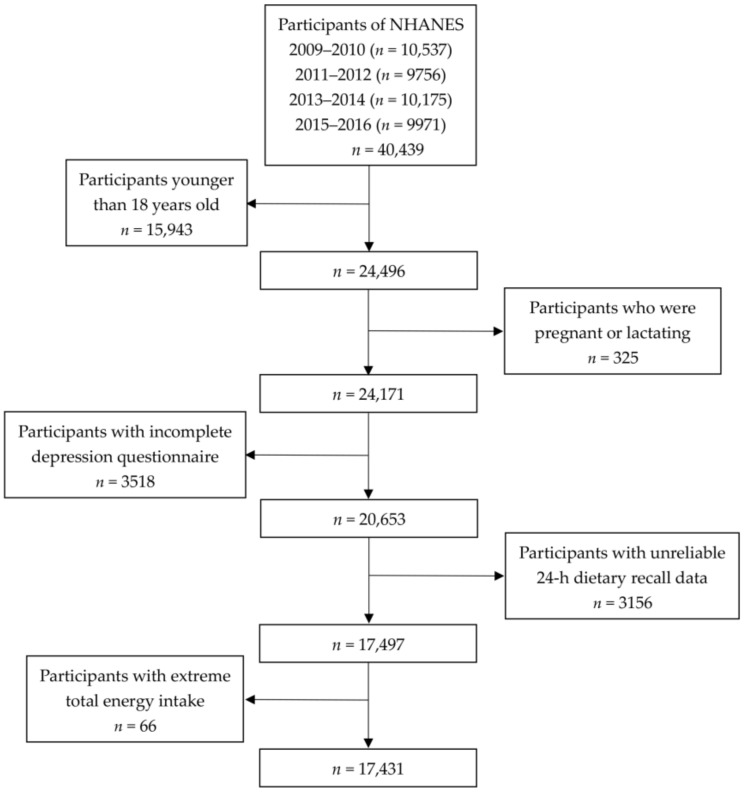
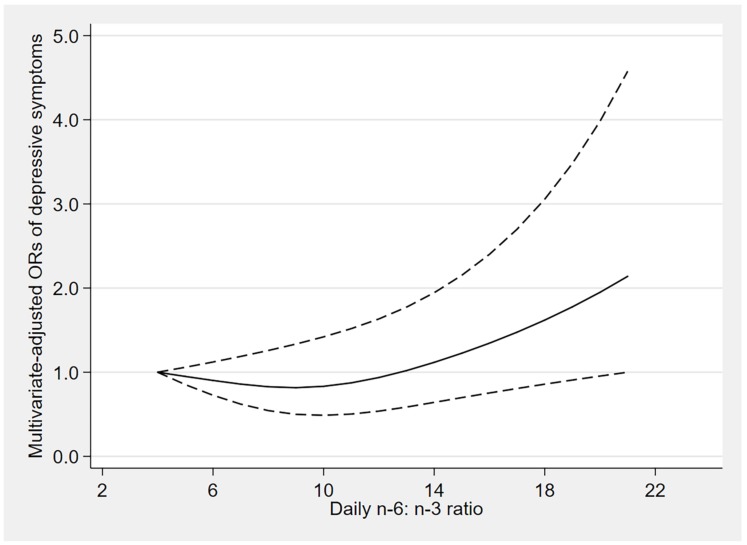
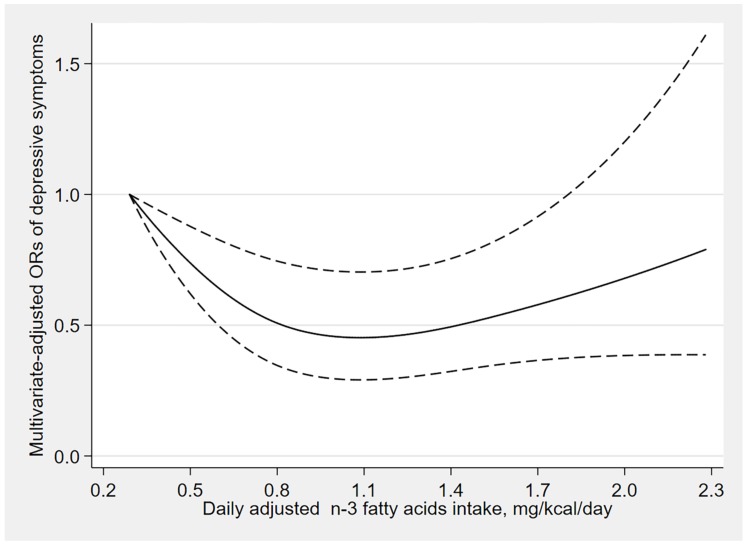
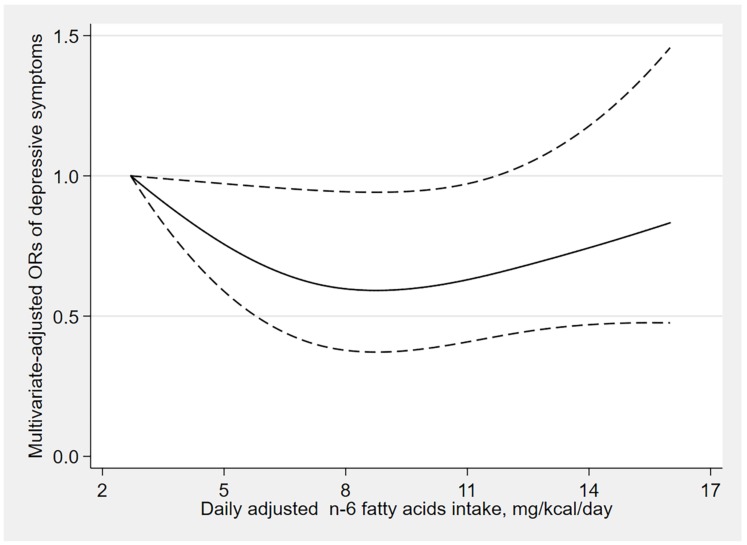
Many studies have explored the association between n-3 fatty acids and depression, but research on the associations of n-6 fatty acids and n-6:n-3 ratio with depression is more scarce, and the results are controversial. Therefore, we conducted this cross-sectional study to explore the associations of n-3 and n-6 fatty acid intakes and n-6:n-3 ratio with the risk of depressive symptoms using data from National Health and Nutrition Examination Survey (NHANES) 2009-2016. Dietary data on n-3 and n-6 fatty acids were obtained through two 24-h dietary recall interviews, and were adjusted by energy. Depressive symptoms were measured by PHQ-9 (nine-item Patient Health Questionnaire). We applied logistic regression and restricted cubic spline models to assess the relationships of n-3 and n-6 fatty acids intake and n-6:n-3 ratio with the risk of depressive symptoms. A total of 17,431 individuals over 18 years old were enrolled in this study. In the multivariate-adjusted model 2, compared with the lowest category, the highest odd ratios (ORs) with 95% confidence intervals (CIs) for n-3 fatty acid intake and n-6:n-3 ratio were 0.71 (0.55-0.92) and 1.66 (1.10-2.50), and middle OR (95% CI) for n-6 fatty acid intake was 0.72 (0.56-0.92), respectively. Our study suggests that n-3 and n-6 fatty acids intake were inversely associated with the risk of depressive symptoms, while the n-6:n-3 ratio was positively associated with the risk of depressive symptoms.
许多研究探讨了 n-3 脂肪酸与抑郁症之间的关系,但关于 n-6 脂肪酸和 n-6:n-3 比值与抑郁症之间关系的研究则更为匮乏,且结果存在争议。因此,我们利用 2009-2016 年国家健康与营养调查(NHANES)的数据进行了这项横断面研究,旨在探讨 n-3 和 n-6 脂肪酸摄入量以及 n-6:n-3 比值与抑郁症状风险之间的关系。n-3 和 n-6 脂肪酸的饮食数据通过两次 24 小时膳食回顾访谈获得,并通过能量进行了调整。抑郁症状通过 PHQ-9(九项患者健康问卷)进行测量。我们应用逻辑回归和限制立方样条模型来评估 n-3 和 n-6 脂肪酸摄入量以及 n-6:n-3 比值与抑郁症状风险之间的关系。这项研究共纳入了 17431 名 18 岁以上的个体。在多变量调整模型 2 中,与最低类别相比,n-3 脂肪酸摄入量和 n-6:n-3 比值的最高比值比(OR)及其 95%置信区间(CI)分别为 0.71(0.55-0.92)和 1.66(1.10-2.50),n-6 脂肪酸摄入量的中间 OR(95%CI)为 0.72(0.56-0.92)。我们的研究表明,n-3 和 n-6 脂肪酸摄入量与抑郁症状风险呈负相关,而 n-6:n-3 比值与抑郁症状风险呈正相关。