Department of Biomedicine, Neuroscience and Advanced Diagnostics (BIND), Section of Human Anatomy, University of Palermo, 90127 Palermo, Italy.
Euro-Mediterranean Institute of Science and Technology (IEMEST), 90139 Palermo, Italy.
Int J Mol Sci. 2020 Jan 19;21(2):661. doi: 10.3390/ijms21020661.
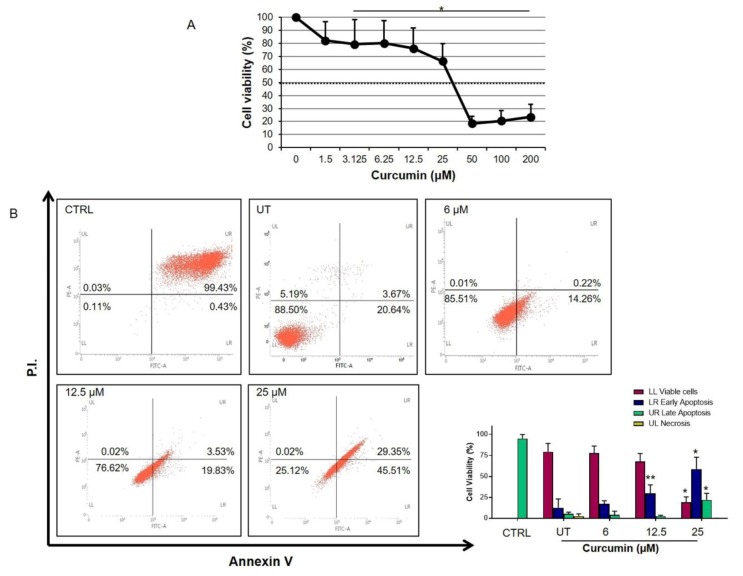
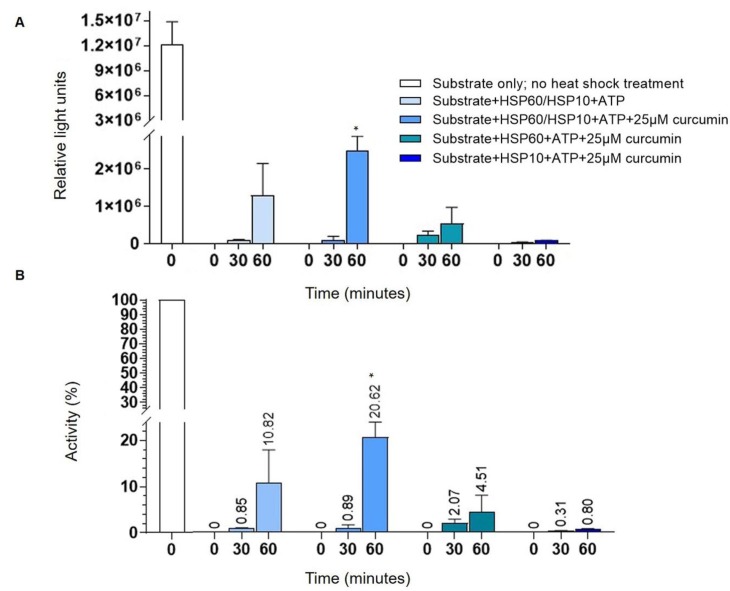
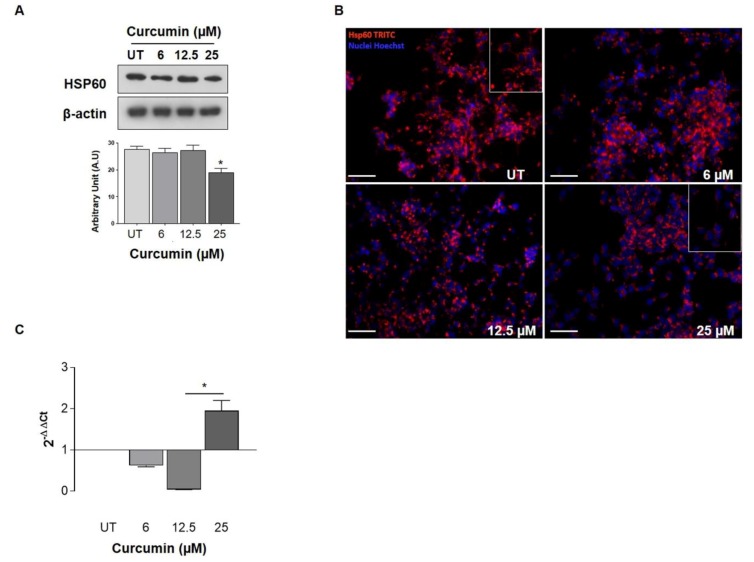
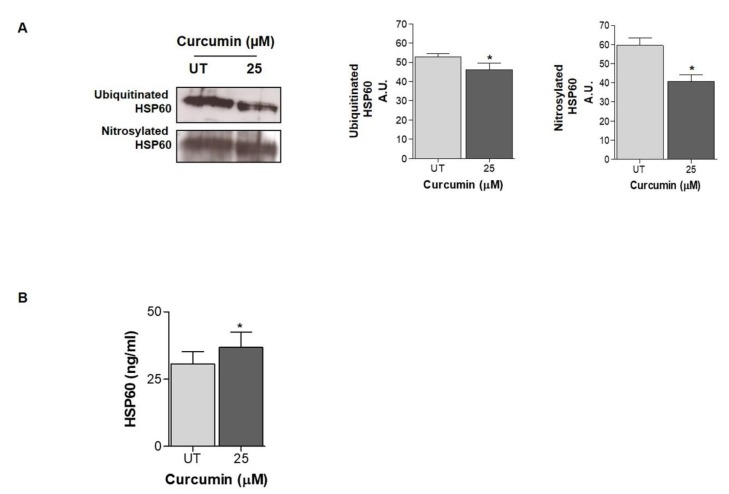
The fundamental challenge in fighting cancer is the development of protective agents able to interfere with the classical pathways of malignant transformation, such as extracellular matrix remodeling, epithelial-mesenchymal transition and, alteration of protein homeostasis. In the tumors of the brain, proteotoxic stress represents one of the main triggering agents for cell transformation. Curcumin is a natural compound with anti-inflammatory and anti-cancer properties with promising potential for the development of therapeutic drugs for the treatment of cancer as well as neurodegenerative diseases. Among the mediators of cancer development, HSP60 is a key factor for the maintenance of protein homeostasis and cell survival. High HSP60 levels were correlated, in particular, with cancer development and progression, and for this reason, we investigated the ability of curcumin to affect HSP60 expression, localization, and post-translational modifications using a neuroblastoma cell line. We have also looked at the ability of curcumin to interfere with the HSP60/HSP10 folding machinery. The cells were treated with 6, 12.5, and 25 µM of curcumin for 24 h, and the flow cytometry analysis showed that the compound induced apoptosis in a dose-dependent manner with a higher percentage of apoptotic cells at 25 µM. This dose of curcumin-induced a decrease in HSP60 protein levels and an upregulation of HSP60 mRNA expression. Moreover, 25 µM of curcumin reduced HSP60 ubiquitination and nitration, and the chaperonin levels were higher in the culture media compared with the untreated cells. Furthermore, curcumin at the same dose was able to favor HSP60 folding activity. The reduction of HSP60 levels, together with the increase in its folding activity and the secretion in the media led to the supposition that curcumin might interfere with cancer progression with a protective mechanism involving the chaperonin.
抗击癌症的根本挑战是开发能够干扰恶性转化经典途径的保护剂,如细胞外基质重塑、上皮-间充质转化和蛋白质平衡的改变。在脑肿瘤中,蛋白毒性应激是细胞转化的主要触发因素之一。姜黄素是一种具有抗炎和抗癌特性的天然化合物,具有开发治疗癌症和神经退行性疾病的治疗药物的巨大潜力。在癌症发展的介质中,HSP60 是维持蛋白质平衡和细胞存活的关键因素。HSP60 水平升高与癌症的发展和进展尤其相关,因此,我们研究了姜黄素对 HSP60 表达、定位和翻译后修饰的影响,使用神经母细胞瘤细胞系。我们还研究了姜黄素干扰 HSP60/HSP10 折叠机制的能力。用 6、12.5 和 25 µM 的姜黄素处理细胞 24 小时,流式细胞术分析表明,该化合物呈剂量依赖性诱导细胞凋亡,25 µM 时凋亡细胞的比例更高。该剂量的姜黄素诱导 HSP60 蛋白水平降低和 HSP60 mRNA 表达上调。此外,25 µM 的姜黄素减少了 HSP60 的泛素化和硝化,与未经处理的细胞相比,培养介质中的伴侣蛋白水平更高。此外,相同剂量的姜黄素能够促进 HSP60 的折叠活性。HSP60 水平的降低,加上其折叠活性的增加和在培养基中的分泌,使人们假设姜黄素可能通过涉及伴侣蛋白的保护机制来干扰癌症的进展。