Primary Health Care Centre Cervera, Gerència d'Atenció Primaria, Institut Català de la Salut, Lleida, Spain.
Department of Medicine, University of Lleida & Biomedical Research Institute of Lleida, Lleida, Spain.
BMJ Open. 2020 Jan 20;10(1):e033332. doi: 10.1136/bmjopen-2019-033332.
To assess the prevalence of undiagnosed diabetes and pre-diabetes in the healthy population in the Mollerussa cohort. As a secondary objective, to identify the variables associated with these conditions and to describe the changes in glycaemic status after 1 year of follow-up in subjects with pre-diabetes.
Prospective observational cohort study.
General population from a semi-rural area.
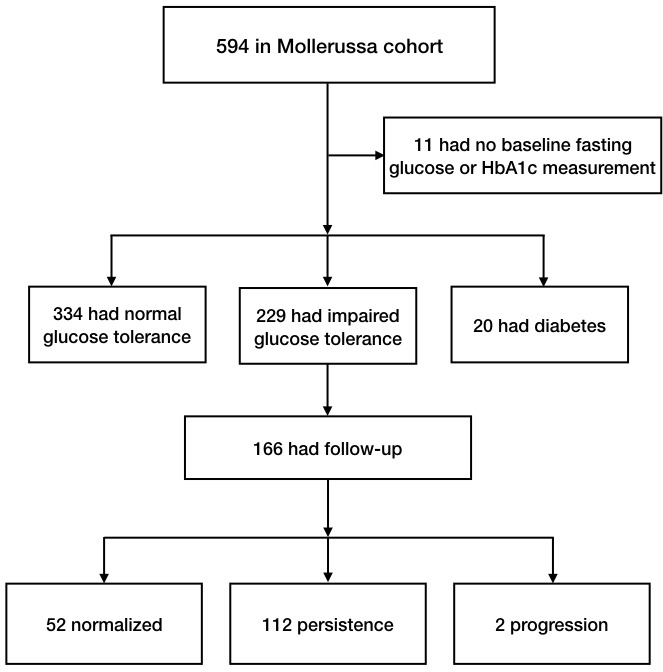
The study included 583 participants without a diagnosis of diabetes recruited between March 2011 and July 2014.
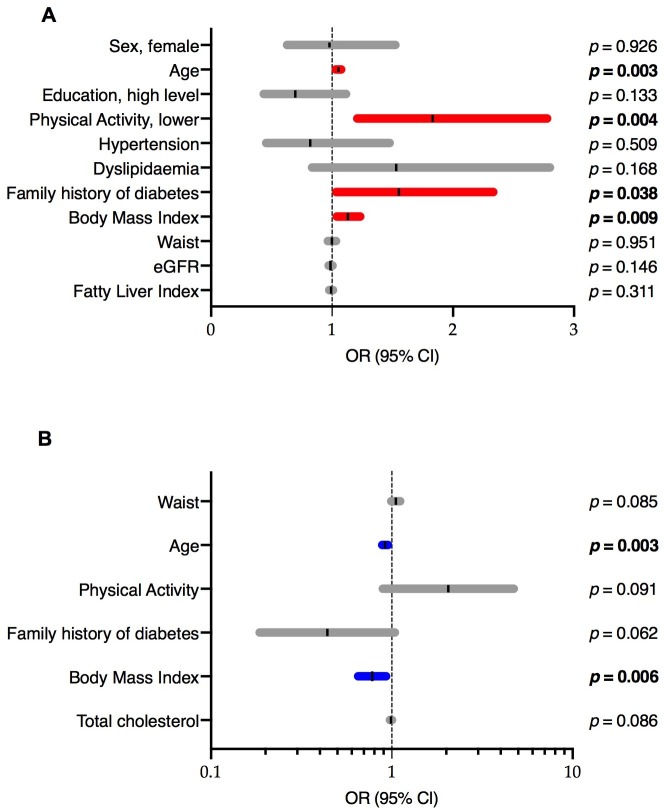
The prevalence of undiagnosed diabetes was 20, 3.4% (95% CI 2.6 to 4.2) and that of pre-diabetes was 229, 39.3% (37.3 to 41.3). Among those with pre-diabetes, 18.3% had isolated impaired fasting plasma glucose (FPG) (FPG: 100 to <126 mg/dL), 58.1% had isolated impaired glycated haemoglobin (HbA1c) (HbA1c 5.7 to <6.5) and 23.6% fulfilled both criteria. Follow-up data were available for 166 subjects; 41.6%(37.8 to 45.4) returned to normoglycaemia, 57.6% (57.8 to 61.4) persisted in pre-diabetes and 0.6% (0 to 1.2) progressed to diabetes. Individuals with pre-diabetes had worse cardiometabolic risk profiles and sociodemographic features than normoglycaemic subjects. In the logistic regression model, variables significantly associated with pre-diabetes were older age (OR; 95% CI) (1.033; 1.011 to 1.056), higher physical activity (0.546; 0.360 to 0.827), body mass index (1.121; 1.029 to 1.222) and a family history of diabetes (1.543; 1.025 to 2.323). The variables significantly associated with glycaemic normalisation were older age (0.948; 0.916 to 0.982) and body mass index (0.779; 0.651 to 0.931).
Among adults in our region, the estimated prevalence of undiagnosed diabetes was 3.4% and that of pre-diabetes was 39.3%. After a 1-year follow-up, a small proportion of subjects (0.6%) with pre-diabetes progressed to diabetes, while a high proportion (41.6%) returned to normoglycaemia. Individuals with pre-diabetes who returned to normoglycaemia were younger and had a lower body mass index.
评估莫勒萨队列中健康人群中未确诊的糖尿病和糖尿病前期的患病率。作为次要目标,确定与这些情况相关的变量,并描述糖尿病前期患者在 1 年随访后血糖状态的变化。
前瞻性观察队列研究。
半农村地区的一般人群。
该研究纳入了 2011 年 3 月至 2014 年 7 月期间招募的 583 名无糖尿病诊断的参与者。
未确诊糖尿病的患病率为 20.3%(95%CI 2.6%至 4.2%),糖尿病前期的患病率为 229.3%(37.3%至 41.3%)。在糖尿病前期患者中,18.3%存在孤立性空腹血糖受损(FPG)(FPG:100 至 <126mg/dL),58.1%存在孤立性糖化血红蛋白受损(HbA1c)(HbA1c 5.7%至 <6.5%),23.6%同时符合这两个标准。有 166 名患者可获得随访数据;41.6%(37.8%至 45.4%)恢复正常血糖,57.6%(57.8%至 61.4%)持续存在糖尿病前期,0.6%(0%至 1.2%)进展为糖尿病。患有糖尿病前期的个体比血糖正常的个体具有更差的代谢风险特征和社会人口统计学特征。在逻辑回归模型中,与糖尿病前期显著相关的变量是年龄较大(OR;95%CI)(1.033;1.011 至 1.056)、更高的身体活动水平(0.546;0.360 至 0.827)、体重指数(1.121;1.029 至 1.222)和糖尿病家族史(1.543;1.025 至 2.323)。与血糖正常化显著相关的变量是年龄较大(0.948;0.916 至 0.982)和体重指数(0.779;0.651 至 0.931)。
在我们地区的成年人中,未确诊糖尿病的估计患病率为 3.4%,糖尿病前期的患病率为 39.3%。经过 1 年的随访,少数(0.6%)糖尿病前期患者进展为糖尿病,而大多数(41.6%)患者恢复正常血糖。恢复正常血糖的糖尿病前期患者年龄较小,体重指数较低。