Jia Zhilong, Zhao Xiaojing, Liu Xiaoshuang, Zhao Le, Jia Qian, Shi Jinlong, Xu Xiao, Hao Lijun, Xu Zhenguo, Zhong Qin, Yu Kang, Cui Saijia, Chen Huining, Guo Jianying, Li Xiang, Han Yang, Song Xinyu, Zhao Chenghui, Bo Xiaochen, Tian Yaping, Wang Weidong, Xie Guotong, Feng Qiang, He Kunlun
Beijing Key Laboratory for Precision Medicine of Chronic Heart Failure, Chinese PLA General Hospital, Beijing, China.
Laboratory of Translational Medicine, Chinese PLA General Hospital, Beijing, China.
mSystems. 2020 Jan 21;5(1):e00660-19. doi: 10.1128/mSystems.00660-19.
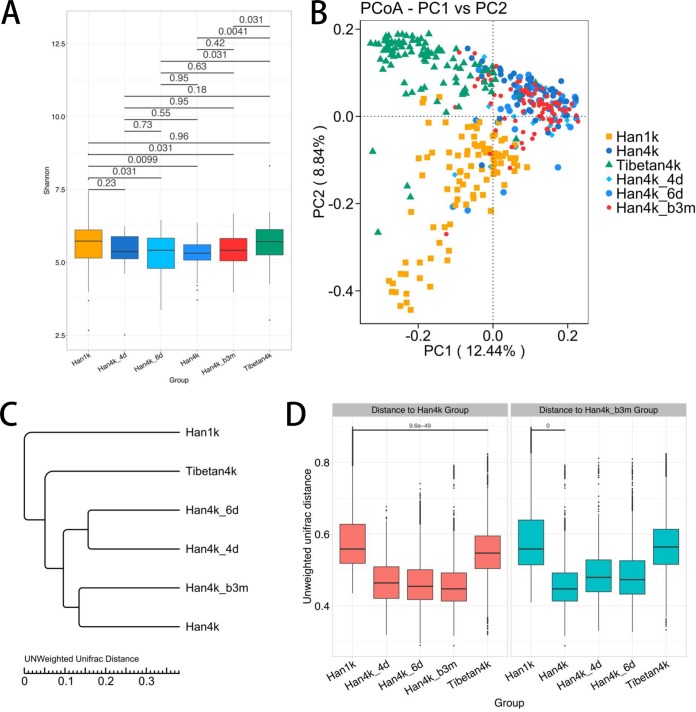
The intestinal microbiota is significantly affected by the external environment, but our understanding of the effects of extreme environments such as plateaus is far from adequate. In this study, we systematically analyzed the variation in the intestinal microbiota and 76 blood clinical indexes among 393 healthy adults with different plateau living durations (Han individuals with no plateau living, with plateau living for 4 to 6 days, with plateau living for >3 months, and who returned to the plain for 3 months, as well as plateau-living Tibetans). The results showed that the high-altitude environment rapidly (4 days) and continually (more than 3 months) shaped both the intestinal microbiota and clinical indexes of the Han population. With prolongation of plateau living, the general characteristics of the intestinal microbiota and clinical indexes of the Han population were increasingly similar to those of the Tibetan population. The intestinal microbiota of the Han population that returned to the plain area for 3 months still resembled that of the plateau-living Han population rather than that of the Han population on the plain. Moreover, clinical indexes such as blood glucose were significantly lower in the plateau groups than in the nonplateau groups, while the opposite result was obtained for testosterone. Interestingly, there were Tibetan-specific correlations between glucose levels and and abundance in the intestine. The results of this study suggest that a hypoxic environment could rapidly and lastingly affect both the human intestinal microbiota and blood clinical indexes, providing new insights for the study of plateau adaptability. The data presented in the present study demonstrate that the hypoxic plateau environment has a profound impact on the gut microbiota and blood clinical indexes in Han and Tibetan individuals. The plateau-changed signatures of the gut microbiota and blood clinical indexes were not restored to the nonplateau status in the Han cohorts, even when the individuals returned to the plain from the plateau for several months. Our study will improve the understanding of the great impact of hypoxic environments on the gut microbiota and blood clinical indexes as well as the adaptation mechanism and intervention targets for plateau adaptation.
肠道微生物群受到外部环境的显著影响,但我们对高原等极端环境的影响了解还远远不够。在本研究中,我们系统分析了393名不同高原居住时长的健康成年人(未在高原居住过的汉族个体、在高原居住4至6天的汉族个体、在高原居住超过3个月的汉族个体、返回平原3个月的汉族个体以及长期居住在高原的藏族个体)的肠道微生物群变化和76项血液临床指标。结果表明,高原环境迅速(4天)且持续(超过3个月)塑造了汉族人群的肠道微生物群和临床指标。随着高原居住时间的延长,汉族人群肠道微生物群和临床指标的总体特征与藏族人群越来越相似。返回平原地区3个月的汉族人群的肠道微生物群仍类似于高原居住的汉族人群,而不是平原地区的汉族人群。此外,高原组的血糖等临床指标显著低于非高原组,而睾酮则相反。有趣的是,肠道中葡萄糖水平与[具体微生物名称1]和[具体微生物名称2]丰度之间存在藏族特有的相关性。本研究结果表明,低氧环境可迅速且持久地影响人类肠道微生物群和血液临床指标,为高原适应性研究提供了新的见解。本研究提供的数据表明,低氧高原环境对汉族和藏族个体的肠道微生物群和血液临床指标有深远影响。即使个体从高原返回平原数月,汉族队列中肠道微生物群和血液临床指标的高原变化特征也未恢复到非高原状态。我们的研究将增进对低氧环境对肠道微生物群和血液临床指标的重大影响以及高原适应机制和干预靶点的理解。