Emergency Department, The Affiliated Wuxi People's Hospital of Nanjing Medical University, No.299 Qingyang Road, Wuxi, 214023, Jiangsu Province, People's Republic of China.
University of California, Santa Cruz, 95064, USA.
BMC Pulm Med. 2023 Mar 8;23(1):78. doi: 10.1186/s12890-023-02365-z.
The risk of death in sepsis patients with acute respiratory distress syndrome (ARDS) was as high as 20-50%. Few studies focused on the risk identification of ARDS among sepsis patients. This study aimed to develop and validate a nomogram to predict the ARDS risk in sepsis patients based on the Medical Information Mart for Intensive Care IV database.
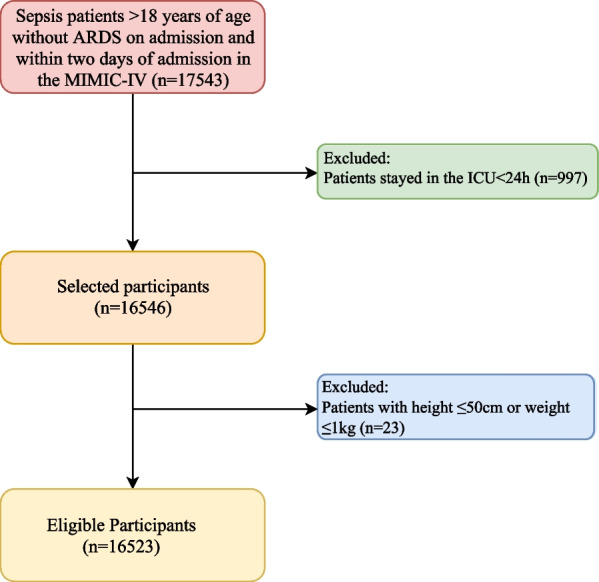
A total of 16,523 sepsis patients were included and randomly divided into the training and testing sets with a ratio of 7:3 in this retrospective cohort study. The outcomes were defined as the occurrence of ARDS for ICU patients with sepsis. Univariate and multivariate logistic regression analyses were used in the training set to identify the factors that were associated with ARDS risk, which were adopted to establish the nomogram. The receiver operating characteristic and calibration curves were used to assess the predictive performance of nomogram.
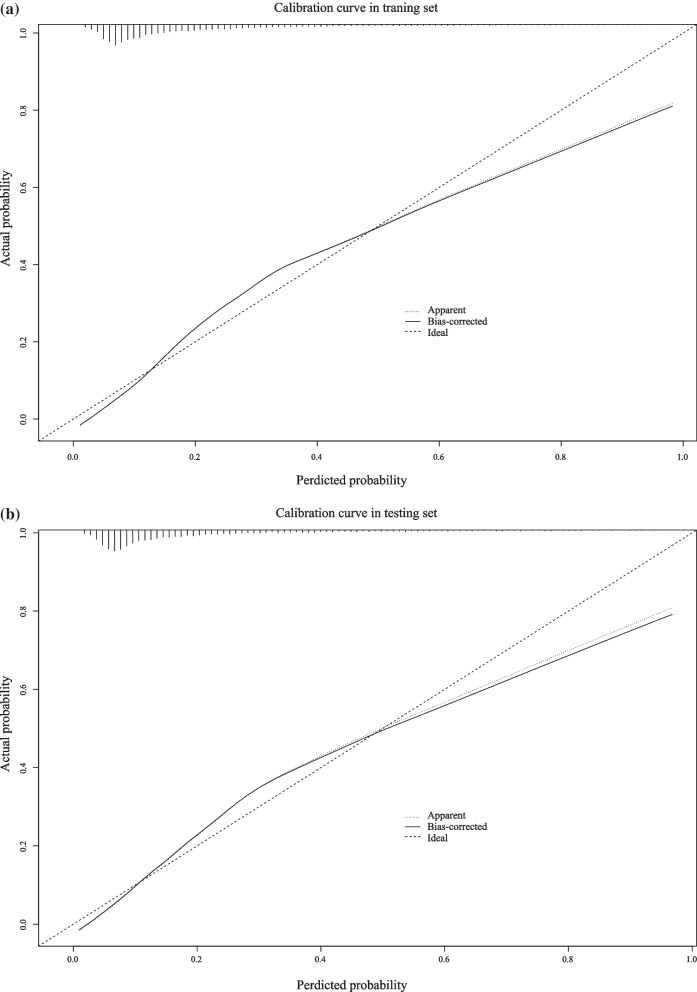
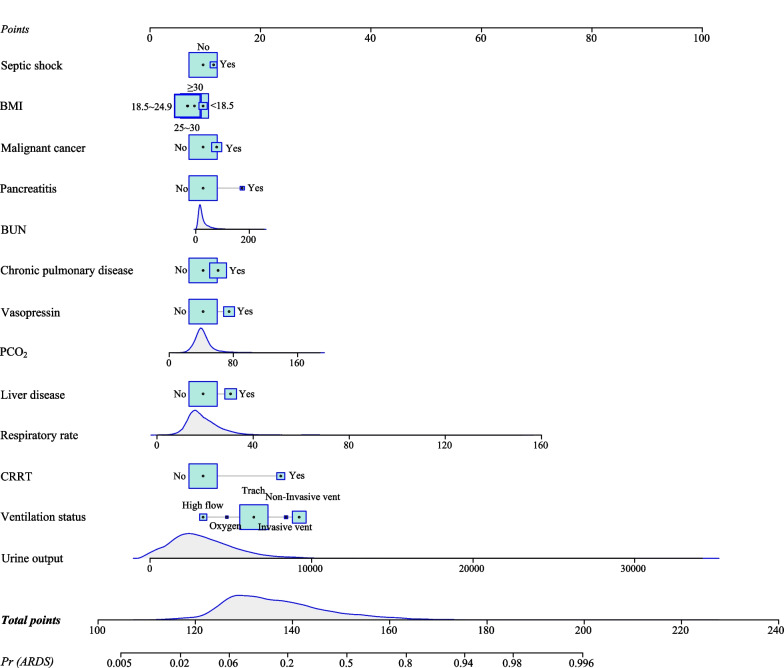
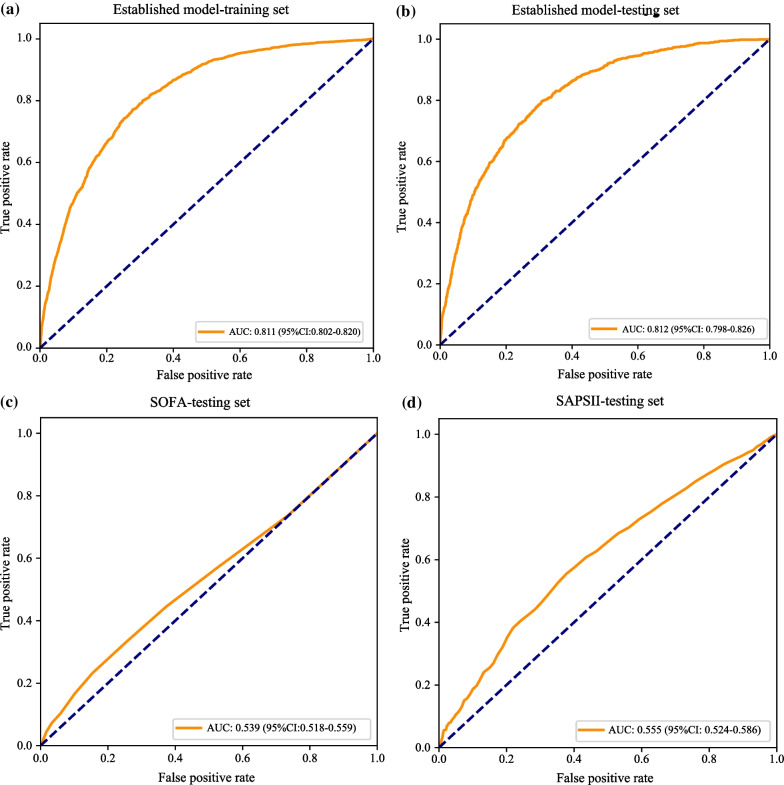
Totally 2422 (20.66%) sepsis patients occurred ARDS, with the median follow-up time of 8.47 (5.20, 16.20) days. The results found that body mass index, respiratory rate, urine output, partial pressure of carbon dioxide, blood urea nitrogen, vasopressin, continuous renal replacement therapy, ventilation status, chronic pulmonary disease, malignant cancer, liver disease, septic shock and pancreatitis might be predictors. The area under the curve of developed model were 0.811 (95% CI 0.802-0.820) in the training set and 0.812 (95% CI 0.798-0.826) in the testing set. The calibration curve showed a good concordance between the predicted and observed ARDS among sepsis patients.
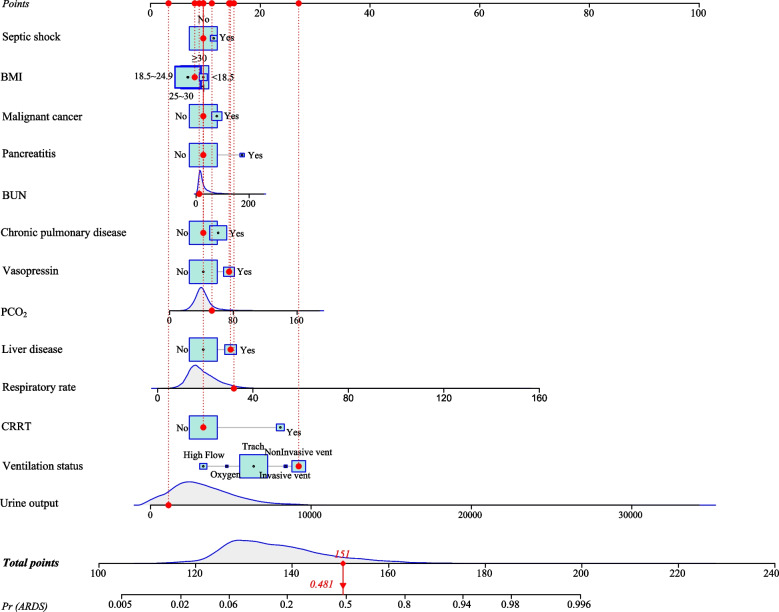
We developed a model incorporating thirteen clinical features to predict the ARDS risk in patients with sepsis. The model showed a good predictive ability by internal validation.
患有急性呼吸窘迫综合征(ARDS)的脓毒症患者的死亡率高达 20-50%。很少有研究关注脓毒症患者中 ARDS 的风险识别。本研究旨在基于医疗信息集市重症监护 IV 数据库开发和验证一种预测脓毒症患者 ARDS 风险的列线图。
这是一项回顾性队列研究,共纳入 16523 例脓毒症患者,并将其随机分为训练集和测试集,比例为 7:3。该研究的结局定义为 ICU 脓毒症患者发生 ARDS。在训练集中,使用单变量和多变量逻辑回归分析来识别与 ARDS 风险相关的因素,并采用这些因素来建立列线图。使用接受者操作特征和校准曲线来评估列线图的预测性能。
共有 2422(20.66%)例脓毒症患者发生 ARDS,中位随访时间为 8.47(5.20,16.20)天。结果发现,体重指数、呼吸频率、尿量、二氧化碳分压、血尿素氮、血管加压素、连续肾脏替代治疗、通气状态、慢性肺部疾病、恶性肿瘤、肝脏疾病、脓毒性休克和胰腺炎可能是预测因素。在训练集中,开发模型的曲线下面积为 0.811(95%CI 0.802-0.820),在测试集中为 0.812(95%CI 0.798-0.826)。校准曲线显示,预测的脓毒症患者 ARDS 与观察到的 ARDS 之间具有良好的一致性。
我们开发了一种包含 13 个临床特征的模型,用于预测脓毒症患者的 ARDS 风险。内部验证表明,该模型具有良好的预测能力。