Population Health Sciences, Bristol Medical School, University of Bristol, Bristol, UK.
Translational Health Sciences, Bristol Medical School, University of Bristol, Bristol, UK.
BMJ Open. 2020 Jan 21;10(1):e031645. doi: 10.1136/bmjopen-2019-031645.
Understanding patients' preferences for treatment is crucial to provision of good care and shared decisions, especially when more than one treatment option exists for a given condition. One such condition is infection of the area around the prosthesis after hip replacement, which affects between 0.4% and 3% of patients. There is more than one treatment option for this major complication, and our study aimed to assess the value that patients place on aspects of revision surgery for periprosthetic hip infection.
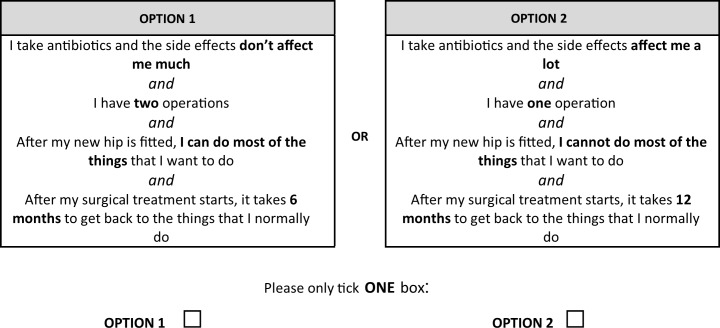
We identified four attributes of revision surgery for periprosthetic hip infection. Using a discrete choice experiment (DCE), we measured the value placed on each attribute by 57 people who had undergone either one-stage or two-stage revision surgery for infection.
The DCE was conducted with participants from nine National Health Service hospitals in the UK.
Adults who had undergone revision surgery for periprosthetic hip infection (N=57).
Overall, the strongest preference was for a surgical option that resulted in no restrictions on engaging in valued activities after a new hip is fitted (β=0.7). Less valued but still important attributes included a shorter time taken from the start of treatment to return to normal activities (6 months; β=0.3), few or no side effects from antibiotics (β=0.2), and having only one operation (β=0.2).
The results highlight that people who have had revision surgery for periprosthetic hip infection most value aspects of care that affect their ability to engage in normal everyday activities. These were the most important characteristics in decisions about revision surgery.
了解患者对治疗方案的偏好对于提供优质护理和共同决策至关重要,尤其是在针对某种疾病存在多种治疗选择的情况下。髋关节置换术后假体周围感染就是这样一种疾病,约有 0.4%至 3%的患者会出现这种情况。对于这种主要并发症,有多种治疗选择,我们的研究旨在评估患者对髋关节假体周围感染翻修手术各方面的重视程度。
我们确定了髋关节假体周围感染翻修手术的四个属性。通过离散选择实验(DCE),我们测量了 57 名接受一期或二期翻修手术治疗感染的患者对每个属性的重视程度。
DCE 在英国 9 家国民保健服务医院的参与者中进行。
接受髋关节假体周围感染翻修手术的成年人(N=57)。
总体而言,患者对不会限制新髋关节安装后参与有价值活动的手术方案的偏好最强(β=0.7)。虽然不太重要但仍很重要的属性包括从治疗开始到恢复正常活动所需的时间更短(6 个月;β=0.3)、抗生素副作用少或无(β=0.2)以及只需进行一次手术(β=0.2)。
结果表明,接受髋关节假体周围感染翻修手术的患者最看重影响其正常日常活动能力的护理方面。这些是翻修手术决策中最重要的特征。