Natural Resources Canada, Canadian Wood Fibre Centre, 1055 rue Du PEPS, P.O. Box 10380, QC, G1V 4C7, Canada.
Canada Research Chair in Forest Genomics, Institute of Systems and Integrative Biology, and Centre for Forest Research, Université Laval, 1030 Avenue de la Médecine, QC, G1V 0A6, Canada.
Heredity (Edinb). 2020 Apr;124(4):562-578. doi: 10.1038/s41437-019-0290-3. Epub 2020 Jan 22.
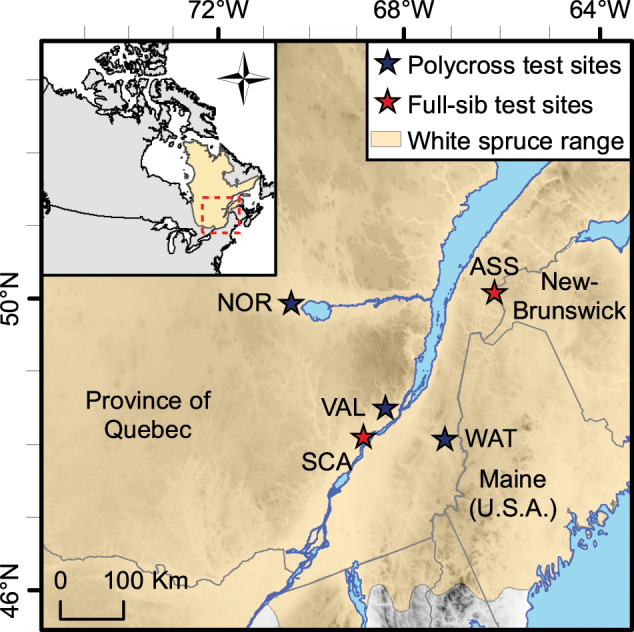
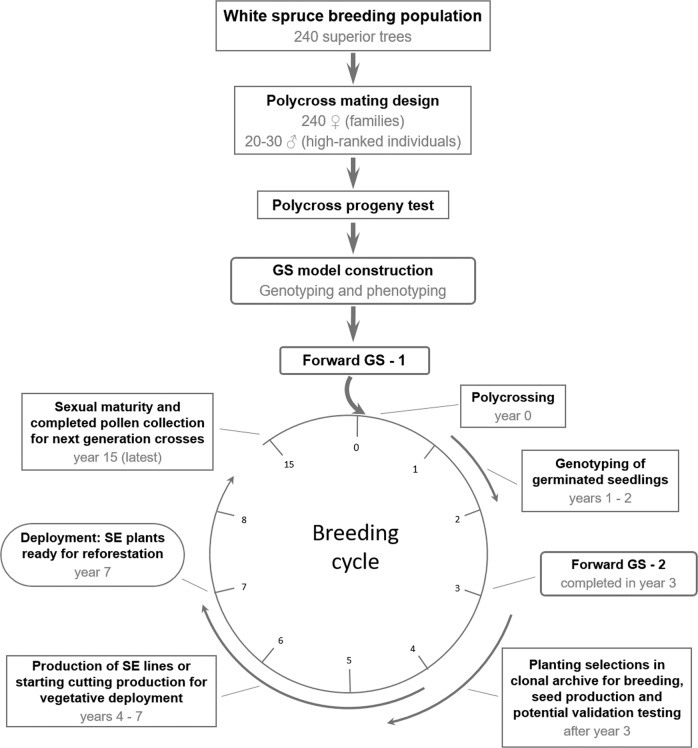
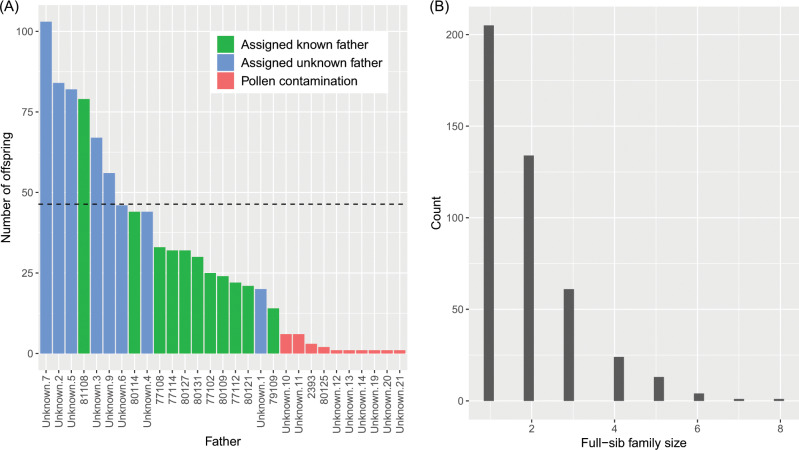
Genomic selection (GS) has a large potential for improving the prediction accuracy of breeding values and significantly reducing the length of breeding cycles. In this context, the choice of mating designs becomes critical to improve the efficiency of breeding operations and to obtain the largest genetic gains per time unit. Polycross mating designs have been traditionally used in tree and plant breeding to perform backward selection of the female parents. The possibility to use genetic markers for paternity identification and for building genomic prediction models should allow for a broader use of polycross tests in forward selection schemes. We compared the accuracies of genomic predictions of offspring's breeding values from a polycross and a full-sib (partial diallel) mating design with similar genetic background in white spruce (Picea glauca). Trees were phenotyped for growth and wood quality traits, and genotyped for 4092 SNPs representing as many gene loci distributed across the 12 spruce chromosomes. For the polycross progeny test, heritability estimates were smaller, but more precise using the genomic BLUP (GBLUP) model as compared with pedigree-based models accounting for the maternal pedigree or for the reconstructed full pedigree. Cross-validations showed that GBLUP predictions were 22-52% more accurate than predictions based on the maternal pedigree, and 5-7% more accurate than predictions using the reconstructed full pedigree. The accuracies of GBLUP predictions were high and in the same range for most traits between the polycross (0.61-0.70) and full-sib progeny tests (0.61-0.74). However, higher genetic gains per time unit were expected from the polycross mating design given the shorter time needed to conduct crosses. Considering the operational advantages of the polycross design in terms of easier handling of crosses and lower associated costs for test establishment, we believe that this mating scheme offers great opportunities for the development and operational application of forward GS.
基因组选择(GS)在提高育种值预测准确性和显著缩短育种周期方面具有巨大潜力。在这种情况下,选择交配设计对于提高育种效率和在单位时间内获得最大遗传增益变得至关重要。多父本杂交设计在树木和植物育种中传统上用于进行母本的反向选择。利用遗传标记进行亲子关系鉴定和构建基因组预测模型的可能性,应该允许更广泛地在正向选择方案中使用多父本杂交试验。我们比较了在白松(Picea glauca)中具有相似遗传背景的多父本和全同胞(部分双列)交配设计的后代育种值的基因组预测准确性。对白松进行了生长和木材质量性状的表型测定,并对 4092 个 SNP 进行了基因型分析,这些 SNP 代表了分布在 12 条云杉染色体上的许多基因座。对于多父本杂交后代试验,与基于系谱的模型相比,使用基因组 BLUP(GBLUP)模型估计的遗传力更小,但更精确,这些模型考虑了母本系谱或重建的完整系谱。交叉验证表明,GBLUP 预测比基于母本系谱的预测准确 22-52%,比使用重建的完整系谱的预测准确 5-7%。GBLUP 预测的准确性很高,在多父本(0.61-0.70)和全同胞后代试验(0.61-0.74)之间大多数性状的预测准确性相似。然而,由于杂交需要的时间更短,预计多父本交配设计的遗传增益更高。考虑到多父本交配设计在杂交处理更容易和相关测试建立成本更低方面的操作优势,我们认为这种交配方案为正向 GS 的开发和操作应用提供了巨大的机会。