Umeå Plant Science Centre, Department of Forest Genetics and Plant Physiology, Swedish University of Agricultural Sciences, SE-90183, Umeå, Sweden.
Skogforsk, Ekebo 2250, SE-268 90, Svalöv, Sweden.
BMC Genomics. 2018 Dec 18;19(1):946. doi: 10.1186/s12864-018-5256-y.
Genomic selection (GS) can increase genetic gain by reducing the length of breeding cycle in forest trees. Here we genotyped 1370 control-pollinated progeny trees from 128 full-sib families in Norway spruce (Picea abies (L.) Karst.), using exome capture as genotyping platform. We used 116,765 high-quality SNPs to develop genomic prediction models for tree height and wood quality traits. We assessed the impact of different genomic prediction methods, genotype-by-environment interaction (G × E), genetic composition, size of the training and validation set, relatedness, and number of SNPs on accuracy and predictive ability (PA) of GS.
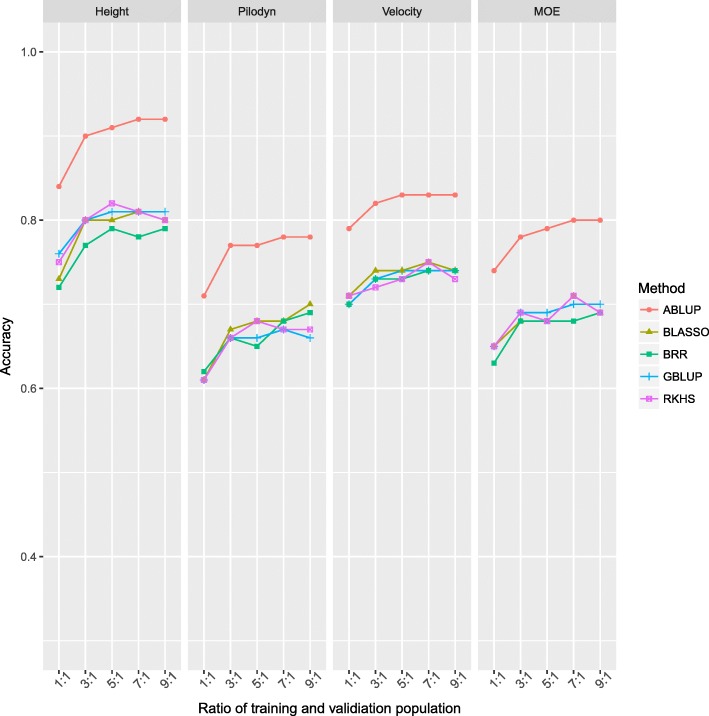
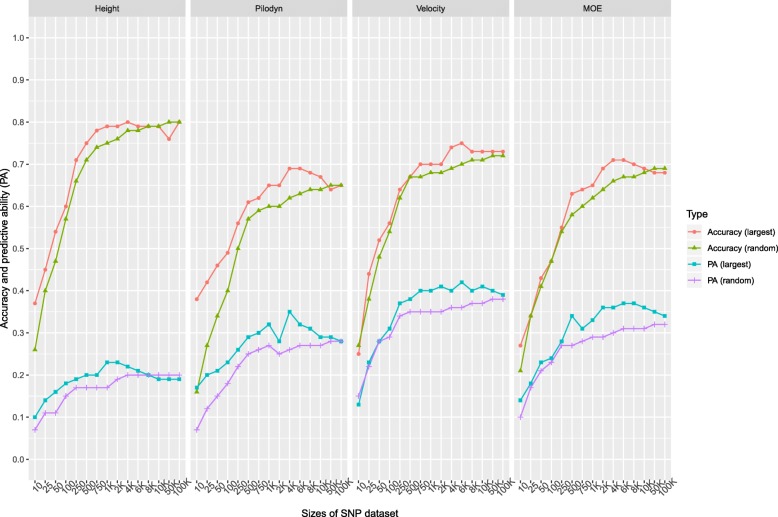
Using G matrix slightly altered heritability estimates relative to pedigree-based method. GS accuracies were about 11-14% lower than those based on pedigree-based selection. The efficiency of GS per year varied from 1.71 to 1.78, compared to that of the pedigree-based model if breeding cycle length was halved using GS. Height GS accuracy decreased to more than 30% while using one site as training for GS prediction and using this model to predict the second site, indicating that G × E for tree height should be accommodated in model fitting. Using a half-sib family structure instead of full-sib structure led to a significant reduction in GS accuracy and PA. The full-sib family structure needed only 750 markers to reach similar accuracy and PA, as compared to 100,000 markers required for the half-sib family, indicating that maintaining the high relatedness in the model improves accuracy and PA. Using 4000-8000 markers in full-sib family structure was sufficient to obtain GS model accuracy and PA for tree height and wood quality traits, almost equivalent to that obtained with all markers.
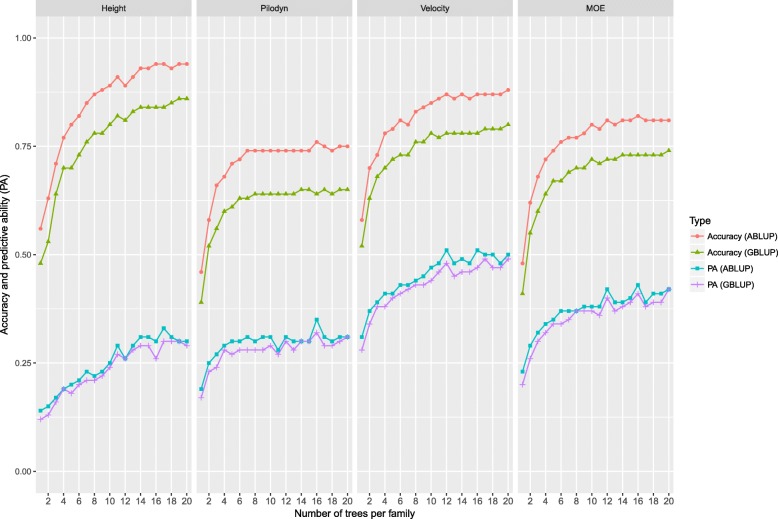
The study indicates that GS would be efficient in reducing generation time of breeding cycle in conifer tree breeding program that requires long-term progeny testing. The sufficient number of trees within-family (16 for growth and 12 for wood quality traits) and number of SNPs (8000) are required for GS with full-sib family relationship. GS methods had little impact on GS efficiency for growth and wood quality traits. GS model should incorporate G × E effect when a strong G × E is detected.
基因组选择(GS)可以通过缩短林木育种周期来提高遗传增益。在这里,我们对 128 个挪威云杉(Picea abies(L.)Karst.)全同胞家系的 1370 株控制授粉后代进行了基因型分析,使用外显子捕获作为基因分型平台。我们使用 116765 个高质量 SNP 来开发树木高度和木材质量性状的基因组预测模型。我们评估了不同基因组预测方法、基因型-环境互作(G×E)、遗传组成、训练和验证集的大小、亲缘关系和 SNP 数量对 GS 准确性和预测能力(PA)的影响。
使用 G 矩阵相对于基于系谱的方法略微改变了遗传力估计值。GS 准确性比基于系谱选择的准确性低 11-14%。如果使用 GS 将育种周期长度减半,GS 的年效率从 1.71 到 1.78 不等。使用一个地点作为 GS 预测的训练地点,然后使用该模型预测第二个地点,导致树木高度的 GS 准确性下降到 30%以上,表明应该在模型拟合中考虑 G×E 对树木高度的影响。使用半同胞家系结构而不是全同胞家系结构会显著降低 GS 的准确性和 PA。全同胞家系结构仅需 750 个标记即可达到与 100000 个标记相当的准确性和 PA,表明在模型中保持高度的亲缘关系可以提高准确性和 PA。在全同胞家系结构中使用 4000-8000 个标记足以获得树木高度和木材质量性状的 GS 模型准确性和 PA,几乎与使用所有标记获得的结果相当。
该研究表明,GS 将在需要长期后代测试的针叶树育种计划中有效缩短育种周期。对于具有全同胞家系关系的 GS,需要足够数量的家系内树木(生长性状 16 株,木材质量性状 12 株)和 SNP 数量(8000 个)。GS 方法对生长和木材质量性状的 GS 效率影响不大。当检测到强烈的 G×E 时,GS 模型应包含 G×E 效应。