Centre for Tropical Crops and Biocommodities, Science and Engineering Faculty, Queensland University of Technology, Brisbane, Queensland, Australia.
Centre for Crop and Disease Management, School of Molecular and Life Sciences, Curtin University, Bentley, Western Australia, Australia.
PLoS One. 2020 Jan 24;15(1):e0227994. doi: 10.1371/journal.pone.0227994. eCollection 2020.
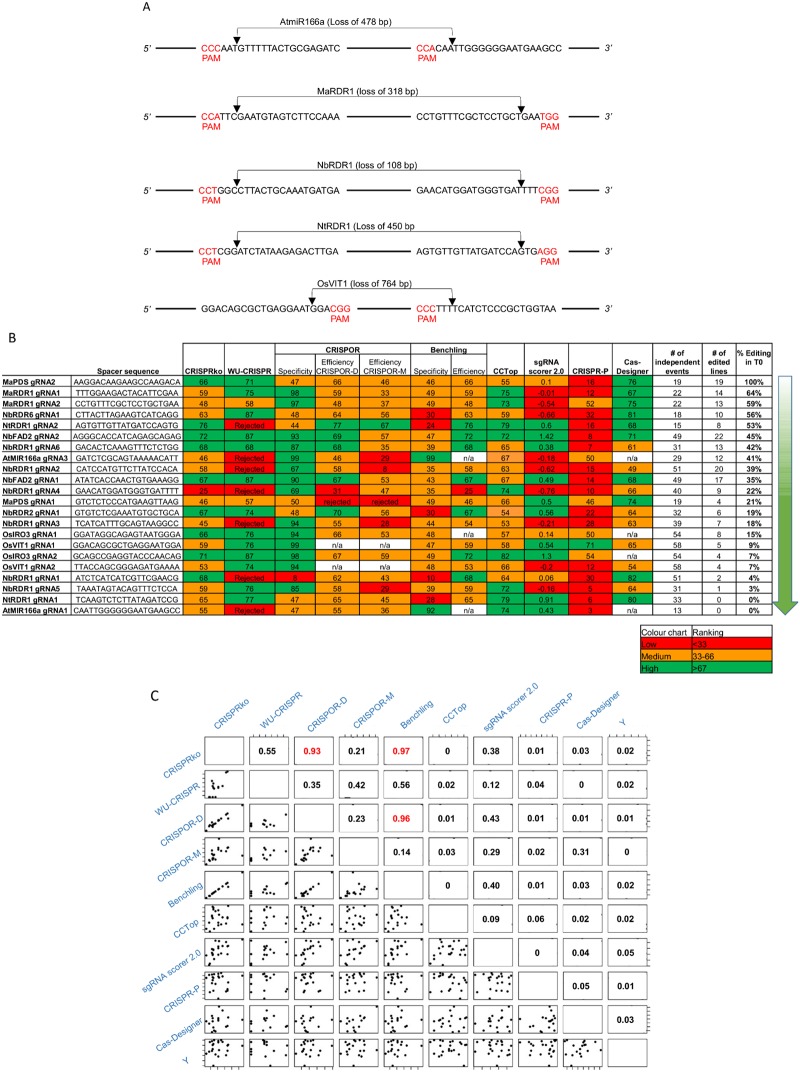
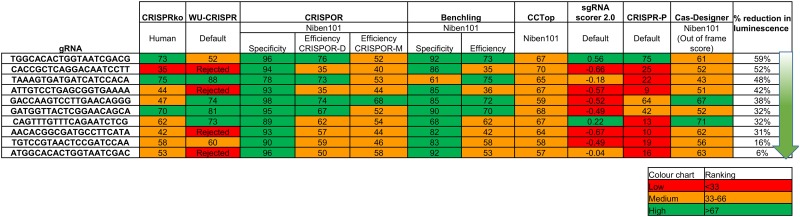
Introducing a new trait into a crop through conventional breeding commonly takes decades, but recently developed genome sequence modification technology has the potential to accelerate this process. One of these new breeding technologies relies on an RNA-directed DNA nuclease (CRISPR/Cas9) to cut the genomic DNA, in vivo, to facilitate the deletion or insertion of sequences. This sequence specific targeting is determined by guide RNAs (gRNAs). However, choosing an optimum gRNA sequence has its challenges. Almost all current gRNA design tools for use in plants are based on data from experiments in animals, although many allow the use of plant genomes to identify potential off-target sites. Here, we examine the predictive uniformity and performance of eight different online gRNA-site tools. Unfortunately, there was little consensus among the rankings by the different algorithms, nor a statistically significant correlation between rankings and in vivo effectiveness. This suggests that important factors affecting gRNA performance and/or target site accessibility, in plants, are yet to be elucidated and incorporated into gRNA-site prediction tools.
通过传统的杂交方法将新的特性引入作物中通常需要几十年的时间,但最近开发的基因组序列修饰技术有可能加速这一过程。这些新的育种技术之一依赖于 RNA 指导的 DNA 核酸酶(CRISPR/Cas9)在体内切割基因组 DNA,以促进序列的缺失或插入。这种序列特异性靶向是由向导 RNA(gRNA)决定的。然而,选择最佳的 gRNA 序列具有一定的挑战性。尽管许多 gRNA 设计工具允许使用植物基因组来识别潜在的脱靶位点,但几乎所有当前用于植物的 gRNA 设计工具都是基于动物实验数据。在这里,我们检查了八种不同在线 gRNA 位点工具的预测一致性和性能。不幸的是,不同算法的排名之间几乎没有共识,也没有排名与体内有效性之间存在统计学上显著的相关性。这表明,影响 gRNA 性能和/或靶位点可及性的重要因素,在植物中,仍有待阐明并纳入 gRNA 位点预测工具。