Beijing Key Laboratory of Gene Resource and Molecular Development, College of Life Sciences, Beijing Normal University, Beijing 100875, China.
Department of Molecular and Cellular Biology, College of Biological Science, University of Guelph, 50 Stone Rd E, Guelph, ON N1G 2W1, Canada.
Cells. 2020 Jan 22;9(2):275. doi: 10.3390/cells9020275.
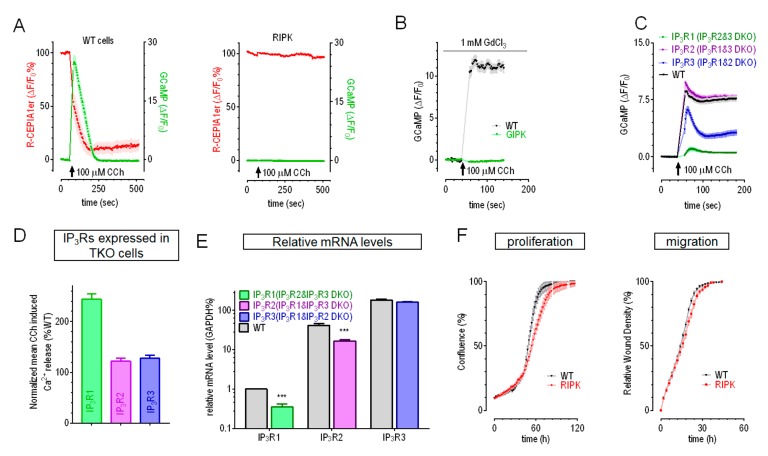
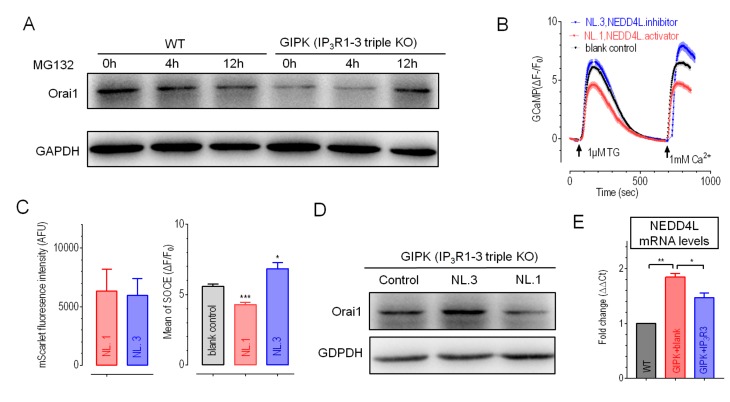
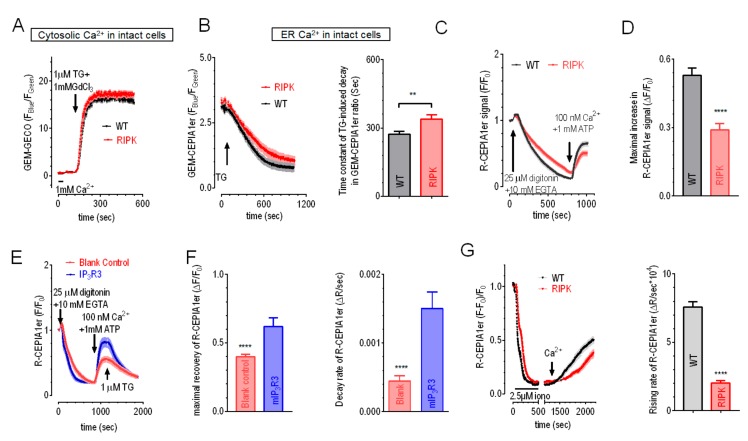
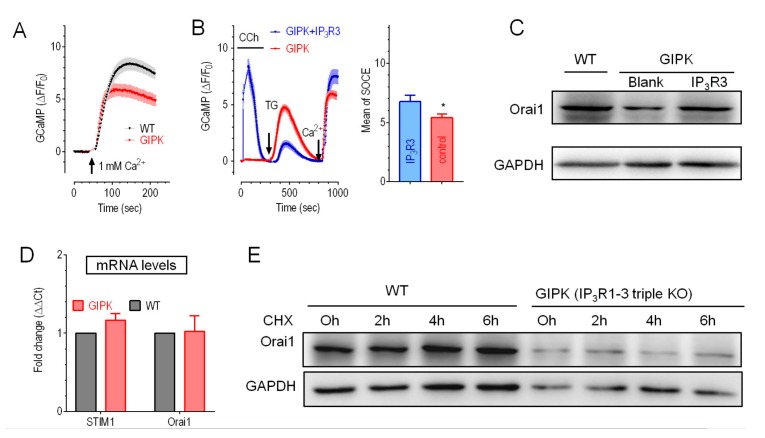
Being the largest the Ca store in mammalian cells, endoplasmic reticulum (ER)-mediated Ca signalling often involves both Ca release via inositol 1, 4, 5-trisphosphate receptors (IPR) and store operated Ca entries (SOCE) through Ca release activated Ca (CRAC) channels on plasma membrane (PM). IPRs are functionally coupled with CRAC channels and other Ca handling proteins. However, it still remains less well defined as to whether IPRs could regulate ER-mediated Ca signals independent of their Ca releasing ability. To address this, we generated IPRs triple and double knockout human embryonic kidney (HEK) cell lines (IPRs-TKO, IPRs-DKO), and systemically examined ER Ca dynamics and CRAC channel activity in these cells. The results showed that the rate of ER Ca leakage and refilling, as well as SOCE were all significantly reduced in IPRs-TKO cells. And these TKO effects could be rescued by over-expression of IPR3. Further, results showed that the diminished SOCE was caused by NEDD4L-mediated ubiquitination of Orai1 protein. Together, our findings indicate that IPR3 is one crucial player in coordinating ER-mediated Ca signalling.
作为哺乳动物细胞中最大的钙库,内质网(ER)介导的钙信号通常涉及通过肌醇 1,4,5-三磷酸受体(IPR)释放 Ca 和通过质膜(PM)上的 Ca 释放激活 Ca(CRAC)通道进行的储存操作 Ca 进入(SOCE)。IPRs 与 CRAC 通道和其他钙处理蛋白在功能上耦联。然而,IPRs 是否能够独立于其 Ca 释放能力来调节 ER 介导的 Ca 信号,仍然不太明确。为了解决这个问题,我们生成了 IPRs 三重和双重敲除的人胚肾(HEK)细胞系(IPRs-TKO、IPRs-DKO),并系统地检查了这些细胞中的 ER Ca 动力学和 CRAC 通道活性。结果表明,IPRs-TKO 细胞中 ER Ca 泄漏和再填充以及 SOCE 的速率均显著降低。并且这些 TKO 效应可以通过过表达 IPR3 来挽救。此外,结果表明,SOCE 的减少是由 NEDD4L 介导的 Orai1 蛋白泛素化引起的。总之,我们的研究结果表明,IPR3 是协调 ER 介导的 Ca 信号的关键因素之一。