Population Health Sciences Institute, Newcastle University Centre for Cancer, Newcastle University, Level 5, Sir James Spence Institute, Royal Victoria Infirmary, Queen Victoria Road, Newcastle, NE1 4LP, UK.
Cancer Research @ UCC, University College Cork, Cork, Ireland.
Support Care Cancer. 2020 Oct;28(10):4813-4824. doi: 10.1007/s00520-019-05268-0. Epub 2020 Jan 24.
Pain, fatigue and depression are common sequelae of a cancer diagnosis. The extent to which these occur together in prostate cancer survivors is unknown. We (i) investigated prevalence of the pain-fatigue-depression symptom cluster and (ii) identified factors associated with experiencing the symptom cluster among prostate cancer survivors.
Men in Ireland diagnosed with prostate cancer 2-18 years previously were identified from population-based cancer registries and sent postal questionnaires. Cancer-related pain and fatigue were measured using the EORTC QLQ-C30 and depression using the DASS-21. Cut-offs to define 'caseness' were pain ≥ 25, fatigue ≥ 39 and depression ≥ 10. Associations between survivor-related factors, clinical variables and specific prostate cancer physical symptoms and the symptom cluster were assessed using multivariate logistic regression.
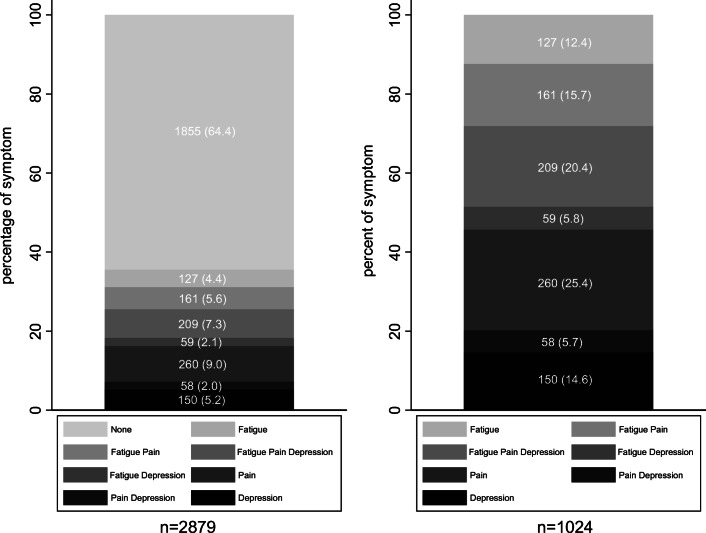
A total of 3348 men participated (response rate = 54%). Twenty-four percent had clinically significant pain, 19.7% had clinically significant fatigue, and 14.4% had depression; 7.3% had all three symptoms. In multivariate analysis, factors significantly associated with the symptom cluster were living in Northern Ireland, experiencing back pain at diagnosis and being affected by incontinence, loss of sexual desire, bowel problems, gynecomastia and hot flashes post-treatment. There was a strong association between the cluster and health-related quality of life.
The pain-fatigue-depression symptom cluster is present in 1 in 13 prostate cancer survivors. Physical after-effects of prostate cancer treatment are associated with this cluster. More attention should be paid to identifying and supporting survivors who experience multiple symptoms; this may help health-related quality of life improve among the growing population of prostate cancer survivors.
疼痛、疲劳和抑郁是癌症诊断后的常见后遗症。前列腺癌幸存者中这些症状同时出现的程度尚不清楚。我们:(i)调查了疼痛-疲劳-抑郁症状群的发生率;(ii)确定了与前列腺癌幸存者出现症状群相关的因素。
从基于人群的癌症登记处确定了在爱尔兰被诊断患有前列腺癌 2-18 年的男性,并向他们发送了邮寄问卷。使用 EORTC QLQ-C30 测量癌症相关疼痛和疲劳,使用 DASS-21 测量抑郁。疼痛≥25、疲劳≥39 和抑郁≥10 的切点用于定义“病例”。使用多变量逻辑回归评估幸存者相关因素、临床变量以及特定的前列腺癌躯体症状与症状群之间的关联。
共有 3348 名男性参与(应答率为 54%)。24%的人有明显的疼痛,19.7%的人有明显的疲劳,14.4%的人有抑郁;7.3%的人有这三种症状。多变量分析显示,与症状群显著相关的因素有居住在北爱尔兰、诊断时有背痛以及受尿失禁、性欲丧失、肠道问题、乳房女性化和治疗后潮热的影响。该症状群与健康相关的生活质量有很强的关联。
13 名前列腺癌幸存者中就有 1 人存在疼痛-疲劳-抑郁症状群。前列腺癌治疗后的身体后遗症与该症状群有关。应该更加关注识别和支持出现多种症状的幸存者;这可能有助于改善不断增长的前列腺癌幸存者群体的健康相关生活质量。