John A. Moran Eye Center at University of Utah, Salt Lake City, UT.
Los Altos Eye Physicians, Los Altos, CA.
Asia Pac J Ophthalmol (Phila). 2020 Jan-Feb;9(1):54-58. doi: 10.1097/01.APO.0000617936.16124.ba.
To determine whether use of a mobile device-based ophthalmic camera by ophthalmic technicians (OTs) in village screening camps in Nepal followed by remote image interpretation by an ophthalmologist can improve detection of ocular pathology and medical decision-making.
Evaluation of mobile device-based ophthalmic camera through study of before and after clinical decision-making.
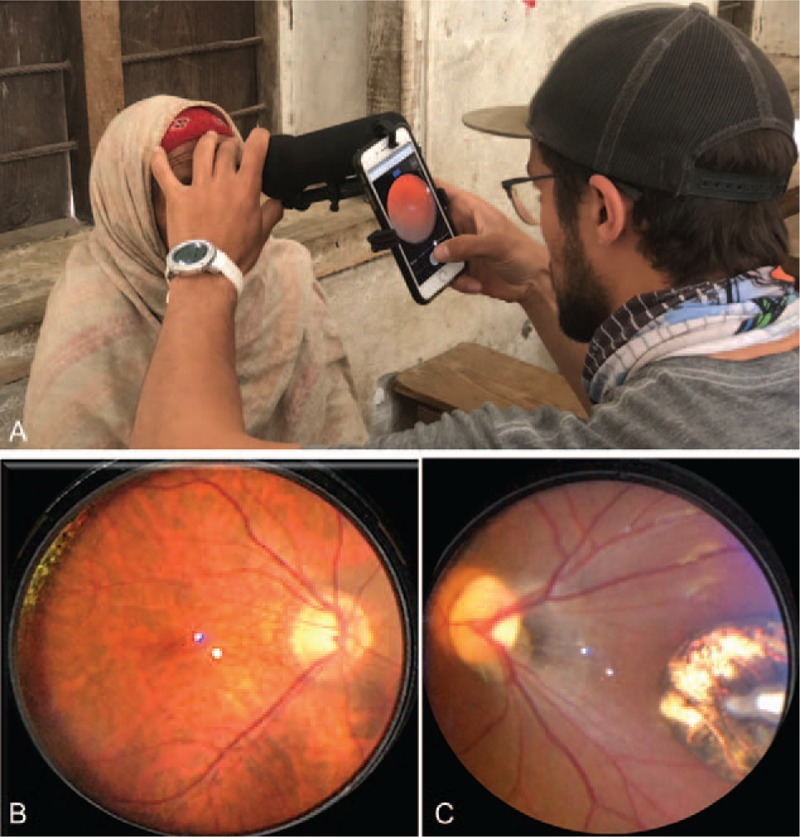
One hundred forty patients over 18 years of age presenting to remote screening camps with best-corrected visual acuity ≤20/60 in one or both eyes were enrolled. Participants were examined by an OT with direct ophthalmoscopy. The technician recorded a diagnosis for each eye and a disposition for each patient. Patients then had anterior segment and fundus photos and/or videos taken using a smartphone-based ophthalmic camera system. Photos and videos were uploaded to a secure, HIPAA-compliant, cloud-based server, and interpreted by masked ophthalmologists from XXX, who independently recorded diagnoses and a disposition for each patient.
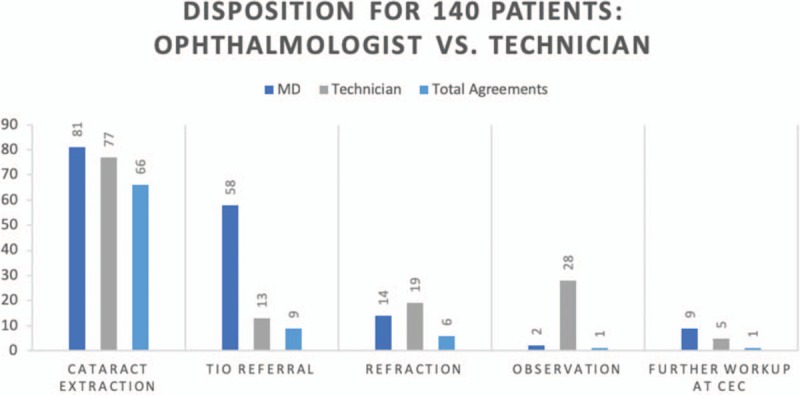
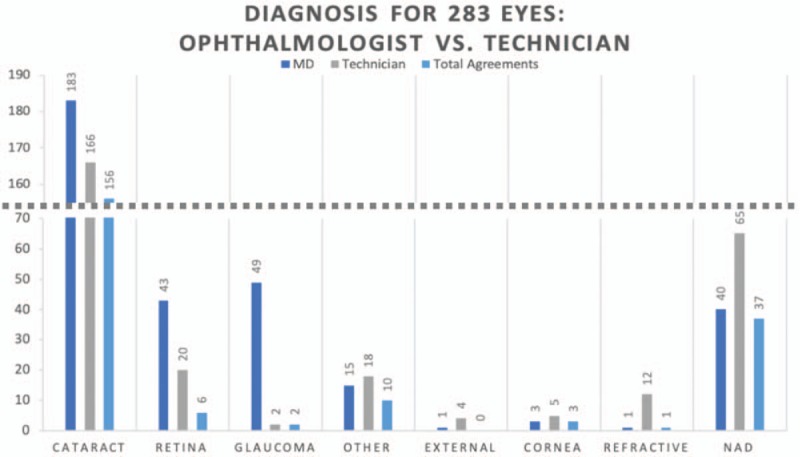
The diagnoses given by OTs and ophthalmologists differed in 42.4% of eyes. Diagnosis agreement was highest for cataract [k = 0.732, 95% confidence interval (CI) 0.65-0.81], but much lower for posterior segment (retina/optic nerve) pathology (k = 0.057, 95% CI -0.03-0.14). Ophthalmologists and OTs suggested different dispositions for 68.6% of patients. Agreement was highest for cataract extraction (k = 0.623, 95% CI 0.49-0.75), whereas agreement for referral to XXX was lower (k = 0.12, 95% CI 0.00-0.24).
Remote ophthalmologist consultation utilizing a mobile device ophthalmic camera system is logistically feasible, easily scalable, and capable of capturing high-quality images in the setting of rural eye screening camps. Although OTs are well equipped to identify and triage anterior segment pathology, this technology may be helpful in the detection of and referral for posterior segment pathology.
确定在尼泊尔的乡村筛查营地中,由眼科技术员(OT)使用基于移动设备的眼科相机,然后由眼科医生进行远程图像解释,是否可以提高眼部病理学的检测和医疗决策能力。
通过对临床决策前后的移动设备眼科相机进行评估。
将 140 名年龄在 18 岁以上的患者纳入研究,这些患者在一只或两只眼睛的最佳矫正视力≤20/60。参与者由 OT 进行直接检眼镜检查。技术员记录每只眼睛的诊断和每位患者的处置。然后,使用基于智能手机的眼科相机系统对患者进行眼前段和眼底拍照和/或录像。照片和视频上传到安全的、符合 HIPAA 标准的云基础服务器,由来自 XXX 的盲法眼科医生进行解释,眼科医生独立记录每位患者的诊断和处置。
OT 和眼科医生的诊断在 42.4%的眼中存在差异。对于白内障的诊断一致性最高[k=0.732,95%置信区间(CI)0.65-0.81],但对于后段(视网膜/视神经)病变的诊断一致性要低得多[k=0.057,95%CI -0.03-0.14]。眼科医生和 OT 为 68.6%的患者提出了不同的处置建议。对于白内障摘除的一致性最高[k=0.623,95%CI 0.49-0.75],而对于转诊至 XXX 的一致性较低[k=0.12,95%CI 0.00-0.24]。
利用移动设备眼科相机系统进行远程眼科医生咨询在后勤上是可行的,易于扩展,并且能够在农村眼部筛查营地中捕获高质量的图像。尽管 OT 非常擅长识别和分诊眼前段病变,但这项技术可能有助于检测和转诊后段病变。