Institute of Vegetable and Floriculture Science, National Agriculture and Food Research Organization (NARO), Fujimoto 2-1, Tsukuba, Ibaraki, 305-0852, Japan.
Japanese Society for the Promotion of Science (JSPS), Tokyo, 102-0083, Japan.
Sci Rep. 2020 Jan 28;10(1):1299. doi: 10.1038/s41598-020-58313-y.
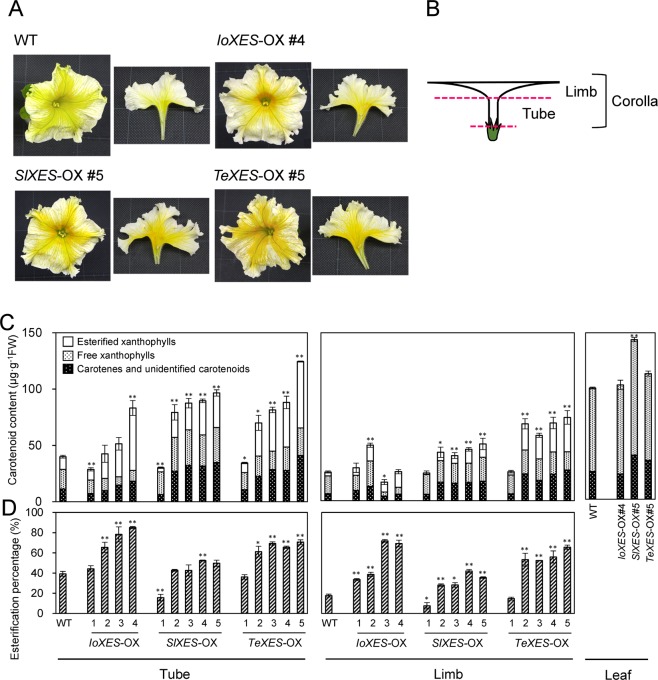
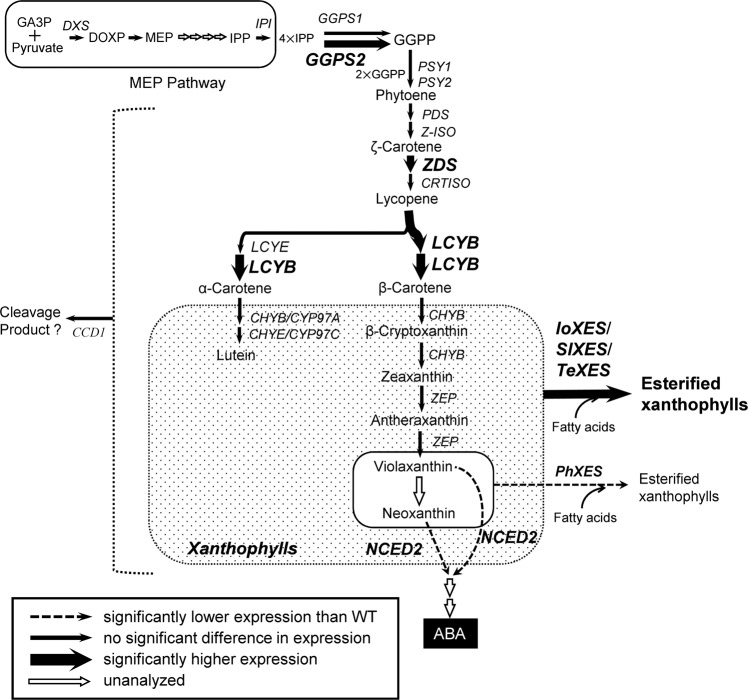
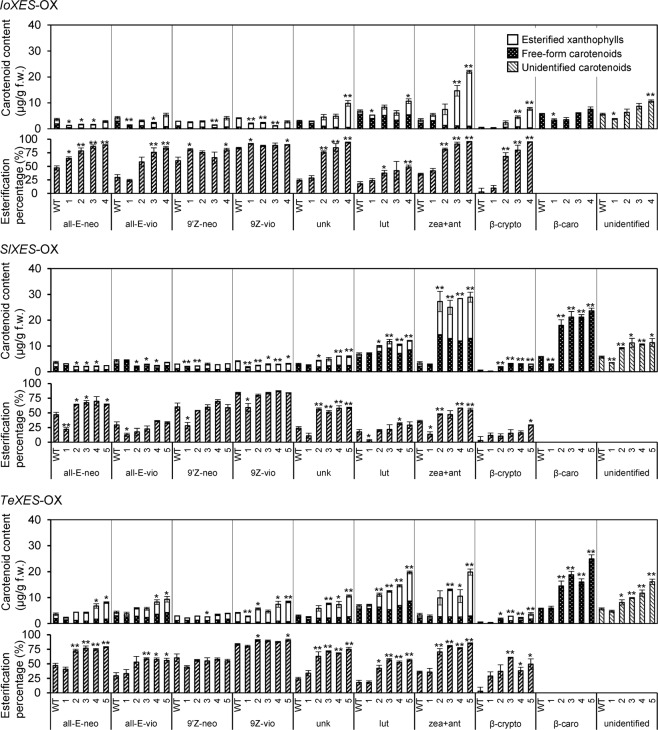
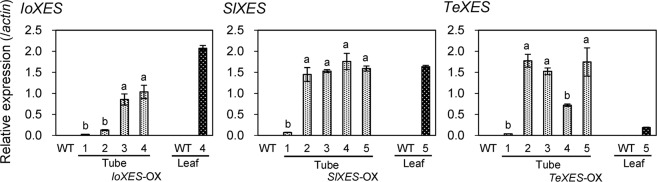
The majority of carotenoids in petals are xanthophylls and most of these xanthophylls are esterified with fatty acids. Although petunia (Petunia x hybrida) is an important ornamental plant, it cannot accumulate enough carotenoids to have deep-yellow flowers. Our previous study suggested that low esterification activity causes low carotenoid accumulation in petunia corollas. Here, we introduced xanthophyll esterase (XES) from the petals of Ipomoea obscura, tomato (Solanum lycopersicum), and marigold (Tagetes erecta) into a pale-yellow-flowered cultivar of petunia to see whether these affect carotenoid accumulation in petunia corollas. Carotenoid contents and the proportions of esterified xanthophylls were elevated in the corollas of XES-overexpressing (XES-OX) transformants. Expression analysis showed that the transcript levels of endogenous carotenoid biosynthetic genes, which included geranylgeranyl diphosphate synthase 2, ζ-carotene desaturase, and lycopene β-ring cyclase in corolla tubes were upregulated in XES-OX plants. In addition, we discovered a difference in the composition of esterified xanthophylls among XES-OX plants, which may be caused by differences in the substrate specificity of their respective XESs. We conclude that esterification is an important process for carotenoid accumulation and XES is a useful tool for the quantitative and qualitative control of carotenoid accumulation in petals.
花瓣中的大多数类胡萝卜素为叶黄素,且大多数叶黄素都与脂肪酸酯化。虽然矮牵牛(Petunia x hybrida)是一种重要的观赏植物,但它不能积累足够的类胡萝卜素来使花朵呈现深黄色。我们之前的研究表明,低酯化活性导致矮牵牛花瓣中类胡萝卜素积累水平较低。在这里,我们将来自Ipomoea obscura、番茄(Solanum lycopersicum)和万寿菊(Tagetes erecta)花瓣的叶黄素酯酶(XES)引入到一个开浅黄色花的矮牵牛品种中,以观察这些基因是否会影响矮牵牛花瓣中的类胡萝卜素积累。过表达 XES(XES-OX)转化体的花瓣中类胡萝卜素含量和酯化叶黄素的比例均升高。表达分析表明,在 XES-OX 植株的花瓣管中,内源性类胡萝卜素生物合成基因的转录水平上调,这些基因包括牻牛儿基牻牛儿焦磷酸合酶 2、ζ-胡萝卜素脱饱和酶和番茄红素 β-环化酶。此外,我们发现 XES-OX 植株中酯化叶黄素的组成存在差异,这可能是由于它们各自的 XES 具有不同的底物特异性所致。我们的结论是,酯化是类胡萝卜素积累的一个重要过程,XES 是定量和定性控制花瓣中类胡萝卜素积累的有用工具。