Department of Psychology, University of Georgia.
Department of Psychiatry and Behavioral Sciences, Emory University School of Medicine.
J Pers Assess. 2021 Mar-Apr;103(2):204-213. doi: 10.1080/00223891.2020.1713138. Epub 2020 Jan 29.
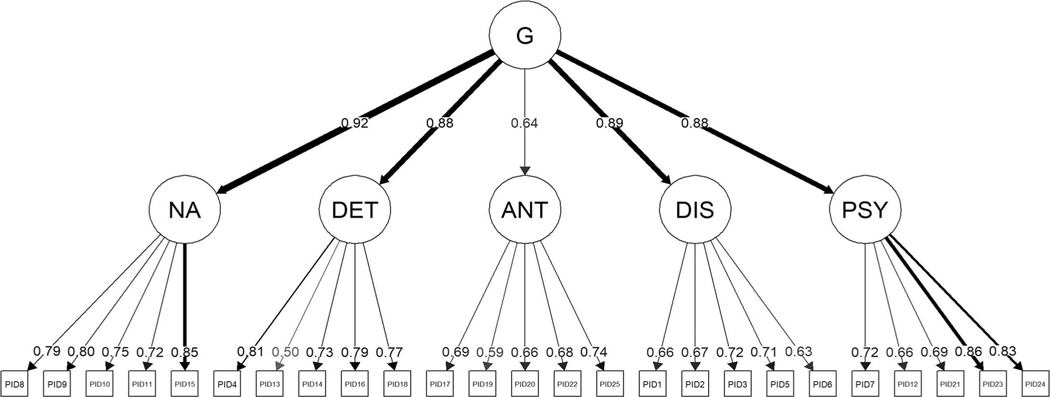
In the current study, we used a sample of predominantly African-American women with high rates of trauma exposure (N = 434) to examine psychometric properties of the Personality Inventory for DSM-5-Brief Form (PID-5-BF). We compared model fit between a model with five correlated latent factors and a higher-order model in which the five latent factors were used to estimate a single "general pathology" factor. Additionally, we computed estimates of internal consistency and domain interrelations and examined indices of convergent/discriminant validity of the PID-5-BF domains by examining their relations to relevant criterion variables. The expected five-factor structure demonstrated good fit indices in a confirmatory factor analysis, and the more parsimonious, higher-order model was retained. Within this higher-order model, the first-order factors accounted for more variance in the criterion variables than the general pathology factor in most instances. The PID-5-BF domains were highly interrelated (s = .38 to .66), and convergent/discriminant validity of the domains varied: and generally showed the hypothesized pattern of relations with external criteria, while and displayed less consistent and discriminant relations. Results are discussed in terms of the costs and benefits of using brief pathological trait measures in samples characterized by high levels of psychopathology.
在当前的研究中,我们使用了一个主要由具有高创伤暴露率的非裔美国女性组成的样本(N=434),来检验 DSM-5-简短形式人格量表(PID-5-BF)的心理计量学特性。我们比较了一个具有五个相关潜在因素的模型和一个高阶模型的拟合度,在高阶模型中,这五个潜在因素被用来估计一个单一的“一般病理”因素。此外,我们计算了 PID-5-BF 各领域的内部一致性和领域间相关性的估计值,并通过考察它们与相关效标变量的关系,检验了 PID-5-BF 各领域的聚合/区别效度指标。预期的五因素结构在验证性因素分析中表现出良好的拟合指数,保留了更简约的高阶模型。在这个高阶模型中,一阶因素在大多数情况下比一般病理因素更能解释效标变量的方差。PID-5-BF 各领域之间高度相关(s=.38 至.66),领域的聚合/区别效度各不相同: 和 通常表现出与外部标准预期的关系模式,而 和 则表现出较少一致和区别的关系。结果从使用具有高精神病理学水平样本的简短病理性特质测量的成本和效益方面进行了讨论。