Hwang Hyun Chan, Kim Sun Mi, Han Doug Hyun, Min Kyoung Joon
Department of Psychiatry, College of Medicine, Chung-Ang University, Seoul, Republic of Korea.
Psychiatry Investig. 2020 Jan;17(1):37-46. doi: 10.30773/pi.2019.0084. Epub 2020 Jan 25.
Coping can be defined as the reactions to harm or distress individuals take to reduce stress. This study aimed to determine how an individual's temperament and character is correlated with the person's main coping method.
The Korean version of the Ways of Coping Questionnaire and Temperament and Character Inventory-Revised-Short Version were used to evaluate the coping strategies and temperament and character of 1,035 people. Four hierarchical linear regression analyses with the scores of each coping strategy subscale as a dependent variable were performed.
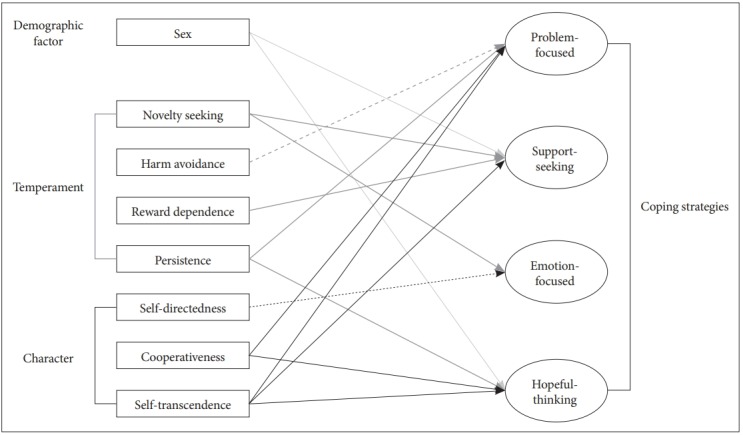
High persistence, cooperativeness, self-transcendence, and low harm avoidance were associated with using a problem-focused coping strategy. Being female, high novelty seeking, reward dependence, and self-transcendence were associated with using a supportseeking coping strategy. High novelty seeking, self-transcendence, and low self-directedness were associated with using emotion-focused coping strategy. Being female, high novelty seeking, persistence, cooperativeness, and self-transcendence were associated with using a hopeful-thinking coping strategy.
Our results show that there may be specific personality features guiding what kind of coping strategy an individual might use in a given situation.
应对可被定义为个体为减轻压力而对伤害或痛苦做出的反应。本研究旨在确定个体的气质和性格如何与该人的主要应对方式相关联。
使用应对方式问卷的韩语版本以及修订版气质与性格量表简版来评估1035人的应对策略、气质和性格。以每种应对策略子量表的得分作为因变量进行了四项分层线性回归分析。
高坚持性、合作性、自我超越以及低伤害回避与采用以问题为中心的应对策略相关。女性、高新奇寻求、奖励依赖和自我超越与采用寻求支持的应对策略相关。高新奇寻求、自我超越和低自我导向与采用以情绪为中心的应对策略相关。女性、高新奇寻求、坚持性、合作性和自我超越与采用乐观思维的应对策略相关。
我们的结果表明,可能存在特定的人格特征指导个体在特定情况下可能使用何种应对策略。