Department of Radiology and Center for Imaging Science, Samsung Medical Center, Sungkyunkwan University School of Medicine, Seoul, Korea.
Department of Radiology and Medical Research Institute, Pusan National University Hospital, Pusan National University School of Medicine, Busan, Korea.
Korean J Radiol. 2020 Feb;21(2):159-171. doi: 10.3348/kjr.2019.0630.
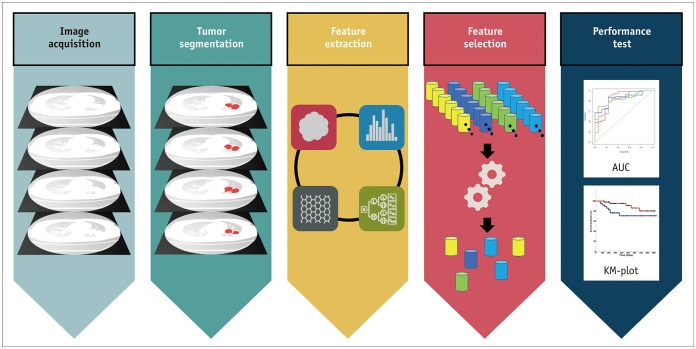
Ideally, radiomics features and radiomics signatures can be used as imaging biomarkers for diagnosis, staging, prognosis, and prediction of tumor response. Thus, the number of published radiomics studies is increasing exponentially, leading to a myriad of new radiomics-based evidence for lung cancer. Consequently, it is challenging for radiologists to keep up with the development of radiomics features and their clinical applications. In this article, we review the basics to advanced radiomics in lung cancer to guide young researchers who are eager to start exploring radiomics investigations. In addition, we also include technical issues of radiomics, because knowledge of the technical aspects of radiomics supports a well-informed interpretation of the use of radiomics in lung cancer.
理想情况下,放射组学特征和放射组学特征可以用作成像生物标志物,用于诊断、分期、预后和预测肿瘤反应。因此,发表的放射组学研究数量呈指数级增长,为肺癌提供了大量新的基于放射组学的证据。因此,放射科医生很难跟上放射组学特征及其临床应用的发展。在本文中,我们回顾了肺癌中放射组学的基础知识和高级知识,以指导那些渴望开始探索放射组学研究的年轻研究人员。此外,我们还包括放射组学的技术问题,因为了解放射组学的技术方面有助于对放射组学在肺癌中的应用有一个明智的解释。