Li Dan, Weng Shanshan, Zhong Chenhan, Tang Xiujun, Zhu Ning, Cheng Yi, Xu Dong, Yuan Ying
Department of Medical Oncology, The Second Affiliated Hospital, Zhejiang University School of Medicine, Hangzhou, China.
Department of Surgical Oncology, The Second Affiliated Hospital, Zhejiang University School of Medicine, Hangzhou, China.
Front Oncol. 2020 Jan 13;9:1426. doi: 10.3389/fonc.2019.01426. eCollection 2019.
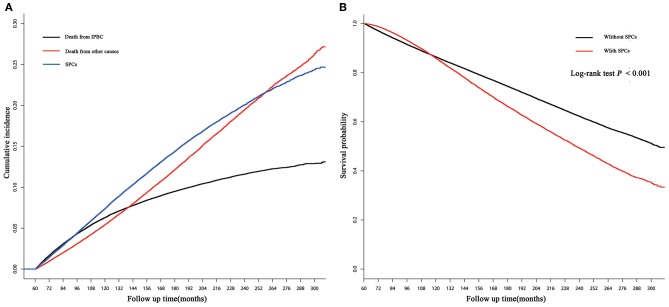
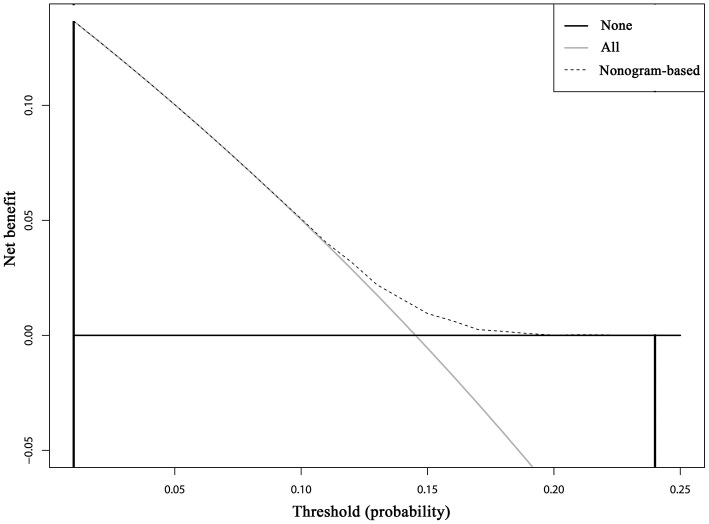
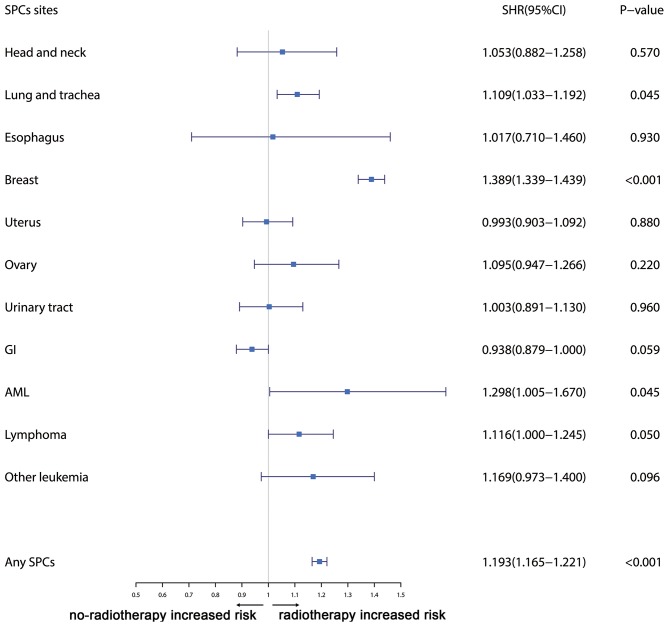
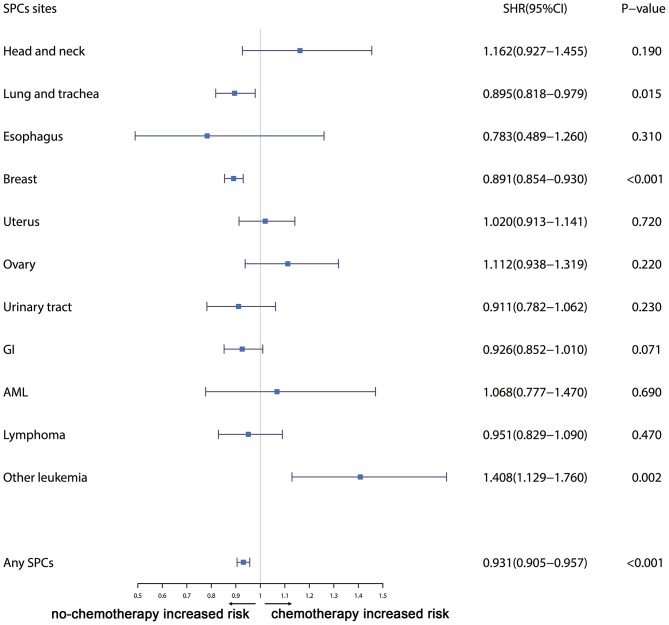
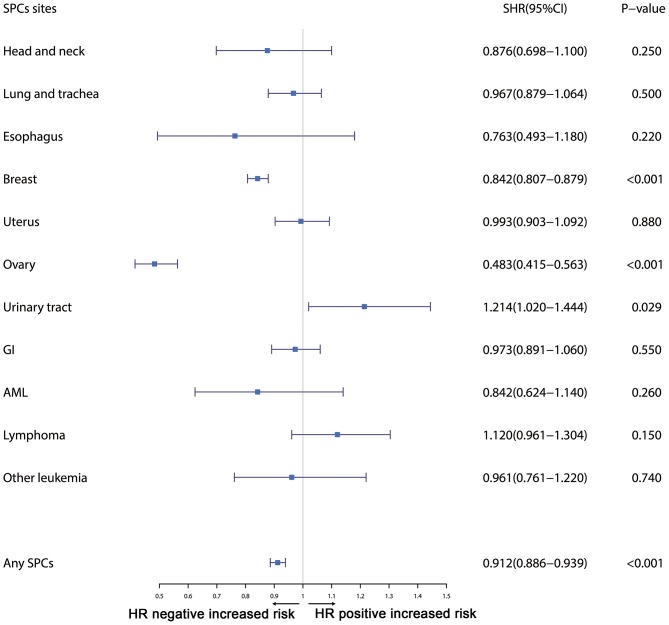
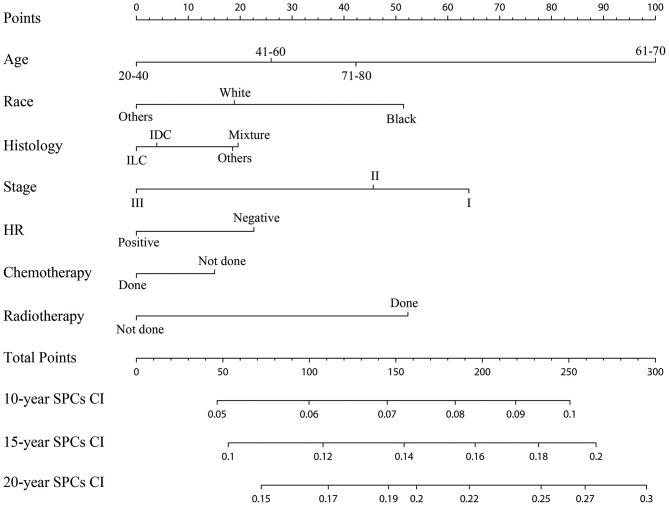
The current study explored the risk of developing second primary cancers (SPCs) among long-term early-stage breast cancer survivors and identified risk factors to build an externally validated clinical prediction model. The cumulative incidence of SPCs was calculated by Gray method among survivors of early-stage initial primary breast cancer (IPBC). Comparisons of treatment-related risk by selected organ sites were performed. A nomogram was established to estimate the individual risk of developing SPCs based on the multivariate Fine and Gray risk model. Decision curve analysis (DCA) was used to evaluate clinical usefulness of the model. The cumulative incidence of developing SPCs after early-stage IPBC was 7.43% at 10 years, 14.41% at 15 years, and 20.08% at 20 years. Radiotherapy was associated with elevated risks of any SPCs and with elevated risks of lung cancer (SHR: 1.109; = 0.045), breast cancer (SHR: 1.389; < 0.001), and AML (SHR: 1.298; = 0.045). Chemotherapy was significantly associated with a declined risk of any SPCs, with decreased risks of lung (SHR: 0.895; = 0.015) and breast cancers (SHR: 0.891; < 0.001), as well as elevated risks of other leukemias (SHR: 1.408; = 0.002). HR-positive status was associated with decreased risks of any SPCs; with decreased risks of breast (SHR: 0.842; < 0.001) and ovarian cancers (SHR: 0.483; < 0.001); and with elevated risks of urinary tract cancers (SHR: 1.214; = 0.029). We found that the cumulative incidence of developing SPCs increased over time and did not plateau. Risk factors for developing SPCs identified by our study were not consistent with those of previous studies. The prediction model can help identify individuals at higher risk of SPCs.
本研究探讨了长期早期乳腺癌幸存者发生第二原发性癌症(SPC)的风险,并确定了风险因素,以建立一个经过外部验证的临床预测模型。采用Gray法计算早期原发性乳腺癌(IPBC)幸存者中SPC的累积发病率。对选定器官部位的治疗相关风险进行了比较。基于多变量Fine和Gray风险模型建立了一个列线图,以估计个体发生SPC的风险。采用决策曲线分析(DCA)评估该模型的临床实用性。早期IPBC后发生SPC的累积发病率在10年时为7.43%,15年时为14.41%,20年时为20.08%。放疗与任何SPC的风险升高以及肺癌(风险比:1.109;P = 0.045)、乳腺癌(风险比:1.389;P < 0.001)和急性髓系白血病(AML,风险比:1.298;P = 0.045)的风险升高相关。化疗与任何SPC的风险显著降低、肺癌(风险比:0.895;P = 0.015)和乳腺癌(风险比:0.891;P < 0.001)的风险降低以及其他白血病的风险升高(风险比:1.408;P = 0.002)相关。HR阳性状态与任何SPC的风险降低相关;与乳腺癌(风险比:0.842;P < 0.001)和卵巢癌(风险比:0.483;P < 0.001)的风险降低相关;与泌尿系统癌症的风险升高(风险比:1.214;P = 0.029)相关。我们发现,发生SPC的累积发病率随时间增加且未达到平台期。我们研究确定的发生SPC的风险因素与先前研究的风险因素不一致。该预测模型有助于识别SPC风险较高的个体。