Wang Da-Yuan, van der Mei Henny C, Ren Yijin, Busscher Henk J, Shi Linqi
State Key Laboratory of Medicinal Chemical Biology, Key Laboratory of Functional Polymer Materials, Ministry of Education, Institute of Polymer Chemistry, College of Chemistry, Nankai University, Tianjin, China.
Department of Biomedical Engineering, University of Groningen and University Medical Center Groningen, Groningen, Netherlands.
Front Chem. 2020 Jan 10;7:872. doi: 10.3389/fchem.2019.00872. eCollection 2019.
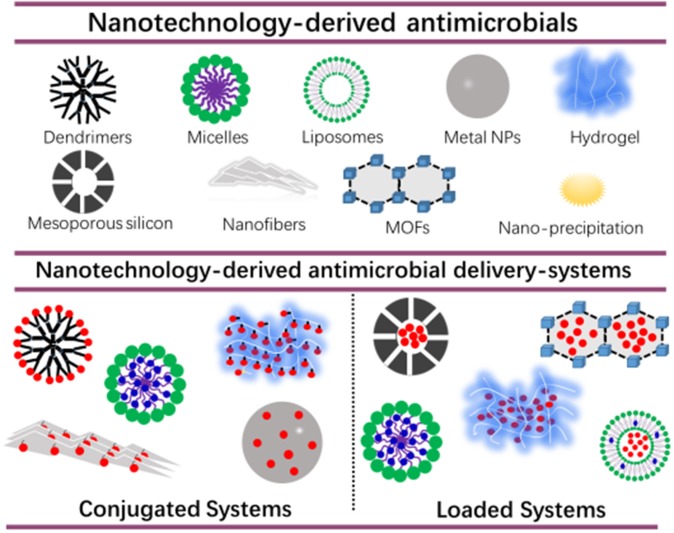
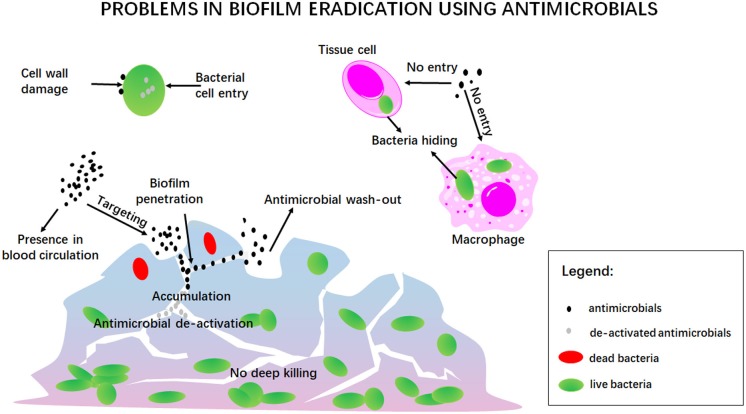
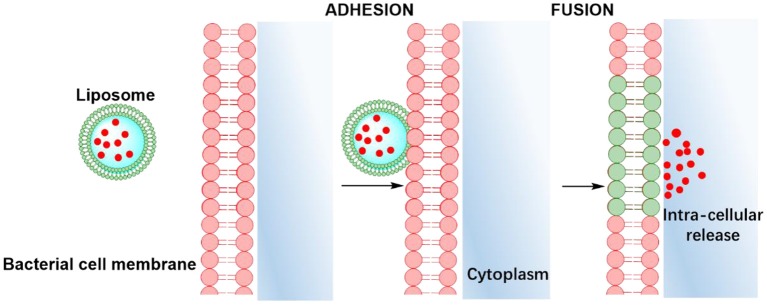
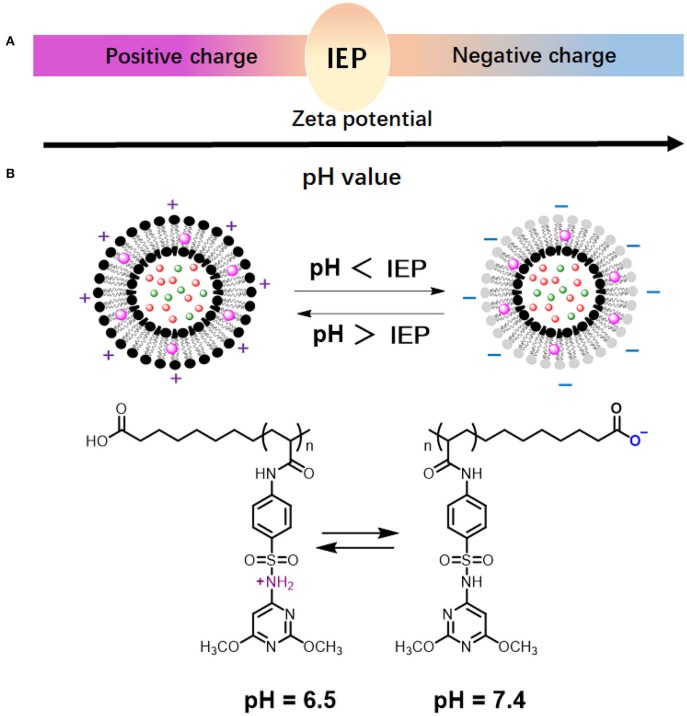
Many nanotechnology-based antimicrobials and antimicrobial-delivery-systems have been developed over the past decades with the aim to provide alternatives to antibiotic treatment of infectious-biofilms across the human body. Antimicrobials can be loaded into nanocarriers to protect them against de-activation, and to reduce their toxicity and potential, harmful side-effects. Moreover, antimicrobial nanocarriers such as micelles, can be equipped with stealth and pH-responsive features that allow self-targeting and accumulation in infectious-biofilms at high concentrations. Micellar and liposomal nanocarriers differ in hydrophilicity of their outer-surface and inner-core. Micelles are self-assembled, spherical core-shell structures composed of single layers of surfactants, with hydrophilic head-groups and hydrophobic tail-groups pointing to the micellar core. Liposomes are composed of lipids, self-assembled into bilayers. The hydrophilic head of the lipids determines the surface properties of liposomes, while the hydrophobic tail, internal to the bilayer, determines the fluidity of liposomal-membranes. Therefore, whereas micelles can only be loaded with hydrophobic antimicrobials, hydrophilic antimicrobials can be encapsulated in the hydrophilic, aqueous core of liposomes and hydrophobic or amphiphilic antimicrobials can be inserted in the phospholipid bilayer. Nanotechnology-derived liposomes can be prepared with diameters <100-200 nm, required to prevent reticulo-endothelial rejection and allow penetration into infectious-biofilms. However, surface-functionalization of liposomes is considerably more difficult than of micelles, which explains while self-targeting, pH-responsive liposomes that find their way through the blood circulation toward infectious-biofilms are still challenging to prepare. Equally, development of liposomes that penetrate over the entire thickness of biofilms to provide deep killing of biofilm inhabitants still provides a challenge. The liposomal phospholipid bilayer easily fuses with bacterial cell membranes to release high antimicrobial-doses directly inside bacteria. Arguably, protection against de-activation of antibiotics in liposomal nanocarriers and their fusogenicity constitute the biggest advantage of liposomal antimicrobial carriers over antimicrobials free in solution. Many Gram-negative and Gram-positive bacterial strains, resistant to specific antibiotics, have been demonstrated to be susceptible to these antibiotics when encapsulated in liposomal nanocarriers. Recently, also progress has been made concerning large-scale production and long-term storage of liposomes. Therewith, the remaining challenges to develop self-targeting liposomes that penetrate, accumulate and kill deeply in infectious-biofilms remain worthwhile to pursue.
在过去几十年里,人们开发了许多基于纳米技术的抗菌剂和抗菌递送系统,旨在为人体感染性生物膜的抗生素治疗提供替代方案。抗菌剂可以装载到纳米载体中,以保护它们不被失活,并降低其毒性和潜在的有害副作用。此外,诸如胶束之类的抗菌纳米载体可以具备隐身和pH响应特性,使其能够在感染性生物膜中实现自我靶向并高浓度积累。胶束纳米载体和脂质体纳米载体在外表面和内核的亲水性方面存在差异。胶束是由单层表面活性剂自组装而成的球形核壳结构,亲水头部基团和疏水尾部基团指向胶束核心。脂质体由脂质组成,自组装成双分子层。脂质的亲水头部决定了脂质体的表面性质,而双分子层内部的疏水尾部决定了脂质体膜的流动性。因此,胶束只能装载疏水性抗菌剂,而亲水性抗菌剂可以封装在脂质体的亲水性水相中,疏水性或两亲性抗菌剂可以插入磷脂双分子层中。源自纳米技术的脂质体可以制备成直径小于100 - 200纳米,这是防止网状内皮系统排斥并允许其渗透到感染性生物膜所必需的。然而,脂质体的表面功能化比胶束要困难得多,这就解释了为什么制备能够通过血液循环到达感染性生物膜的自我靶向、pH响应脂质体仍然具有挑战性。同样,开发能够穿透生物膜整个厚度以深度杀灭生物膜内细菌的脂质体仍然是一个挑战。脂质体的磷脂双分子层很容易与细菌细胞膜融合,从而直接在细菌内部释放高剂量的抗菌剂。可以说,脂质体纳米载体中抗生素的抗失活保护及其融合性是脂质体抗菌载体相对于溶液中游离抗菌剂的最大优势。许多对特定抗生素耐药的革兰氏阴性和革兰氏阳性细菌菌株,当封装在脂质体纳米载体中时,已被证明对这些抗生素敏感。最近,在脂质体的大规模生产和长期储存方面也取得了进展。因此,开发能够在感染性生物膜中穿透、积累并深度杀灭细菌的自我靶向脂质体所面临的剩余挑战仍然值得去攻克。