Gupta Sukrit, Rajapakse Jagath C, Welsch Roy E
School of Computer Science and Engineering, Nanyang Technological University, 639798, Singapore.
School of Computer Science and Engineering, Nanyang Technological University, 639798, Singapore.
Neuroimage Clin. 2020;25:102186. doi: 10.1016/j.nicl.2020.102186. Epub 2020 Jan 17.
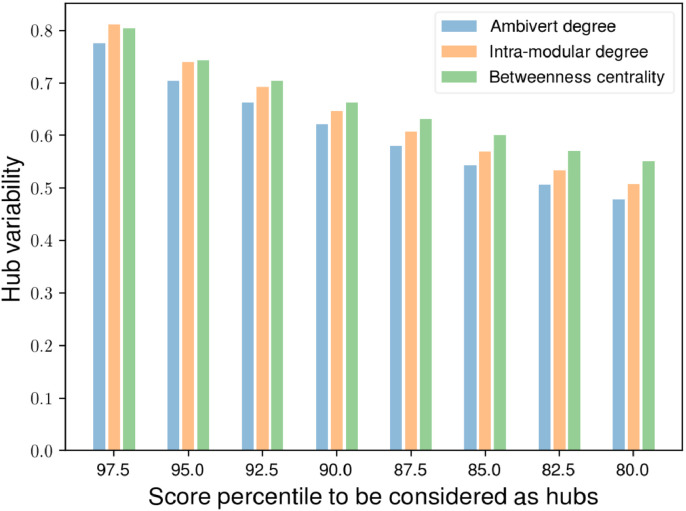
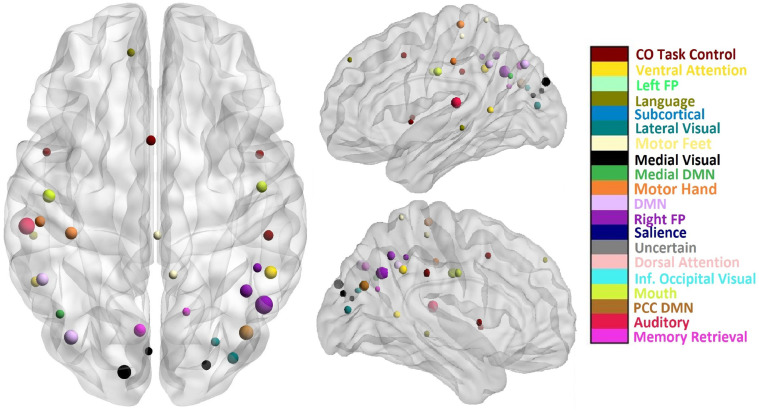
Functional modules in the human brain support its drive for specialization whereas brain hubs act as focal points for information integration. Brain hubs are brain regions that have a large number of both within and between module connections. We argue that weak connections in brain functional networks lead to misclassification of brain regions as hubs. In order to resolve this, we propose a new measure called ambivert degree that considers the node's degree as well as connection weights in order to identify nodes with both high degree and high connection weights as hubs. Using resting-state functional MRI scans from the Human Connectome Project, we show that ambivert degree identifies brain hubs that are not only crucial but also invariable across subjects. We hypothesize that nodal measures based on ambivert degree can be effectively used to classify patients from healthy controls for diseases that are known to have widespread hub disruption. Using patient data for Alzheimer's Disease and Autism Spectrum Disorder, we show that the hubs in the patient and healthy groups are very different for both the diseases and deep feedforward neural networks trained on nodal hub features lead to a significantly higher classification accuracy with significantly fewer trainable weights compared to using functional connectivity features. Thus, the ambivert degree improves identification of crucial brain hubs in healthy subjects and can be used as a diagnostic feature to detect neurological diseases characterized by hub disruption.
人类大脑中的功能模块支持其专业化驱动,而脑枢纽则作为信息整合的焦点。脑枢纽是在模块内部和模块之间都有大量连接的脑区。我们认为,脑功能网络中的弱连接会导致脑区被误分类为枢纽。为了解决这个问题,我们提出了一种新的度量方法,称为“兼性程度”,它同时考虑节点的度和连接权重,以便将具有高度和高连接权重的节点识别为枢纽。使用来自人类连接组计划的静息态功能磁共振成像扫描数据,我们表明兼性程度能够识别出不仅至关重要而且在不同个体间具有稳定性的脑枢纽。我们假设,基于兼性程度的节点度量方法可以有效地用于将患有已知存在广泛枢纽破坏疾病的患者与健康对照进行分类。利用阿尔茨海默病和自闭症谱系障碍的患者数据,我们发现,对于这两种疾病,患者组和健康组中的枢纽差异很大,并且与使用功能连接特征相比,基于节点枢纽特征训练的深度前馈神经网络在可训练权重显著减少的情况下,能够实现显著更高的分类准确率。因此,兼性程度提高了对健康受试者中关键脑枢纽的识别能力,并可作为一种诊断特征来检测以枢纽破坏为特征的神经系统疾病。