Institute of Systems Engineering and Information Technology, Federal University of Itajubá (UNIFEI), Itajubá, 37500-903, Brazil.
Department of Computing, Federal Institute of Education, Science and Technology of South of Minas Gerais (IFSULDEMINAS), Machado, 37750-000, Brazil.
Sci Rep. 2022 Apr 11;12(1):6030. doi: 10.1038/s41598-022-09821-6.
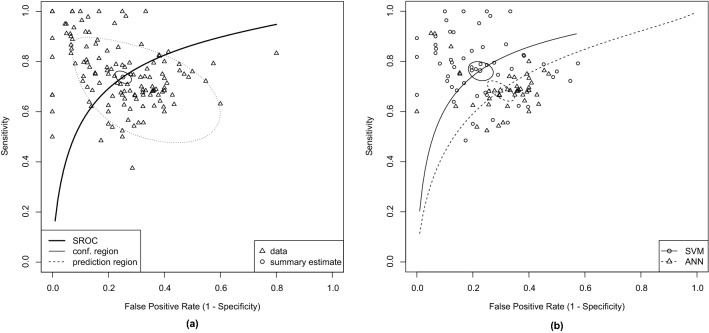
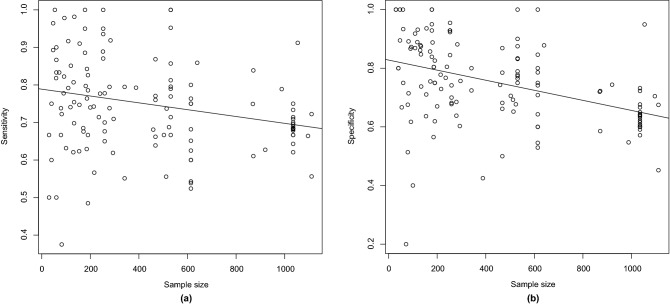
Autism Spectrum Disorder (ASD) diagnosis is still based on behavioral criteria through a lengthy and time-consuming process. Much effort is being made to identify brain imaging biomarkers and develop tools that could facilitate its diagnosis. In particular, using Machine Learning classifiers based on resting-state fMRI (rs-fMRI) data is promising, but there is an ongoing need for further research on their accuracy and reliability. Therefore, we conducted a systematic review and meta-analysis to summarize the available evidence in the literature so far. A bivariate random-effects meta-analytic model was implemented to investigate the sensitivity and specificity across the 55 studies that offered sufficient information for quantitative analysis. Our results indicated overall summary sensitivity and specificity estimates of 73.8% and 74.8%, respectively. SVM stood out as the most used classifier, presenting summary estimates above 76%. Studies with bigger samples tended to obtain worse accuracies, except in the subgroup analysis for ANN classifiers. The use of other brain imaging or phenotypic data to complement rs-fMRI information seems promising, achieving higher sensitivities when compared to rs-fMRI data alone (84.7% versus 72.8%). Finally, our analysis showed AUC values between acceptable and excellent. Still, given the many limitations indicated in our study, further well-designed studies are warranted to extend the potential use of those classification algorithms to clinical settings.
自闭症谱系障碍 (ASD) 的诊断仍然基于行为标准,通过冗长且耗时的过程。目前正在努力确定脑影像学生物标志物并开发有助于诊断的工具。特别是,使用基于静息状态 fMRI (rs-fMRI) 数据的机器学习分类器很有前景,但需要进一步研究其准确性和可靠性。因此,我们进行了系统评价和荟萃分析,以总结迄今为止文献中可用的证据。实施了双变量随机效应荟萃分析模型,以调查在提供定量分析所需足够信息的 55 项研究中分类器的敏感性和特异性。我们的结果表明,总体汇总敏感性和特异性估计值分别为 73.8%和 74.8%。SVM 是最常用的分类器,其汇总估计值高于 76%。除了人工神经网络分类器的亚组分析外,样本量较大的研究往往准确性较差。使用其他脑影像学或表型数据来补充 rs-fMRI 信息似乎很有前景,与仅使用 rs-fMRI 数据相比,获得更高的敏感性(84.7%对 72.8%)。最后,我们的分析显示 AUC 值在可接受和优秀之间。尽管如此,鉴于我们研究中指出的许多局限性,仍需要进一步精心设计的研究来扩展这些分类算法在临床环境中的潜在用途。