Department of Internal Medicine and Nephrology, Faculty of Medicine, Alexandria University, Alexandria, Egypt.
Department of Renal Medicine, Salford Royal NHS Foundation Trust, Salford, United Kingdom.
PLoS One. 2020 Jan 31;15(1):e0228101. doi: 10.1371/journal.pone.0228101. eCollection 2020.
The R102G variant in complement 3 (C3) results in two allotypic variants: C3 fast (C3F) and C3 slow (C3S). C3F presents at increased frequency in patients with chronic kidney disease (CKD), our aim is to explore its role in CKD progression and mortality.
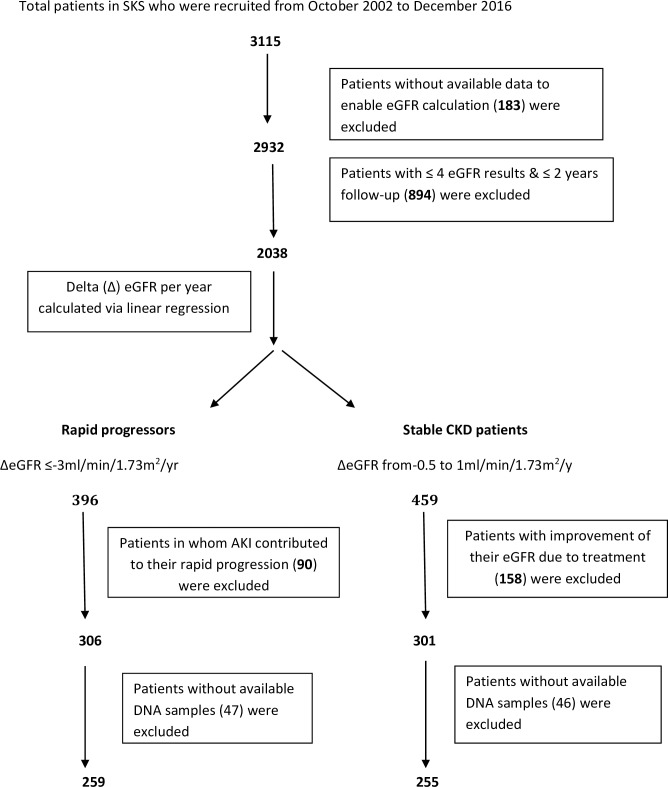
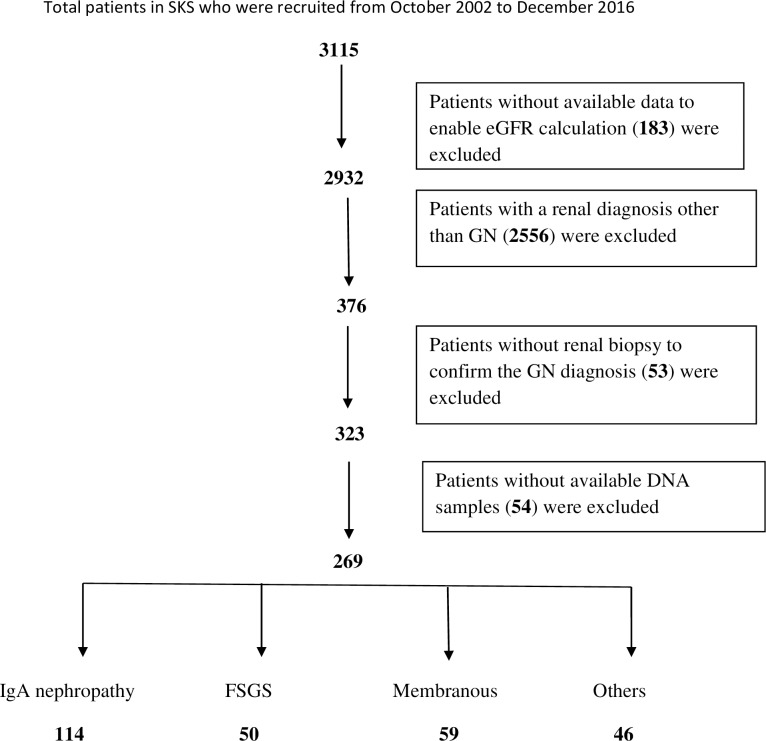
Delta (Δ) eGFR for 2038 patients in the Salford Kidney Study (SKS) was calculated by linear regression; those with ≤-3ml/min/1.73m2/yr were defined as rapid progressors (RP) and those with ΔeGFR between -0.5 and +1ml/min/1.73m2/yr, labelled stable CKD patients (SP).A group of 454 volunteers was used as a control group. In addition, all biopsy-proven glomerulonephritis (GN) patients were studied regardless of their ΔeGFR. R102G was analysed by real-time PCR, and genotypic and allelic frequencies were compared between RP and SP along with the healthy control group.
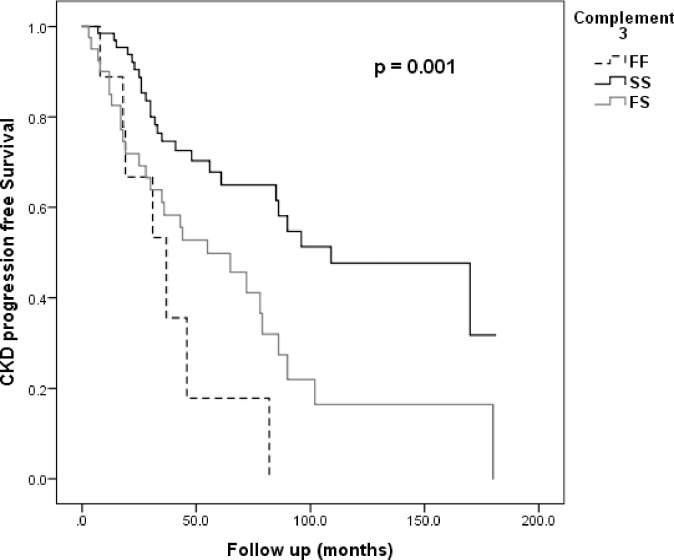
There were 255 SP and 259 RP in the final cohort. Median ΔeGFR was 0.07 vs. -4.7 ml/min/1.73m2/yr in SP vs. RP. C3F allele frequency was found to be significantly higher in our CKD cohort (25.7%) compared with the healthy control group (20.6%); p = 0.008.However, there was no significant difference in C3F allele frequency between the RP and SP groups. In a subgroup analysis of 37 patients with IgA nephropathy in the CKD cohort (21 RP and 16 SP), there was a significantly higher frequency of C3F in RP 40.5% vs. 9.4% in SP; p = 0.003. In the GN group, Cox regression showed an association between C3F and progression only in those with IgA nephropathy (n = 114);HR = 1.9 (95% CI 1.1-3.1; p = 0.018) for individuals heterozygous for the C3F variant, increased further for individuals homozygous for the variant, HR = 2.8 (95% CI 1.2-6.2; p = 0.014).
The C3 variant R102G is associated with progression of CKD in patients with IgA nephropathy.
补体 3(C3)中的 R102G 变体导致两种同种异型变体:C3 快(C3F)和 C3 慢(C3S)。C3F 在慢性肾脏病(CKD)患者中的频率增加,我们的目的是探讨其在 CKD 进展和死亡中的作用。
通过线性回归计算 2038 名萨尔福德肾脏研究(SKS)患者的 ΔeGFR;那些 ΔeGFR≤-3ml/min/1.73m2/yr 的被定义为快速进展者(RP),而 ΔeGFR 在-0.5 到+1ml/min/1.73m2/yr 之间的被定义为稳定 CKD 患者(SP)。一组 454 名志愿者作为对照组。此外,无论其 ΔeGFR 如何,所有经活检证实的肾小球肾炎(GN)患者均被研究。通过实时 PCR 分析 R102G,比较 RP 和 SP 以及健康对照组之间的基因型和等位基因频率。
最终队列中共有 255 名 SP 和 259 名 RP。中位 ΔeGFR 为 0.07 vs. SP 中的-4.7 ml/min/1.73m2/yr。与健康对照组(20.6%)相比,我们的 CKD 队列中 C3F 等位基因频率明显更高(25.7%);p=0.008。然而,RP 和 SP 组之间的 C3F 等位基因频率没有显著差异。在 CKD 队列中 IgA 肾病的 37 名患者亚组分析中(21 名 RP 和 16 名 SP),RP 中 C3F 的频率明显更高,为 40.5%,而 SP 中为 9.4%;p=0.003。在 GN 组中,Cox 回归显示 C3F 与进展之间存在关联,仅在 IgA 肾病患者中(n=114);HR=1.9(95%CI 1.1-3.1;p=0.018),杂合子变异体患者进一步增加,HR=2.8(95%CI 1.2-6.2;p=0.014)。
C3 变体 R102G 与 IgA 肾病患者 CKD 的进展有关。