Department of Oriental Neuropsychiatry, Graduate School of Oriental Medicine, Dongguk University, Goyang, Republic of Korea.
Cell Biotech R&D Center, Gimpo, Republic of Korea.
Daru. 2020 Jun;28(1):181-189. doi: 10.1007/s40199-020-00329-w. Epub 2020 Feb 1.
The gut microbiota is closely associated with the bidirectional gut-brain axis that modulates neuropsychological functions of the central nervous system, thereby affecting mental disorders such as depression. Although it is known that probiotics affect brain functions, the impact of probiotics on the regulation of the prevalence and composition of gut microbiota, leading to anti-depressive effects has not been well understood.
Mice were randomly divided into four different groups (n = 10 for each group) as follows: Group G1 (normal group) as control and group G2 (stress group) were given sterile saline via oral route daily for 8 weeks without and with stress condition, respectively. Under the stress condition, group G3 (fluoxetine group) was administered with fluoxetine hydrochloride and group G4 (probiotic group) was orally given multi-strains of probiotics daily for 8 weeks. After treatment, all mice underwent behavioral testing. Furthermore, fecal samples were collected from randomly selected 5 mice of each group on day 60 and taxonomical analysis of intestinal microbial distribution was performed.
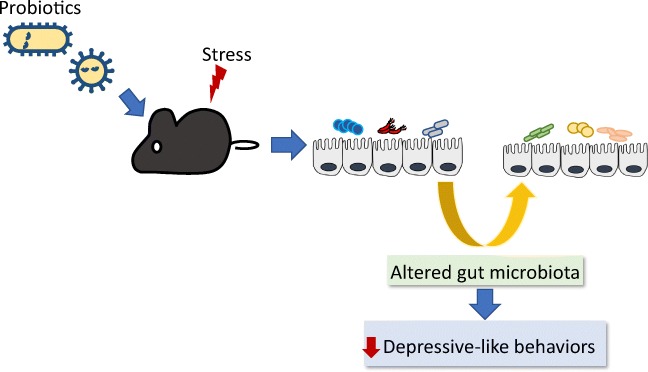
Mice subjected to restraint stress showed depressive-like behaviors along with high corticosterone levels in serum. However, probiotic administration alleviated depressive-like behaviors and decreased corticosterone level. Moreover, fecal microbiota was distinctly altered in probiotic-treated mice of the stress group. The relative abundance of phylum and genus levels was significantly decreased in the stress group, but probiotic administration restored the composition of microbes restored.
Ingested probiotics alter the composition of gut microbiota, likely improving the symptoms of depression. Graphical abstract Probiotic administration alters gut microbiota and reduces depressive-like behaviors.
肠道微生物群与双向肠道-大脑轴密切相关,调节中枢神经系统的神经心理功能,从而影响抑郁症等精神疾病。虽然已知益生菌会影响大脑功能,但益生菌对肠道微生物群的流行和组成的调节作用,从而产生抗抑郁作用,尚未得到很好的理解。
将小鼠随机分为四组(每组 10 只):G1 组(正常组)作为对照,G2 组(应激组)每天给予无菌生理盐水经口灌胃,共 8 周,有无应激条件。在应激条件下,G3 组(氟西汀组)给予盐酸氟西汀,G4 组(益生菌组)每天给予多株益生菌经口灌胃,共 8 周。治疗后,所有小鼠均进行行为测试。此外,在第 60 天从每组随机选择的 5 只小鼠中收集粪便样本,并进行肠道微生物分布的分类学分析。
束缚应激小鼠表现出抑郁样行为,同时血清皮质酮水平升高。然而,益生菌给药缓解了抑郁样行为并降低了皮质酮水平。此外,应激组益生菌处理的小鼠粪便微生物群明显改变。应激组的门和属水平的相对丰度显著降低,但益生菌给药恢复了微生物的组成。
摄入益生菌会改变肠道微生物群的组成,可能改善抑郁症状。