Department of Family Medicine and Chronic Care, End-of-Life Care Research Group, Vrije Universiteit Brussel (VUB) and Ghent University, Brussels, Belgium.
EMGO Institute for Health and Care research, Expertise Center for Palliative Care, VU University Medical Center, Amsterdam, the Netherlands.
BMC Palliat Care. 2018 Mar 12;17(1):47. doi: 10.1186/s12904-018-0297-1.
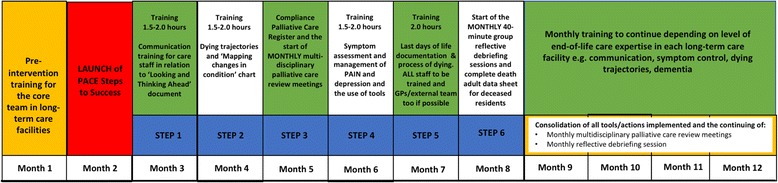
Several studies have highlighted the need for improvement in palliative care delivered to older people long-term care facilities. However, the available evidence on how to improve palliative care in these settings is weak, especially in Europe. We describe the protocol of the PACE trial aimed to 1) evaluate the effectiveness and cost-effectiveness of the 'PACE Steps to Success' palliative care intervention for older people in long-term care facilities, and 2) assess the implementation process and identify facilitators and barriers for implementation in different countries.
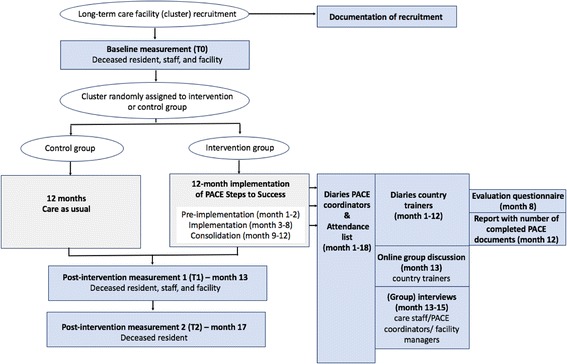
We will conduct a multi-facility cluster randomised controlled trial in Belgium, Finland, Italy, the Netherlands, Poland, Switzerland and England. In total, 72 facilities will be randomized to receive the 'Pace Steps to Success intervention' or to 'care as usual'. Primary outcome at resident level: quality of dying (CAD-EOLD); and at staff level: staff knowledge of palliative care (Palliative Care Survey).
resident's quality of end-of-life care, staff self-efficacy, self-perceived educational needs, and opinions on palliative care. Economic outcomes: direct costs and quality-adjusted life years (QALYs). Measurements are performed at baseline and after the intervention. For the resident-level outcomes, facilities report all deaths of residents in and outside the facilities over a previous four-month period and structured questionnaires are sent to (1) the administrator, (2) staff member most involved in care (3) treating general practitioner, and (4) a relative. For the staff-level outcomes, all staff who are working in the facilities are asked to complete a structured questionnaire. A process evaluation will run alongside the effectiveness evaluation in the intervention group using the RE-AIM framework.
The lack of high quality trials in palliative care has been recognized throughout the field of palliative care research. This cross-national cluster RCT designed to evaluate the impact of the palliative care intervention for long-term care facilities 'PACE Steps to Success' in seven countries, will provide important evidence concerning the effectiveness as well as the preconditions for optimal implementation of palliative care in nursing homes, and this within different health care systems.
The study is registered at www.isrctn.com - ISRCTN14741671 (FP7-HEALTH-2013-INNOVATION-1 603111) Registration date: July 30, 2015.
多项研究强调需要改善长期护理机构中老年人的姑息治疗。然而,关于如何改善这些环境中的姑息治疗的现有证据很薄弱,尤其是在欧洲。我们描述了 PACE 试验的方案,旨在 1)评估“PACE 成功步骤”姑息治疗干预措施对长期护理机构中老年人的有效性和成本效益,以及 2)评估实施过程并确定在不同国家实施的促进因素和障碍。
我们将在比利时、芬兰、意大利、荷兰、波兰、瑞士和英国进行一项多设施集群随机对照试验。总共 72 个设施将随机分配接受“PACE 成功步骤”干预或“常规护理”。居民层面的主要结局:临终质量(CAD-EOLD);以及员工层面:员工对姑息治疗的知识(姑息治疗调查)。
居民临终关怀质量、员工自我效能感、自我感知教育需求以及对姑息治疗的看法。经济结果:直接成本和质量调整生命年(QALYs)。测量在基线和干预后进行。对于居民层面的结局,设施报告过去四个月内设施内和设施外所有居民的死亡情况,并向以下人员发送结构化问卷:(1)管理员、(2)最参与护理的员工、(3)主治医生和(4)家属。对于员工层面的结局,要求所有在设施工作的员工完成一份结构化问卷。在干预组中,将同时进行效果评估和使用 RE-AIM 框架进行的过程评估。
姑息治疗领域已经认识到高质量试验的缺乏。这项跨国家的集群 RCT 旨在评估姑息治疗干预措施对七个国家长期护理机构“PACE 成功步骤”的影响,将为姑息治疗在养老院中的有效性以及最佳实施的前提条件提供重要证据,这是在不同的医疗保健系统内进行的。
该研究在 www.isrctn.com 上注册 - ISRCTN65160469(FP7-HEALTH-2013-INNOVATION-1 603111)注册日期:2015 年 7 月 30 日。