Meguenni Nacima, Chanteloup Nathalie, Tourtereau Angelina, Ahmed Chafika Ali, Bounar-Kechih Saliha, Schouler Catherine
Laboratory of Analytic Biochemistry and Biotechnology, Mouloud Mammeri University, Tizi Ouzou 15000, Algeria.
ISP, INRA, Université de Tours, UMR 1282, 37 380, Nouzilly, France.
Vet World. 2019 Nov;12(11):1840-1848. doi: 10.14202/vetworld.2019.1840-1848. Epub 2019 Nov 25.
Avian pathogenic cause extensive mortality in poultry flocks, leading to extensive economic losses. To date, in Algeria, little information has been available on virulence potential and antibiotics resistance of avian isolates. Therefore, the aim of this study was the characterization of virulence genes and antibiotic resistance profile of Algerian strains isolated from diseased broilers.
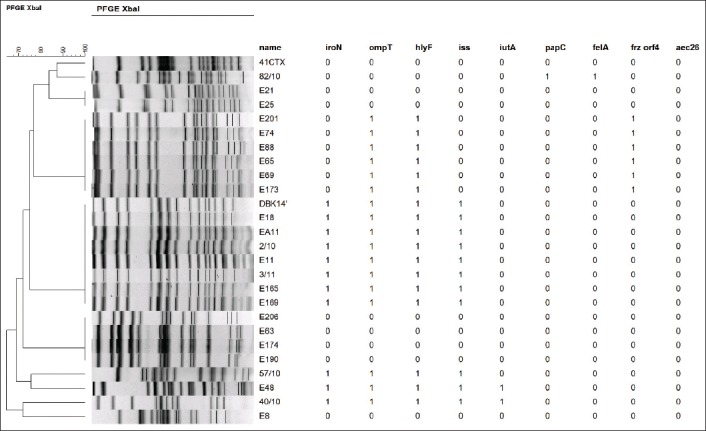
In this study, 43 avian strains isolated from chicken colibacillosis lesions at different years were analyzed to determine their contents in 10 virulence factors by polymerase chain reaction, antimicrobial susceptibility to 22 antibiotics belonging to six different chemical classes and genomic diversity by pulsed-field gel electrophoresis (PFGE).
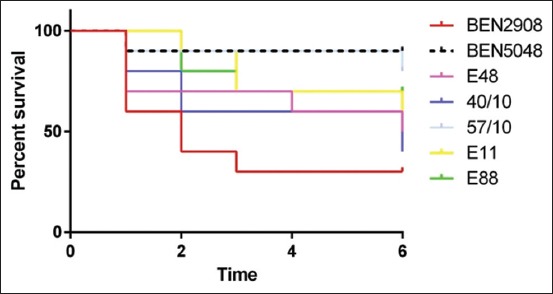
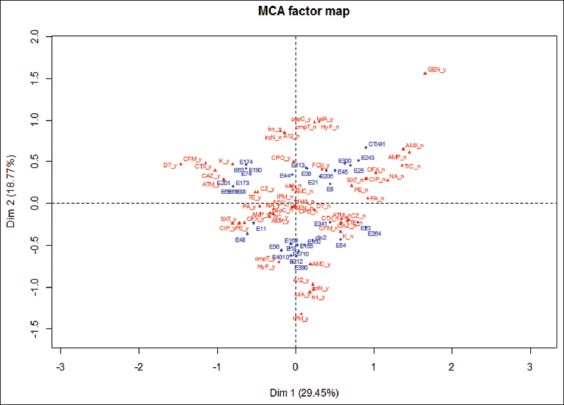
Mainly isolates (58.1%) carried two at six virulence genes and the most frequent virulence gene association detected were T (protectin), F (hemolysin) with 55.8% (p<0.001), and N, A (iron acquisition/uptake systems), and (protectin) with 41.8% (p<0.001). Some strains were diagnosed as virulent according to their virulence gene profile. Indeed, 23.25% of the isolates harbored N, T, F, , and A combination, 14% T, F, and frz (sugar metabolism), and 11,6% N, F, T, , A (iron acquisition/uptake systems), and . The chicken embryo lethality assay performed on five isolates confirmed the potential virulence of these strains. All isolates submitted to PFGE analysis yielded different genetic profiles, which revealed their diversity. Overall, 97.2% of the isolates were resistant to at least one antibiotic and 53.5% demonstrated multi-antimicrobial resistance to three different antimicrobial classes. The highest resistance levels were against nalidixic acid (83.4%), amoxicillin and ampicillin (83.3%), ticarcillin (80.5%), pipemidic acid (75%), and triméthoprim-sulfamethoxazole (66.6%). For beta-lactam class, the main phenotype observed belonged to broad-spectrum beta-lactamases. However, extended-spectrum beta-lactamase associated with three at six virulence factors was also detected in 13 isolates. Two of them were attested virulent as demonstrated in the embryo lethality test which constitutes a real public threat.
It would be imperative in avian production to discourage misuse while maintaining constant vigilance guidelines and regulations, to limit and rationalize antimicrobial use.
禽致病性大肠杆菌在禽群中导致大量死亡,造成巨大经济损失。迄今为止,在阿尔及利亚,关于禽大肠杆菌分离株的毒力潜力和抗生素耐药性的信息很少。因此,本研究的目的是对从患病肉鸡中分离的阿尔及利亚大肠杆菌菌株的毒力基因和抗生素耐药性谱进行表征。
在本研究中,分析了从不同年份鸡大肠杆菌病病变中分离的43株禽大肠杆菌菌株,通过聚合酶链反应确定它们在10种毒力因子中的含量,对属于六种不同化学类别的22种抗生素的抗菌敏感性,以及通过脉冲场凝胶电泳(PFGE)分析基因组多样性。
主要分离株(58.1%)携带六个毒力基因中的两个,检测到的最常见毒力基因组合是T(保护素)、F(溶血素),占55.8%(p<0.001),以及N、A(铁获取/摄取系统)和T(保护素),占41.8%(p<0.001)。根据其毒力基因谱,一些菌株被诊断为有毒力。事实上,23.25%的分离株携带N、T、F、A和A组合,14%携带T、F和frz(糖代谢),11.6%携带N、F、T、A(铁获取/摄取系统)和A。对五个分离株进行的鸡胚致死试验证实了这些菌株的潜在毒力。所有进行PFGE分析的分离株都产生了不同的基因图谱,显示了它们的多样性。总体而言,97.2%的分离株对至少一种抗生素耐药,53.5%对三种不同抗菌类别表现出多重抗菌耐药性。最高耐药水平针对萘啶酸(83.4%)、阿莫西林和氨苄西林(83.3%)、替卡西林(80.5%)、吡哌酸(75%)和甲氧苄啶-磺胺甲恶唑(66.6%)。对于β-内酰胺类,观察到的主要表型属于广谱β-内酰胺酶。然而,在13株分离株中也检测到与六个毒力因子中的三个相关的超广谱β-内酰胺酶。其中两株在胚胎致死试验中被证明有毒力,这构成了真正的公共威胁。
在禽类生产中,必须抑制滥用抗生素的行为,同时保持对指导方针和法规的持续警惕,以限制和合理使用抗菌药物。