Nikolova Christina, Gutierrez Tony
Institute of Mechanical, Process and Energy Engineering, School of Engineering and Physical Sciences, Heriot-Watt University, Edinburgh, United Kingdom.
Front Microbiol. 2020 Jan 17;10:2996. doi: 10.3389/fmicb.2019.02996. eCollection 2019.
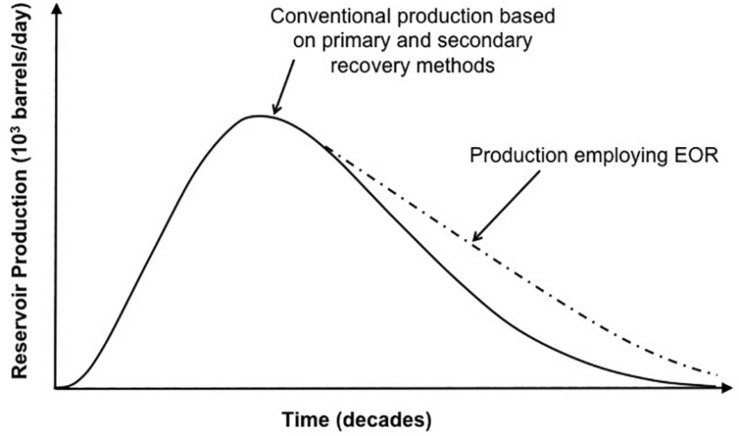
The depletion of oil resources, increasing global energy demand, the current low, yet unpredictable, price of oil, and increasing maturity of major oil fields has driven the need for the development of oil recovery technologies that are less costly and, where possible, environmentally compatible. Using current technologies, between 20 and 40% of the original oil in a reservoir can be extracted by conventional production operations (e.g., vertical drilling), with secondary recovery methods yielding a further 15-25%. Hence, up to 55% of the original oil can remain unrecovered in a reservoir. Enhanced oil recovery (EOR) is a tertiary recovery process that involves application of different thermal, chemical, and microbial processes to recover an additional 7-15% of the original oil in place (OOIP) at an economically feasible production rate from poor-performing and depleted oil wells. EOR can significantly impact oil production, as increase in the recovery rate of oil by even a small margin could bring significant revenues without developing unconventional resources. Microbial enhanced oil recovery (MEOR) is an attractive, alternative oil recovery approach, which is claimed to potentially recover up to 50% of residual oil. The production of biological surface-active compounds (e.g., biosurfactants) during the MEOR process does not require vast energy inputs and are not affected by global crude oil prices. Compared to other EOR methods, MEOR can be an economically and more environmentally friendly alternative. In this review, the current state of knowledge of MEOR, with insights from discussions with the industry and other stakeholders, is presented and in addition to the future outlook for this technology.
石油资源的枯竭、全球能源需求的不断增加、当前油价虽低但不可预测,以及主要油田的日益成熟,促使人们需要开发成本更低且尽可能与环境兼容的石油开采技术。使用当前技术,油藏中20%至40%的原始石油可通过常规生产作业(如垂直钻井)开采出来,二次采油方法可进一步开采出15% - 25%。因此,油藏中高达55%的原始石油可能仍未被开采出来。强化采油(EOR)是一种三次采油过程,它涉及应用不同的热力、化学和微生物方法,以经济可行的生产率从性能不佳和枯竭的油井中额外开采出7% - 15%的原地原始石油(OOIP)。强化采油可显著影响石油产量,因为即使石油采收率仅小幅提高,也能在不开发非常规资源的情况下带来可观收入。微生物强化采油(MEOR)是一种有吸引力的替代采油方法,据称有可能采收高达50%的剩余油。MEOR过程中生物表面活性化合物(如生物表面活性剂)的生产不需要大量能源投入,且不受全球原油价格影响。与其他强化采油方法相比,MEOR可能是一种经济且更环保的选择。在本综述中,介绍了MEOR的当前知识状态,并结合了与行业及其他利益相关者讨论的见解,此外还展望了该技术的未来前景。