Xie Yun, Tian Rui, Jin Wei, Xie Hui, Du Jiang, Zhou Zhigang, Wang Ruilan
Department of Critical Care Medicine, Shanghai General Hospital, Shanghai Jiao Tong University School of Medicine, Songjiang, Shanghai 201600, P.R. China.
Exp Ther Med. 2020 Feb;19(2):1024-1032. doi: 10.3892/etm.2019.8305. Epub 2019 Dec 9.
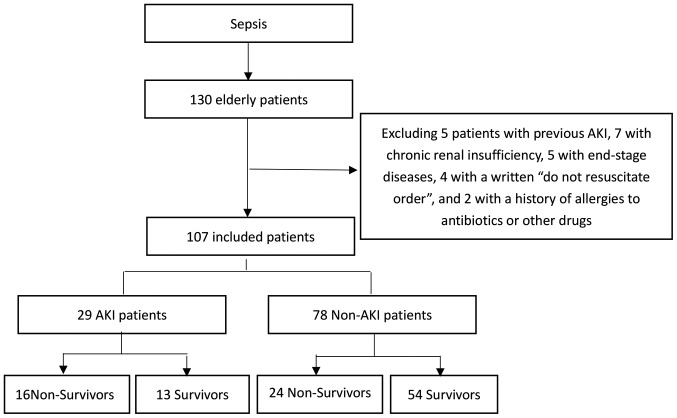
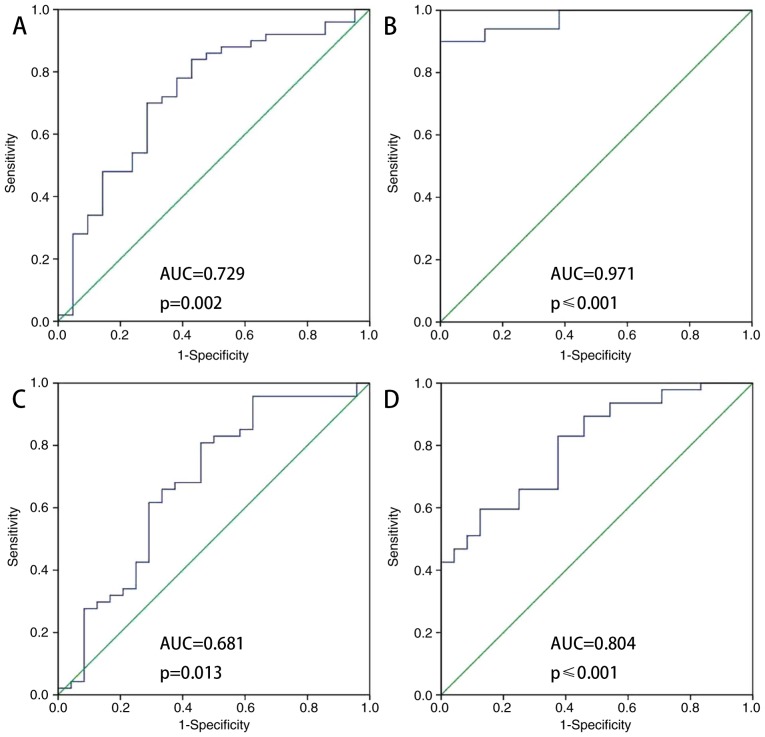
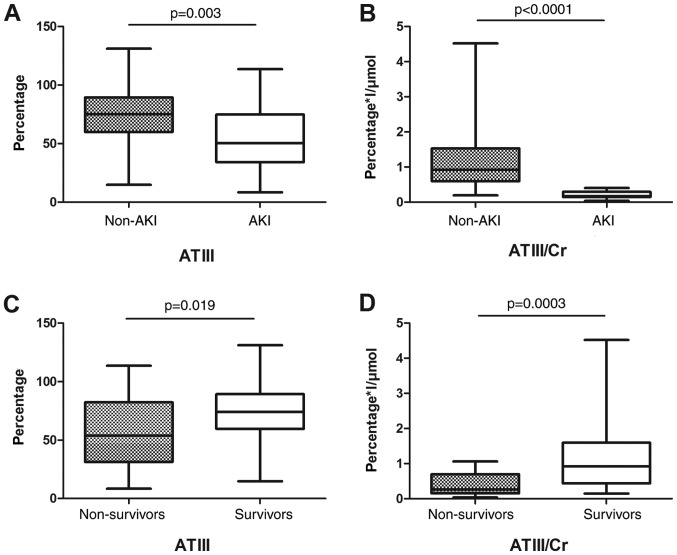
Elderly people represent the age group most frequently affected by acute kidney injury (AKI). The potential of Antithrombin III (ATIII) level for predicting AKI among elderly patients with sepsis is yet to be elucidated. Therefore, the purpose of the present study was to evaluate the ability of ATIII to predict AKI nondevelopment and prognosis in elderly patients with sepsis, in an intensive care unit (ICU). The present study was retrospective and included 107 elderly patients with sepsis who had been admitted to ICUs between October 2015 and March 2018. An assessment of renal function was performed daily by measuring serum creatinine (Cr) level and urine output, and ATIII level was obtained within 48 h of sepsis diagnosis. Among all enrolled patients, 29 (27.1%) developed AKI. ATIII expression was a predictor of AKI nondevelopment [Area under the curve (AUC)-Receiving operator characteristic (ROC)=0.729; sensitivity, 0.700; specificity, 0.714], and the ATIII/Creatine ratio was also a predictor of AKI nondevelopment (AUC-ROC=0.971; sensitivity, 0.900; specificity, 1). The accuracy of ATIII (AUC-ROC=0.681; sensitivity, 0.802; specificity, 0.542) and ATIII/Cr (AUC-ROC=0.804; sensitivity, 0.596; specificity, 0.875) in predicting survival was intermediate. However, the ATIII serum level was able to accurately predict AKI nondevelopment in elderly patients with sepsis, who were admitted to ICUs. Patients were divided into low- and high-ATIII groups using either 66.95% or 55.7% as cut-off values, both of which were used for further analysis. By comparison, the ICU stay was significantly lower in the high-ATIII group [P=0.020 (69.95%) and 0.049 (55.7%)] and off mechanical ventilation time, off continuous renal replacement therapy time and survival time were significantly higher in the high ATIII group [P=0.049, 0.048, and 0.014, respectively (66.95%); and P=0.041, 0.036, and 0.021, respectively (55.7%)]. The current study indicated that ATIII serum level predicts AKI in elderly patients with sepsis, and that low ATIII levels predicted a poorer prognosis.
老年人是急性肾损伤(AKI)最常累及的年龄组。抗凝血酶III(ATIII)水平预测脓毒症老年患者发生AKI的潜力尚未阐明。因此,本研究的目的是评估在重症监护病房(ICU)中,ATIII预测脓毒症老年患者不发生AKI及预后的能力。本研究为回顾性研究,纳入了2015年10月至2018年3月期间入住ICU的107例脓毒症老年患者。通过测量血清肌酐(Cr)水平和尿量,每天对肾功能进行评估,并在脓毒症诊断后48小时内检测ATIII水平。在所有纳入的患者中,29例(27.1%)发生了AKI。ATIII表达是不发生AKI的预测指标[曲线下面积(AUC)-受试者工作特征(ROC)=0.729;敏感性为0.700;特异性为0.714],ATIII/肌酐比值也是不发生AKI的预测指标(AUC-ROC=0.971;敏感性为0.900;特异性为1)。ATIII(AUC-ROC=0.681;敏感性为0.802;特异性为0.542)和ATIII/Cr(AUC-ROC=0.804;敏感性为0.596;特异性为0.875)预测生存的准确性中等。然而,ATIII血清水平能够准确预测入住ICU的脓毒症老年患者不发生AKI。分别以66.95%或55.7%作为临界值,将患者分为低ATIII组和高ATIII组,二者均用于进一步分析。相比之下,高ATIII组的ICU住院时间显著缩短[P=0.020(69.95%)和0.049(55.7%)],高ATIII组的脱机机械通气时间、脱机持续肾脏替代治疗时间和生存时间显著延长[分别为P=0.049、0.048和0.014(66.95%);以及P=0.041、0.036和0.021(55.