Beyoğlu Diren, Idle Jeffrey R
Arthur G. Zupko's Division of Systems Pharmacology and Pharmacogenomics, Arnold & Marie Schwartz College of Pharmacy and Health Sciences, Long Island University, 75 Dekalb Avenue, Brooklyn, NY 11201, USA.
Metabolites. 2020 Jan 28;10(2):50. doi: 10.3390/metabo10020050.
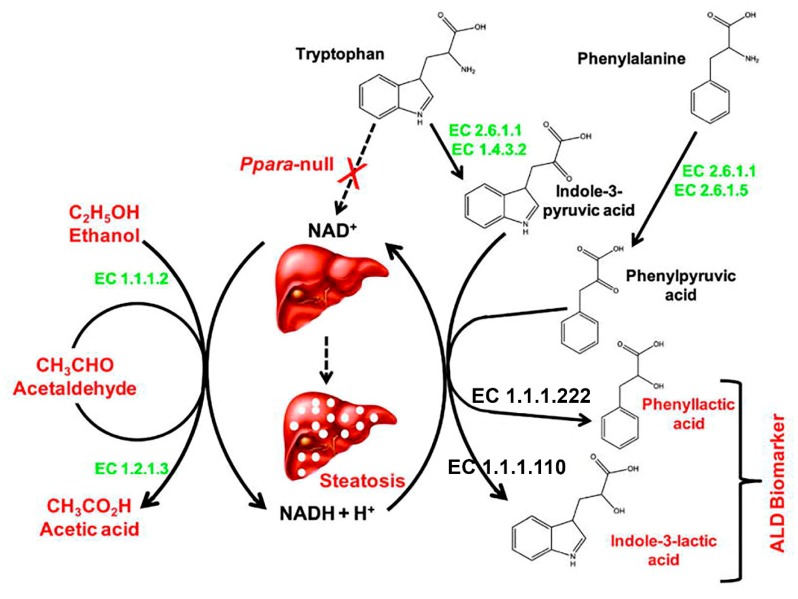
In recent years, there has been a plethora of attempts to discover biomarkers that are more reliable than α-fetoprotein for the early prediction and prognosis of hepatocellular carcinoma (HCC). Efforts have involved such fields as genomics, transcriptomics, epigenetics, microRNA, exosomes, proteomics, glycoproteomics, and metabolomics. HCC arises against a background of inflammation, steatosis, and cirrhosis, due mainly to hepatic insults caused by alcohol abuse, hepatitis B and C virus infection, adiposity, and diabetes. Metabolomics offers an opportunity, without recourse to liver biopsy, to discover biomarkers for premalignant liver disease, thereby alerting the potential of impending HCC. We have reviewed metabolomic studies in alcoholic liver disease (ALD), cholestasis, fibrosis, cirrhosis, nonalcoholic fatty liver (NAFL), and nonalcoholic steatohepatitis (NASH). Specificity was our major criterion in proposing clinical evaluation of indole-3-lactic acid, phenyllactic acid, -lauroylglycine, decatrienoate, -acetyltaurine for ALD, urinary sulfated bile acids for cholestasis, cervonoyl ethanolamide for fibrosis, 16α-hydroxyestrone for cirrhosis, and the pattern of acyl carnitines for NAFL and NASH. These examples derive from a large body of published metabolomic observations in various liver diseases in adults, adolescents, and children, together with animal models. Many other options have been tabulated. Metabolomic biomarkers for premalignant liver disease may help reduce the incidence of HCC.
近年来,人们进行了大量尝试,试图发现比甲胎蛋白更可靠的生物标志物,用于肝细胞癌(HCC)的早期预测和预后评估。这些努力涉及基因组学、转录组学、表观遗传学、微小RNA、外泌体、蛋白质组学、糖蛋白质组学和代谢组学等领域。HCC主要在炎症、脂肪变性和肝硬化的背景下发生,主要是由酒精滥用、乙型和丙型肝炎病毒感染、肥胖和糖尿病引起的肝脏损伤所致。代谢组学提供了一个无需进行肝活检就能发现癌前肝病生物标志物的机会,从而警示即将发生HCC的可能性。我们回顾了酒精性肝病(ALD)、胆汁淤积、纤维化、肝硬化、非酒精性脂肪肝(NAFL)和非酒精性脂肪性肝炎(NASH)的代谢组学研究。在提议对吲哚-3-乳酸、苯乳酸、月桂酰甘氨酸、癸三烯酸、乙酰牛磺酸进行ALD的临床评估,对尿中硫酸化胆汁酸进行胆汁淤积的评估,对神经酰胺乙醇酰胺进行纤维化的评估,对16α-羟基雌酮进行肝硬化的评估,以及对NAFL和NASH的酰基肉碱模式进行评估时,特异性是我们的主要标准。这些例子来自于大量已发表的关于成人、青少年和儿童各种肝病以及动物模型的代谢组学观察结果。许多其他选项也已列表列出。癌前肝病的代谢组学生物标志物可能有助于降低HCC的发病率。