Department of Chemistry, Vanderbilt University, Nashville, TN 37235, USA.
Molecules. 2020 Jan 28;25(3):570. doi: 10.3390/molecules25030570.
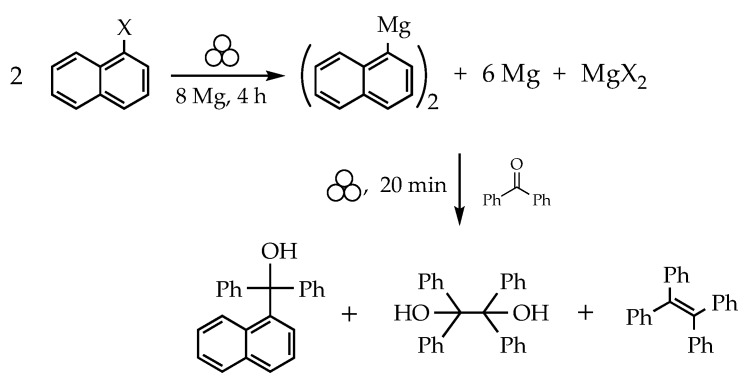
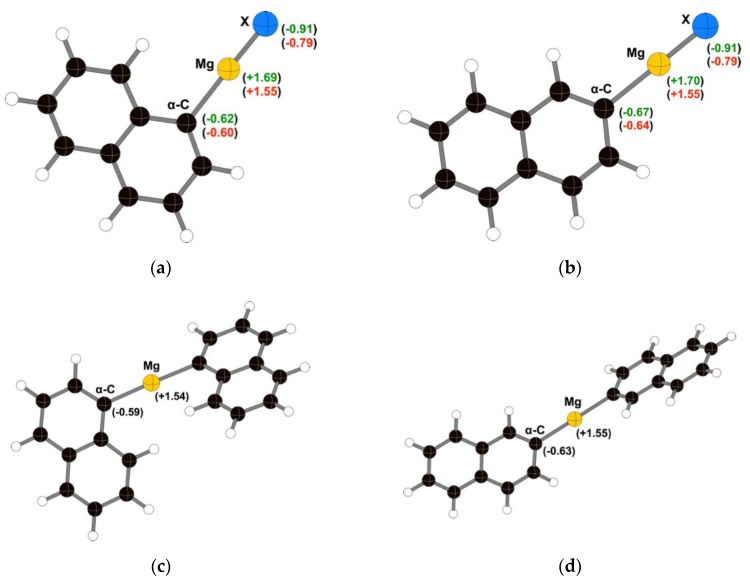
Owing to the strength of the C-F bond, the 'direct' preparation of Grignard reagents, i.e., the interaction of elemental magnesium with an organic halide, typically in an ethereal solvent, fails for bulk magnesium and organofluorine compounds. Previously described mechanochemical methods for preparing Grignard reagents have involved ball milling powdered magnesium with organochlorines or bromines. Activation of the C-F bond through a similar route is also possible, however. For example, milling 1- and 2-fluoronaphthalene with an excess of magnesium metal for 2 h, followed by treatment with FeCl and additional milling, produces the corresponding binaphthalenes, albeit in low yields (ca. 20%). The yields are independent of the particular isomer involved and are also comparable to the yields from corresponding the bromonaphthalenes. These results may reflect similar charges that reside on the α-carbon in the naphthalenes, as indicated by density functional theory calculations.
由于 C-F 键的强度,“直接”制备格氏试剂,即元素镁与有机卤化物的相互作用,通常在醚溶剂中,对于块状镁和有机氟化合物来说是失败的。以前描述的用于制备格氏试剂的机械化学方法涉及将粉状镁与有机氯或溴一起球磨。然而,通过类似的途径也可以激活 C-F 键。例如,将 1-和 2-氟萘与过量的镁金属一起研磨 2 小时,然后用 FeCl 处理并进一步研磨,可得到相应的联萘,尽管产率较低(约 20%)。产率与所涉及的特定异构体无关,也与相应的溴代萘的产率相当。这些结果可能反映了萘中α-碳上的相似电荷,如密度泛函理论计算所示。