Department of Cardiology, The First Hospital of China Medical University, 155 Nanjing North Street, Heping District, Shenyang, 110001, China.
Department of Clinical Epidemiology, Shengjing Hospital of China Medical University, Shenyang, 117004, China.
BMC Cardiovasc Disord. 2020 Feb 3;20(1):44. doi: 10.1186/s12872-020-01350-2.
To investigate the influence of hyperhomocysteinemia (HHcy) and metabolic syndrome (MetS) on left ventricular hypertrophy (LVH) in residents in rural Northeast China.
We performed a cross-sectional baseline data analysis of 6837 subjects (mean age: 54 ± 10 years) recruited from a rural area of China. Anthropometric indicators were measured according to standard methods. MetS was defined by the modified ATP III criteria. HHcy was defined according to the WHO standard: an Hcy level > 15 μmol/L representing HHcy. Four groups were defined: non-HHcy & non-MetS, HHcy & non-MetS, MetS & non-HHcy and HHcy & MetS.
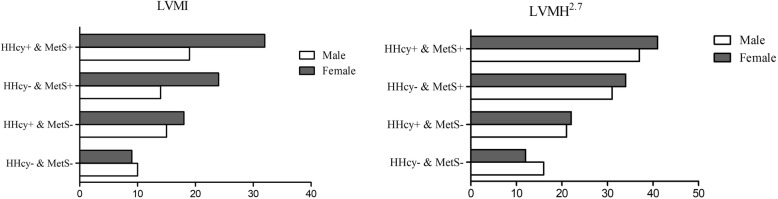
The left ventricular mass index for height (LVMH) in both sexes was significantly higher in the HHcy & MetS group than in the non-HHcy & non-MetS group (females: 51.23 ± 16.34 vs. 40.09 ± 10.55 g, P < 0.001; males: 48.67 ± 12.24 g vs. 42.42 ± 11.38 g, P < 0.001). A similar result was observed in those groups when using the left ventricular mass index (LVMI) for body surface area to define LVH (females: 103.58 ± 31.92 g vs. 86.63 ± 20.47 g, P < 0.001; males: 106.10 ± 24.69 g vs. 98.16 ± 23.29 g, P < 0.001). The results of multiple regression analysis indicated that the HHcy & MetS group had a higher risk of LVH than the other three groups (OR: 1.628 for LVMI, P < 0.001, OR: 2.433 for LVMH, P < 0.001). Moreover, subjects in the HHcy & non-MetS group [OR (95% CI): 1.297 (1.058, 1.591) for LVMI, P < 0.05; OR (95% CI): 1.248 (1.044, 1.492) for LVMH, P < 0.05] also had a statistically greater risk of LVH than subjects in the non-HHcy & non-MetS group. The HHcy & non-MetS group was also found to be significantly and independently associated with LVH.
Hyperhomocysteinemia has an independent effect on LVH. The combined effect of MetS and hyperhomocysteinemia might increase the strength of the abovementioned effects.
探讨高同型半胱氨酸血症(HHcy)和代谢综合征(MetS)对中国东北农村居民左心室肥厚(LVH)的影响。
我们对来自中国农村地区的 6837 名(平均年龄:54±10 岁)受试者进行了横断面基线数据分析。根据标准方法测量人体测量指标。MetS 采用改良的 ATP III 标准定义。HHcy 根据世界卫生组织标准定义:Hcy 水平>15μmol/L 表示 HHcy。将受试者分为 4 组:非 HHcy 且非 MetS、HHcy 且非 MetS、MetS 且非 HHcy 和 HHcy 且 MetS。
无论男女,HHcy 且 MetS 组的左心室质量指数(LVMH)均明显高于非 HHcy 且非 MetS 组(女性:51.23±16.34 vs. 40.09±10.55 g,P<0.001;男性:48.67±12.24 g vs. 42.42±11.38 g,P<0.001)。当使用左心室质量指数(LVMI)来定义 LVH 时,在这些组中也观察到了类似的结果(女性:103.58±31.92 g vs. 86.63±20.47 g,P<0.001;男性:106.10±24.69 g vs. 98.16±23.29 g,P<0.001)。多因素回归分析结果表明,HHcy 且 MetS 组发生 LVH 的风险高于其他三组(LVMI 的 OR:1.628,P<0.001,LVMH 的 OR:2.433,P<0.001)。此外,HHcy 且非 MetS 组[LVMI 的 OR(95%CI):1.297(1.058,1.591),P<0.05;LVMH 的 OR(95%CI):1.248(1.044,1.492),P<0.05]的 LVH 风险也明显高于非 HHcy 且非 MetS 组。HHcy 且非 MetS 组与 LVH 也有显著的独立相关性。
高同型半胱氨酸血症对 LVH 有独立影响。MetS 和高同型半胱氨酸血症的联合作用可能会增加上述影响的强度。